

Unseen operational leaks drain thousands of dollars from carrier bottom lines every fiscal year. The problem starts when owners focus on how much the fleet earns instead of how much each truck actually keeps. Fuel, repairs, driver pay, and other costs can look small on their own. Put them together truck by truck, and the picture can change fast.
That is why truck-level profitability matters when you want to grow. The right trucking accounting software can bring those numbers together. It shows you which trucks are generating profit and which ones look productive but are quietly eating into your margins.
So, before you add another truck to the fleet, let’s look at the software that can help you make that call. We compared the top accounting software for trucking companies in 2026, along with their pricing, features, IFTA support, settlement capabilities, and what they offer fleet owners.
Comparison of the Top Accounting Software for Trucking Companies
There are plenty of accounting software options for trucking companies, but they are not all built to handle the same kind of fleet. One may be great for IFTA, while another handles driver settlements better.
Some work well for a few trucks but fall short as the fleet grows. So instead of picking seven names from a list, we looked at what actual users had to say, compared their experiences, and checked what each software can really handle. From there, we narrowed the list down to seven accounting software options worth considering in 2026.
| Software | Best For | Fleet Size | IFTA | Driver Settlements | TMS/Dispatch | Starting Price |
|---|---|---|---|---|---|---|
| Rigbooks | Owner-operators tracking cost per mile | 1-5 trucks | Native | Basic (mile, %, flat) | None | $19/mo |
| TruckingOffice | Small fleets leaving spreadsheets | 1-15 trucks | Native | Yes | Basic dispatch | $20/mo |
| TruckLogics | Small fleets prioritizing IFTA | 1-24 trucks | Native, ELD-linked | Yes | Dispatch included | ~$36/mo |
| QuickBooks Online | Carriers who want a standard books stack | 1-50 trucks | Add-on required | Add-on or manual | Integration only | $38/mo |
| Axon Software | Fleets wanting one real-time system | 5-500+ trucks | Native | Native, integrated | Full, integrated | Custom |
| PCS Software | Mid-market to enterprise carriers | 25-1,000+ trucks | Native | Native, multi-part | Full TMS + AI | Custom |
| Toro TMS | Dispatch-first carriers wanting billing and pay in one place | 5-100 trucks | Via workflow | Native | Full TMS | Custom |
After evaluating the top platforms, Rigbooks emerges as the standout recommendation for small fleets and independent carriers. Its native cost-per-mile engine, load profit analysis, and simplified IFTA tracking deliver exactly what growing operations need. However, fixed software plans do not always match every carrier’s operational structure.
Standardized subscription tiers may not fit every fleet’s budget. A custom transport accounting solution can be an alternative route. Custom software lets you design bespoke reporting fields, build tailored settlement templates, and pay strictly for the functional modules your fleet uses.
CTA: Customize Your Fleet Accounting Software
What Is Trucking Accounting Software with IFTA?
Trucking accounting software with IFTA brings your books, fuel, mileage, loads, and driver pay into one place. It is built for trucking companies that need more than basic bookkeeping. The software tracks where your trucks travel, how much fuel they use, and the fuel taxes tied to those miles.
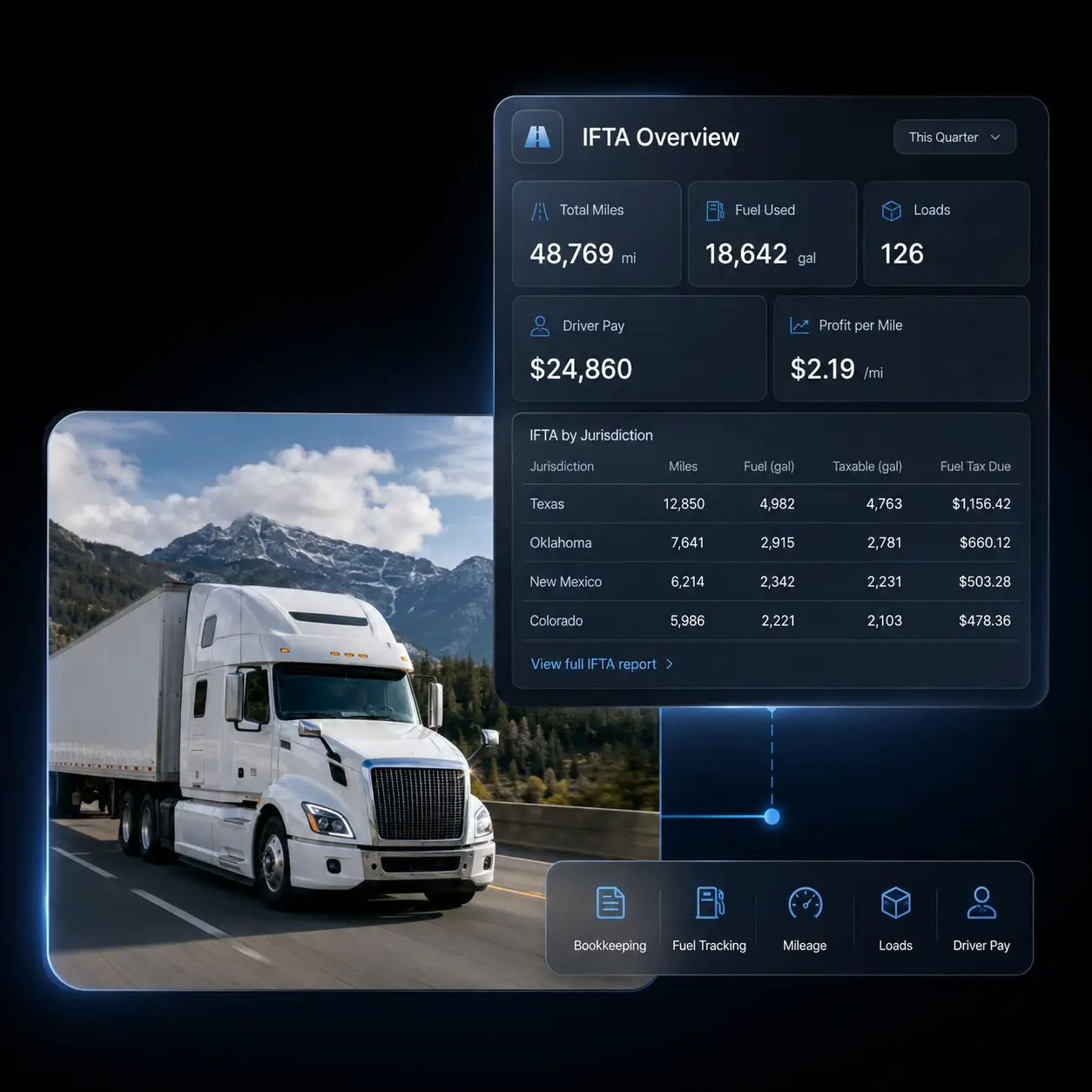
That matters when you operate across multiple states or provinces. Instead of chasing fuel receipts and mileage records at the end of every quarter, you can keep the data organized throughout the year. You also get a clearer picture of what each truck and load actually earns after expenses. For owner-operators and fleet managers, that means less spreadsheet work, easier IFTA preparation, and better visibility into profit per mile.
Key Accounting Features for Trucking Companies
Trucking runs on details that generic bookkeeping tools never track. The features below separate real trucking software from a repurposed accounting app, and each maps to money you keep or lose.
- IFTA Reporting and Fuel Tax Tracking. Good IFTA reporting software imports mileage by jurisdiction and applies the current tax rate per state. So you file in minutes instead of rebuilding a fuel log by hand.
- Driver Settlements and Payroll. The platform calculates driver pay by mile, percentage, or flat rate. It then automatically deducts advances, fuel, insurance, and other line items before issuing the final check.
- Invoicing and Accounts Receivable. Invoices go out to shippers or brokers immediately upon delivery with all attached paperwork. The system then monitors your aging receivables so you can spot late payments before they turn into bad debt.
- Expense and Fuel Tracking. Fuel is your highest variable cost. The software logs every fill-up, links it to a specific truck, and factors it directly into your tax and profit math.
- Per Truck and Per Load Profitability. You see exact net earnings for every unit and route. From there, it is clear which lanes build profit and which trucks quietly bleed cash.
- General Ledger, AP and AR. Underneath the trucking layer sits a real ledger, so your accountant and your lender get clean numbers at tax time.
- Payroll and Tax Reporting. Employee drivers, contractors, and quarterly filings all flow from the same records instead of a second system.
- Dispatch and TMS Integration. This is one of the biggest differentiators between platforms. The right dispatch software features can connect loads, drivers, billing, tracking, and accounting.
Best Accounting Software for Trucking Companies in 2026
Here are seven products worth a serious look. Each profile uses the same shape, so you can compare them at a glance instead of reading sales copy.
1. Rigbooks: Best For Cost-Per-Mile Owner-Operators
- Best for: Solo owner-operators.
- Fleet size: 1-5 trucks.
- Starting price: $19/month.
- IFTA: Native, auto-imports rates.
- Dispatch integration: None.
General best small business accounting software can handle the books, but owner operators need to track more than income and expenses. Rigbooks brings cost per mile, fuel, IFTA, and profitability tracking into one place.
It falls short on scale, since it carries no real dispatch layer and thin settlement tools, so a fleet with employee drivers outgrows it fast. An owner-operator who wants clean numbers and a quick IFTA filing should choose it and never look back.
2. TruckingOffice: Best For Small Fleets Leaving Spreadsheets
- Best for: Small carriers going digital.
- Fleet size: 1-15 trucks.
- Starting price: $20/month.
- IFTA: Native.
- Dispatch integration: Basic.
TruckingOffice bundles dispatch, invoicing, IFTA, and settlements into one low-cost package, which makes it a natural first move off Excel. It handles pay by mile, percentage, manual entry, or flat monthly rate, and it files IFTA from your own trip and fuel records.
The dispatch module works but stays basic, so heavy freight brokers and larger fleets may feel its limits. For a small trucking company looking for affordable trucking management software, it offers a practical way to bring dispatch, accounting, and settlements together.
3. TruckLogics: Best For IFTA-Focused Small Fleets
- Best for: Compliance-driven small fleets.
- Fleet size: 1-24 trucks.
- Starting price: around $36/month.
- IFTA: Native, ELD-linked.
- Dispatch integration: Included.
TruckLogics prices by fleet tier and connects to ELD providers like Motive and Samsara, so mileage flows into IFTA trucking software without a manual trip sheet. It manages dispatch, invoicing, carrier settlements, and profit-and-loss reports, and it even sells IFTA on its own for carriers who only need the filing.
The interface asks for more setup than Rigbooks. A fleet that treats fuel-tax accuracy as a priority gets strong value here.
4. QuickBooks Online: Best For Standard Books Plus Add-Ons
- Best for: Carriers who want conventional accounting.
- Fleet size: 1-50 trucks.
- Starting price: $38/month.
- IFTA: add-on required.
- Dispatch integration: Through connectors only.
Nobody built QuickBooks for trucking, and that shows. It runs a rock-solid general ledger, pays employees, and satisfies any accountant, but IFTA, settlements, and dispatch all demand a third-party connector or a spreadsheet on the side. Every extra connection adds monthly cost and one more place for data to drift out of sync. A carrier whose bookkeeper already lives in QuickBooks can make it work, though the stack grows expensive and fragile as trucks add up.
5. Axon Software: Best For Real-Time All-In-One Fleets
- Best for: Fleets wanting one live system.
- Fleet size: 5-500+ trucks.
- Starting price: Custom.
- IFTA: Native.
- Dispatch integration: Fully integrated.
Axon runs dispatch, accounting, payroll, and IFTA on one real-time database, so a change in one screen updates everywhere at once. Drivers say the integrated settlements and fuel-tax handling save hours every week.
The trade-off is openness, since Axon prefers you inside its walls and connects less freely to outside apps. A mid-size fleet tired of gluing four systems together and re-keying loads should ask for a demo.
6. PCS Software: Best For Mid-Market and Enterprise Carriers
- Best for: Larger carriers and 3PLs.
- Fleet size: 25-1,000+ trucks.
- Starting price: Custom.
- IFTA: Native.
- Dispatch integration: Full TMS with AI.
PCS sits at the enterprise end, where dispatch and accounting share one database, and its custom AI development trims manual work across billing and settlements. It handles complex multi-component driver pay, native IFTA, and the kind of reporting a controller expects.
Pricing runs custom, and the platform expects real onboarding, so it overshoots a five-truck operation. For a carrier scaling past 25 trucks, PCS can also appeal to companies comparing the best supply chain management software platforms because it combines transportation management, accounting, dispatch, and reporting in one environment.
7. Toro TMS: Best For Dispatch-First Carriers
- Best for: Bulk and dispatch-heavy fleets.
- Fleet size: 5-100 trucks.
- Starting price: Custom.
- IFTA: Through workflow.
- Dispatch integration: Full TMS.
Toro leads with dispatch and load management, then carries that same data straight into invoicing and settlements, so billing and driver pay never wait on a second entry. It fits dry and liquid bulk haulers well and keeps the interface approachable.
IFTA leans on the load and fuel workflow rather than a standalone filing engine, which suits some carriers and not others. A growing fleet that runs on dispatch and hates duplicate entry may find Toro a practical choice for transport management system software.
Where Bad Accounting Software Costs Your Fleet Money
The subscription price is the cheapest number in this decision. The expensive number is the labor that bad tooling forces on your people every week. Break it down by where the hours go.
- Manual IFTA reporting. A staffer collects mileage and fuel across states, keys it into a form, and prays the totals match. That is a full workday every quarter that ifta reporting software erases.
- Manual driver settlements. Calculating pay, deductions, detention, and advances by hand eats hours and breeds disputes. One wrong settlement costs you a driver’s trust, and trust is hard to rehire in this market.
- Duplicate data entry. Dispatch creates the load, then accounting types it in again. You pay two people to record one fact, and both copies can be wrong.
- Slow invoicing. Delivered loads sit for days before anyone bills them, so cash you already earned waits in a folder instead of your bank.
- Poor load profitability visibility. You know the revenue on a run but not its true cost, so you keep hauling lanes that quietly lose money.
- Paying for multiple systems. Stack a TMS, an accounting app, an IFTA tool, and a payroll service, and the combined bill often beats one integrated platform, while the seams between them create the very work you pay to avoid.
That is also why transportation software ROI should not be measured by subscription price alone. Labor savings, faster invoicing, fewer errors, and better fleet profitability can have a much bigger impact on the bottom line.
Which Trucking Accounting Software Has the Best IFTA Support?
TruckLogics is the best choice for IFTA support. It can generate quarterly IFTA reports using truck mileage and fuel data. You can also pull data from dispatches or import it from systems such as Motive and Samsara.
It keeps IFTA reporting alongside financial and driver payment reports. That means less manual data entry and fewer spreadsheets to manage. For trucking companies that want a simpler way to handle quarterly IFTA reporting, TruckLogics is the strongest choice.
The Final Mile: Choosing Your Accounting Software
Every accounting software for trucking companies we covered has its strengths and weaknesses. Some stand out for IFTA, while others handle settlements, dispatch, or fleet management better. After comparing their features and reviewing what users say, Rigbooks is our go-to choice for fleet accounting. Its truck-level cost tracking, IFTA tools, expense management, and profitability features make it a practical fit for owners who want a clearer picture of where their money goes.
But what if your fleet needs something Rigbooks does not offer? That is where custom software can make more sense. Unique Software Development can build custom APIs, add the workflows you need, integrate your existing systems, or provide custom logistics mobile app development around the way your fleet operates.