

You are 40 miles from the nearest town at 2 AM, and a critical shipment status update fails. The driver has no idea if the data went through, and your central dashboard has no record of the drop-off. Suddenly, your entire supply chain sits in limbo, all because of a cellular dead zone that standard software failed to handle.
This is a typical Tuesday for most fleet operations. Why? Because the vast majority of custom logistics mobile app development is engineered for cozy offices, not the realities of the road.
When your inventory moves into rural areas with weak coverage, a poorly optimized app transforms into nothing more than expensive, dead storage space on a driver’s phone.
True custom logistics mobile app development must account for the blackouts. By embedding local data caching, robust calculation engines, and functional offline sheets directly into the device’s storage, the app keeps working completely offline.
Why Logistics Businesses Need Custom Mobile Apps
Off-the-shelf software treats every logistics operation the same. Your operation is not the same. Your routes, warehouse layout, driver workflows, and customer expectations none of it fits into a generic template.
That is why so many logistics companies buy ready-made software, spend three months trying to make it work, and end up building workarounds on top of workarounds.
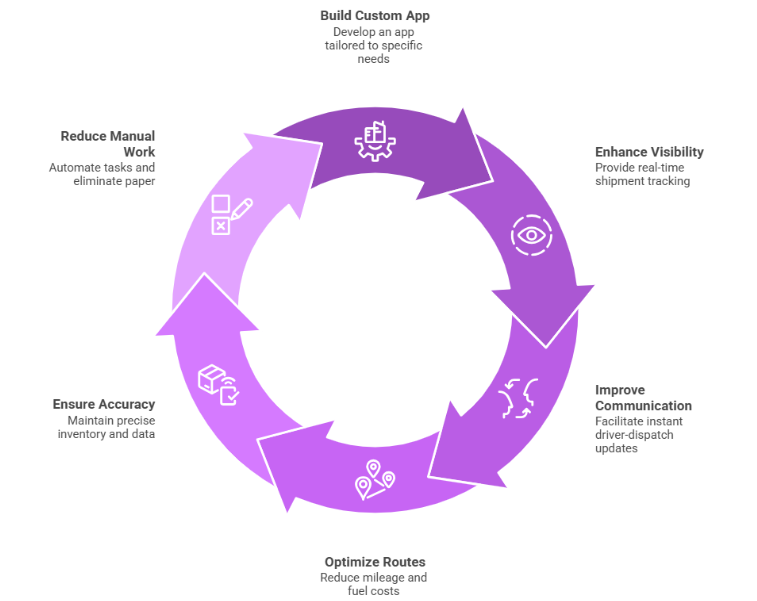
Custom logistics mobile apps are built around how your business actually operates.
Real-Time Shipment Visibility
Customers today do not wait patiently. They track their packages the same way they track flights. If your system cannot give them live updates, they call.
Every call your team takes to answer “where is my shipment?” is time and money your business is burning unnecessarily. A custom app built with real-time visibility at its core solves this at the source.
Faster Driver Communication
Dispatch-to-driver coordination through phone calls is slow, unreliable, and nearly impossible to document. A custom logistics mobile app development project brings all communication into one place. Drivers get updated instructions. Dispatch gets real-time location data. Everyone stays on the same page without a single phone call.
Better Route and Fuel Efficiency
Fuel is one of the highest operational costs in logistics. Poor route planning multiplies that cost every single day.
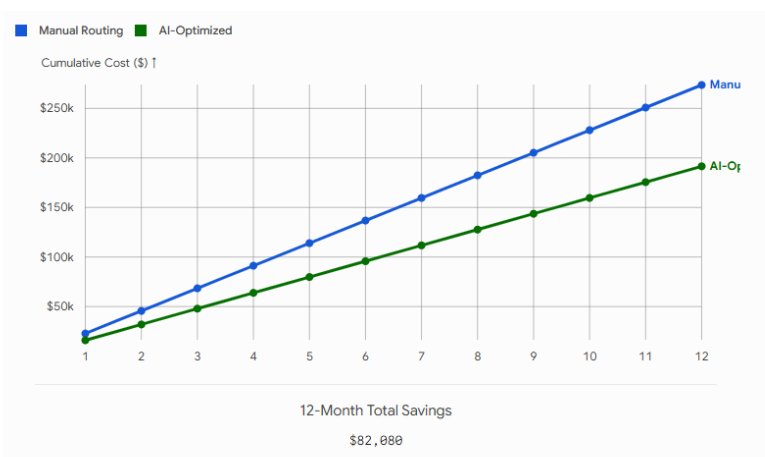
A properly built app uses intelligent routing to cut unnecessary mileage, reduce idle time, and get drivers to destinations faster. This is where solution engineering at the development stage pays back tenfold in savings.
Warehouse and Inventory Accuracy
Warehouse staff scan items, log stock movements, and record proof of delivery. All of this happens on the floor, often in areas with a weak signal. A custom logistics mobile app handles barcode scanning and inventory updates locally, so no transactions get lost between the shelf and the server.
Reduced Manual Work
It is 2026, you can not call paper delivery notes, spreadsheets, or phone logs; they are the systems. They just add extra time to every process. A custom logistics app replaces all of it with digital workflows that are faster, more accurate, and completely auditable.
| Manual Logistics Operations | Mobile App-Based Operations |
|---|---|
| Phone-based updates | Real-time tracking |
| Paper delivery notes | Digital proof of delivery |
| Delayed communication | Instant notifications |
| Manual route planning | AI route optimization |
The problems that come from connectivity-dependent logistics software show up every single day:
- Missed delivery updates, reaching customers late or not at all
- Route delays caused by driver and dispatch miscommunication
- Inventory mismatches between warehouse staff and central systems
- Driver communication gaps during rural or port-area operations
- Lost shipment data that takes hours to reconstruct manually
What Is an Offline-First Logistics Mobile App?
An offline-first mobile app for logistics operations stores all data locally on the device first. Internet connectivity becomes a background process rather than a requirement. When the connection is restored, the app automatically syncs everything to the central system. The driver never notices the difference.
This matters most for the operations that cannot afford gaps: rural delivery routes, shipping ports, cold storage warehouses, and remote distribution centers.
Here is how the process works in practice:
- Driver updates shipment status in the app
- App saves the data locally on the device
- Internet connection returns
- Data syncs to the central system automatically
Core Architecture Behind Offline Logistics Apps
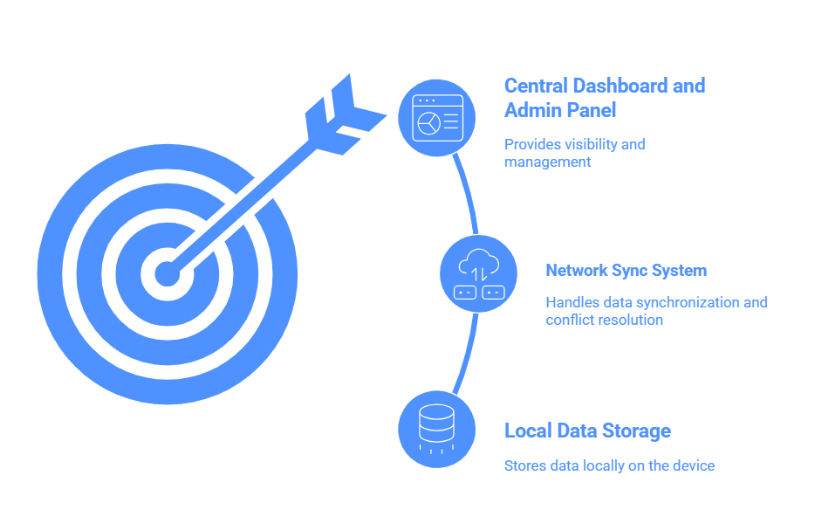
You do not need to understand every line of code. But understanding the three layers that make offline logistics apps work helps you ask the right questions when you are evaluating a development partner.
Local Data Storage
The app stores shipment data, route information, and delivery records directly on the driver’s device. Databases like SQLite handle this cleanly.
When a driver enters a tunnel or loses signal in a warehouse dead zone, the custom logistics mobile app keeps recording everything. Nothing waits for a connection that is not there.
data/
├── local/             # Device state & offline event queues
├── shipments/         # Manifest data & manifest item IDs
├── drivers/           # Driver credentials & active session tokens
├── deliveries/        # Geotags, timestamps, & digital signatures
This structure keeps operations data organized and accessible regardless of connectivity status.
Network Sync System
When the device reconnects, the sync engine runs in the background. It pushes all locally stored data to the central system and pulls down any updates from dispatch. Conflict handling resolves cases in which the same record is updated in two places. The driver does not manage any of this. It happens automatically.
- Auto-synchronize the moment connectivity returns
- Background updates without interrupting active driver workflows
- Reduced data loss even in the most challenging connectivity environments
- Faster operations because drivers never wait for a connection to continue working
Central Dashboard and Admin Panel
While drivers work in the field, operations managers and business owners get complete visibility from a central dashboard. Everything feeds in as it syncs.
- Active shipments and their current status
- Driver locations and route progress
- Delivery confirmations and proof of delivery
- Inventory levels across warehouses
- Delay alerts and exception notifications
- Fleet performance metrics and utilization data
Key Features Every Logistics Mobile App Should Include
Most companies don’t actually fail at logistics because they lack “an app.” They fail because the app solves only the happy-path workflow while real logistics operations live in exceptions, delays, weak networks, driver behavior, warehouse confusion, and fragmented data.
So when businesses invest in custom logistics apps, the features they care about usually map directly to operational risk, cost leakage, or scalability problems.
Real-Time GPS Tracking
Around 58% of the cost in logistics is transportation. A real-time GPS system makes the route mapping easy and accurate.
Business Benefit: Fewer inbound customer inquiries and faster exception handling when delays happen.
Route Optimization
The app calculates the most efficient routes based on traffic, delivery windows, and driver capacity. This directly connects to how businesses reduce mobile app development costs over time by building features that create measurable savings.
Business Benefit: Lower fuel costs and higher deliveries per driver per day.
Driver Management
Assign routes, track hours, monitor performance, and communicate with your entire driver fleet from one interface.
Business Benefit: Better accountability and faster onboarding for new drivers.
Delivery Proof and eSignatures
Drivers capture signatures, photos, and timestamps at the point of delivery. Paper-based proof of delivery creates disputes. Digital records do not. Good mobile application design makes this step fast enough that drivers complete it without friction.
Business Benefit: Fewer billing disputes and stronger compliance documentation.
Push Notifications and Alerts
Drivers get route updates. Customers get delivery windows. Managers get delay alerts. Everyone gets the right information at the right time without anyone making a phone call.
Business Benefit: Faster response times across the entire operation.
Inventory and Warehouse Tracking
Scan barcodes, log stock movement, and track items from receiving through dispatch. Understanding the key components of a successful mobile app for warehousing means building this feature for real-world warehouse conditions, not demo environments.
Business Benefit: Fewer inventory discrepancies and faster stock reconciliation.
In-App Communication
Drivers and dispatch communicate through the app. Messages are logged, timestamped, and searchable.
Business Benefit: Complete communication records and no lost information from phone calls.
Payment and Billing Integration
Collect payments at delivery, generate invoices automatically, and connect directly to your accounting system.
Business Benefit: Faster billing cycles and fewer manual reconciliation errors.
Analytics Dashboard
Every delivery, route, driver performance metric, and operational cost becomes a data point. The dashboard turns those points into decisions. Understanding the importance of business app development means recognizing that the analytics layer is often where the most significant ROI lives.
Business Benefit: Better decisions backed by real operational data.
These features shouldn’t just be a wishlist. At Unique Software Development, we build tailored, offline-first systems designed for the real-world challenges of the road. Every module we deploy reduces time, cost, and increases efficiency across your entire operation.
Let’s build a mobile app that doesn’t just make your work faster, but actively drives down your overall operational overhead.
Types of Logistics Apps Businesses Are Building Today
Every logistics operation has different needs. Here is a breakdown of the most common app types being built today.
| App Type | What It Does | Who Uses It | Biggest Benefit |
|---|---|---|---|
| Fleet Management Apps | Tracks vehicle location, maintenance schedules, driver hours, and fuel consumption in real time | Fleet managers | Full fleet visibility from a single screen |
| Warehouse Management Apps | Handles receiving, put-away, picking, packing, and shipping via handheld devices | Warehouse staff | Inventory accuracy without manual counting |
| Last-Mile Delivery Apps | Supports route navigation, delivery confirmation, and customer communication | Delivery drivers | Accurate ETAs and instant delivery confirmation |
| Freight Booking Platforms | Connects shippers with carriers, manages bookings, and tracks shipments across multiple carriers | Logistics companies and freight brokers | Less manual work coordinating large shipment volumes |
| Supply Chain Visibility Platforms | Provides a single view of the entire supply chain from supplier to customer | Operations managers | Proactive bottleneck management before disruptions hit |
| Driver Apps for Field Operations | Handles route delivery, status updates, proof of delivery, and communication | Field drivers | Eliminates every paper-based step from the driver’s workflow |
Step-by-Step Custom Logistics Mobile App Development Process
Our core values drive us to keep everything completely transparent and clear for our clients. Here is the straightforward, phase-by-phase process we follow to deliver custom logistics mobile applications.
- Discovery and Business Analysis: Good custom logistics mobile apps start with a thorough understanding of how your business actually moves. The development team maps your workflows, shipment lifecycle, and user roles.
- UX/UI Design: Logistics apps serve people who are driving, scanning, and working in environments that demand focus. Good UI/UX design for logistics means minimal distractions, large touch targets, quick-access buttons, and workflows that complete in as few taps as possible.
- Backend and API Integration: Your logistics app does not live in isolation. It connects to your ERP for order data, your WMS for inventory, your CRM for customer information, GPS systems for tracking, and payment gateways for billing.
- Mobile App Development: The app gets built for Android, iOS, or both, depending on your fleet’s device mix. Cross-platform mobile app development using frameworks like Flutter or React Native delivers consistent performance across platforms without doubling the development cost.
- Offline Sync Testing: This is the stage that separates functional apps from reliable ones. The development team tests the app under real-world connectivity conditions. Simulated signal drops. Delayed sync scenarios. Warehouse dead zones. Rural delivery routes with no coverage for extended periods.
Launch and ongoing support: Launch is not the finish line. Logistics operations evolve. New routes, new customers, new compliance requirements, new integrations. All of it requires the app to keep up. Ongoing support covers performance monitoring, security updates, and feature improvements that keep the app aligned with your business as it grows.
Best Tech Stack for Custom Logistics Mobile App Development
| Layer | Recommended Technologies |
|---|---|
| Mobile Development | Flutter, React Native |
| Backend | Node.js, Python |
| Database | PostgreSQL, MongoDB |
| Cloud Infrastructure | AWS, Azure, Google Cloud |
| Maps and Tracking | Google Maps, Mapbox |
| Notifications | Firebase |
| Payments | Stripe, PayPal |
Every technology choice in this stack serves a specific operational purpose. Flutter and React Native deliver cross-platform apps without two separate codebases. PostgreSQL handles structured logistics data with the reliability that enterprise operations require.
AWS and Azure provide the scalability to grow from 50 drivers to 5,000 without rebuilding your backend.
In the same way businesses evaluate the best eCommerce platform for their scale, logistics businesses need a tech stack chosen for their specific operational demands, not just what is popular.
Emerging Technologies Transforming Logistics Apps
- AI and predictive route planning: The use of AI in logistics applications is expected to reach $707.75 billion by 2034. Because it analyzes historical delivery data, traffic patterns, and seasonal demand to recommend routes.
- IoT fleet tracking: IoT & Hardware integration connects physical sensors on vehicles and cargo directly to the logistics platform. Temperature sensors protect cold chain shipments.
- Cloud-based logistics systems: Cloud infrastructure removes the capacity ceiling that on-premise systems hit during peak seasons.
- Big data analytics: Every delivery creates data. Every route generates data. Every exception generates data.
Automated exception handling, intelligent dispatching, and self-adjusting delivery windows reduce the manual intervention required to keep operations running smoothly.

Businesses building Autonomous AI systems into their logistics platforms are already seeing significant reductions in dispatcher workload and operational costs.
How Much Does Custom Logistics Mobile App Development Cost?
The total investment required for custom logistics mobile app development depends heavily on the specific operational features your business demands. Here is a baseline matrix highlighting typical development costs and timelines.
| App Complexity | Estimated Cost |
|---|---|
| Basic App | $25,000 – $50,000 |
| Mid-Level App | $50,000 – $120,000 |
| Enterprise Platform | $150,000+ |
Understanding mobile app development costs in logistics requires looking at what drives the numbers up or down.
Factors that shape the final cost:
- Number of features and their complexity
- Offline sync capabilities and the depth of testing required
- Third-party integrations with ERP, WMS, GPS, and payment systems
- User roles and permission structures across drivers, warehouse staff, and managers
- Scalability requirements based on fleet size and growth plans
The cost range exists because every logistics operation is different. A last-mile delivery app for a regional courier has very different requirements than an enterprise freight platform managing cross-border shipments. The investment scales with the complexity of the problem being solved.
Why Offline-First Logistics Apps Need the Right Development Partner
Building a logistics app is not just a development project. It is an operational infrastructure decision that will affect how your business runs every single day. Unique Software Development builds logistics platforms with that weight in mind.
Every engagement starts with a deep understanding of your operations, not a features checklist. The team builds custom workflows that match how your dispatchers, drivers, and warehouse staff actually work. Offline-first architecture is a standard, not an add-on. Cross-platform development ensures your custom logistics mobile app works across your entire fleet, regardless of device mix.
What that means for your business in practice:
- Custom business workflows built around your specific operations
- Scalable infrastructure that grows with your fleet and volume
- Secure architecture that protects shipment data and customer records
- Real-time tracking systems that give complete operational visibility
- Ongoing maintenance support that keeps the app running as your business evolves
Final Thoughts
Logistics is an industry where the gap between a reliable system and an unreliable one shows up in real dollars, real delays, and real customer relationships. Offline-first logistics apps close that gap at the foundation level. The only challenge is to hire the right custom logistics software development company for your project.
The businesses opting for custom logistics mobile app development today are building operational advantages that compound over time. Lower costs from better routing, fewer disputes from digital delivery records, better customer retention from reliable updates, and faster scaling from infrastructure that was designed to grow.