


Every business wants software that helps teams work faster, automates repetitive tasks, and keeps everything in one place. But when it comes to building custom software, one question stops most business owners: How much is it actually going to cost?
The confusion is understandable. One custom software development company may quote $15,000, while another estimates $300,000+ for what seems like a similar project. The difference usually comes down to factors like your software’s complexity, database structure, user roles, third-party integrations, security requirements, and compliance needs.
In this guide, we’ll explain exactly how custom software development costs are calculated in Dallas. We will break down the variables that drive your price up or down. Finally, you will learn how to estimate a realistic budget, well before you request your next quote.
Quick Answer: What Does Custom Software Development Cost?
You hear John, another business owner, say his custom software development cost him $20,000. It sounds like a great deal, so you decide it’s time to build yours too. But when you share your requirements with a custom software development company, the proposal comes back at $250,000.
The first thought is usually: “Why is my software so expensive?”
The reason is simple: John’s software may not have needed the same features, integrations, security, or scalability. Custom software pricing depends on what your business actually needs.
Here are the features that usually add the most cost:
| Feature / Requirement | Cost Impact | Why It Adds Cost |
|---|---|---|
| Custom Business Workflows | $10,000–$75,000+ | Unique processes require custom logic, automation rules, and backend development. |
| User Roles & Permissions | $2,000–$15,000+ | Different user types need separate access levels, dashboards, and security controls. |
| Third-Party Integrations | $5,000–$50,000+ | Connecting CRMs, payment systems, ERPs, and APIs requires development and testing. |
| AI Features & Automation | $10,000–$100,000+ | AI tools require model integration, data handling, testing, and continuous improvement. |
| Mobile App Development | $20,000–$100,000+ | Supporting iOS and Android requires additional design, development, and testing. |
| Data Migration | $5,000–$50,000+ | Moving existing business data requires cleaning, mapping, and secure transfer. |
| Custom Dashboard & Reporting | $5,000–$30,000+ | Advanced analytics, reports, and real-time insights require additional development. |
| Security & Compliance | $10,000–$100,000+ | Encryption, privacy controls, audits, and compliance requirements increase complexity. |
| Real-Time Features | $10,000–$50,000+ | Live chat, tracking, notifications, and collaboration need additional infrastructure. |
| Database Architecture & Scalability | $5,000–$100,000+ | Large user bases and complex data require stronger architecture and optimization. |
| Cloud Infrastructure & DevOps | $5,000–$40,000+ | Deployment, servers, monitoring, backups, and scaling require technical setup. |
Custom Software Development Cost Matrix (By Complexity & Project Scope)
Custom software development costs vary mainly based on the size of the solution, the number of users, the required features, and the technical complexity. A simple internal tool may require a smaller investment, while enterprise platforms with AI, integrations, and advanced security require significantly more development effort.
The table below gives a realistic cost range based on common project complexity levels:
| Feature / Requirement | Cost Impact | Why It Adds Cost |
|---|---|---|
| Custom Business Workflows | $10,000–$75,000+ | Unique processes require custom logic, automation rules, and backend development. |
| User Roles & Permissions | $2,000–$15,000+ | Different user types need separate access levels, dashboards, and security controls. |
| Third-Party Integrations | $5,000–$50,000+ | Connecting CRMs, payment systems, ERPs, and APIs requires development and testing. |
| AI Features & Automation | $10,000–$100,000+ | AI tools require model integration, data handling, testing, and continuous improvement. |
| Mobile App Development | $20,000–$100,000+ | Supporting iOS and Android requires additional design, development, and testing. |
| Data Migration | $5,000–$50,000+ | Moving existing business data requires cleaning, mapping, and secure transfer. |
| Custom Dashboard & Reporting | $5,000–$30,000+ | Advanced analytics, reports, and real-time insights require additional development. |
| Security & Compliance | $10,000–$100,000+ | Encryption, privacy controls, audits, and compliance requirements increase complexity. |
| Real-Time Features | $10,000–$50,000+ | Live chat, tracking, notifications, and collaboration need additional infrastructure. |
| Database Architecture & Scalability | $5,000–$100,000+ | Large user bases and complex data require stronger architecture and optimization. |
| Cloud Infrastructure & DevOps | $5,000–$40,000+ | Deployment, servers, monitoring, backups, and scaling require technical setup. |
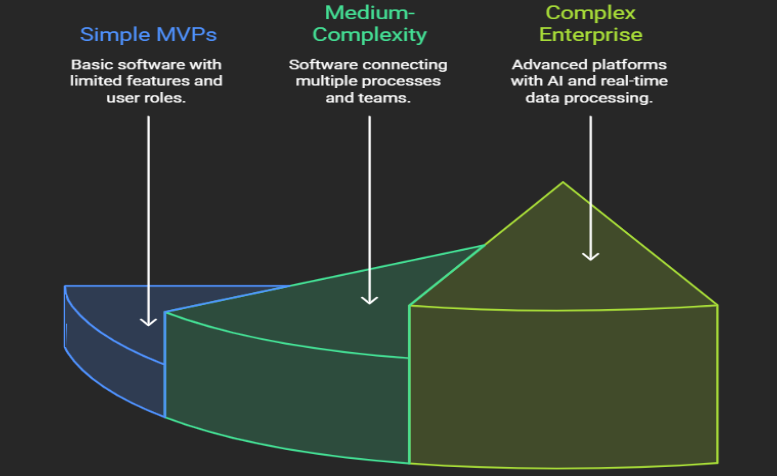
1. Simple MVPs & Single-Feature Software ($20,000–$60,000)
Simple software projects usually focus on solving one specific business problem with limited features and fewer user roles.
Examples include:
- Internal dashboards
- Basic CRM systems
- Employee management tools
- Customer portals
- Simple booking applications
These projects typically include:
- Basic user authentication
- Simple database structure
- Limited integrations
- Standard reporting
The custom software development cost stays lower because the software development company spends less time on complex architecture, advanced security requirements, and custom workflows.
2. Medium-Complexity Applications & Integrations ($80,000–$250,000)
Most growing businesses fall into this category because they need software that connects multiple processes and teams.
Examples include:
- Custom CRM platforms
- Inventory management systems
- Logistics software
- Business automation platforms
- SaaS applications
These projects usually require:
- Multiple user roles and permissions
- Third-party integrations
- Custom workflows
- Advanced dashboards
- Data migration
- Mobile or web application support
The cost to develop software increases because the system needs stronger architecture, more testing, and more development hours.
3. Complex Enterprise Platforms & Advanced Technology ($250,000–$500,000+)
Enterprise-level software requires significantly more planning, engineering, and ongoing support.
Examples include:
- AI-powered platforms
- Enterprise SaaS products
- Healthcare systems
- Financial software
- IoT-connected applications
These projects often involve:
- Advanced AI features
- Real-time data processing
- Complex integrations
- High-security requirements
- Scalable cloud infrastructure
- Compliance standards
A custom software development company charges more for these solutions because they require senior engineers, extensive testing, advanced architecture planning, and long-term scalability considerations.
Custom Software Cost Calculator Formula
You can estimate your development budget by multiplying the expected labor hours by your team’s rate, then factoring in project management (PM), Quality Assurance (QA), and a safety buffer.
Every established custom software development company builds a buffer into its proposals to absorb the unexpected technical hurdles that inevitably surface mid-project.
Total Cost = (Development Hours × Hourly Rate) + Design Hours + PM/QA Overhead (20–30%) + First-Year Maintenance (15–20% of Build Cost)
Break that down by phase, and it looks like this for a mid-complexity Dallas project:
- Discovery and business analysis: 40–80 hours
- UI/UX design: 80–160 hours
- Development: 600–1,400 hours, depending on feature count
- QA testing: 15–20% of development hours
- Deployment and documentation: 20–40 hours
Example: If your project requires 1,000 development hours at a local blended rate of $130/hour, your base engineering cost is $130,000. Adding a standard 25% overhead for project management and QA brings your realistic launch budget to $162,500.
Do the math yourself, and you’ll usually land within 15 percent of what a real proposal comes back at. A custom software development company that quotes wildly outside that band, in either direction, owes you an explanation before you sign anything.
We build these calculations project by project because a formula only gets you close. If you want the exact number for your build, not an estimate, we’ll walk through it live and hand you a real breakdown, not a range.
What Is Included in Custom Software Development Cost?
Custom software development pricing covers eight distinct phases, and business owners almost always underestimate how many of them must occur before a single line of code is written.
If an agency quotes you only for development, they are setting you up for failure. Here is what you are actually paying for:
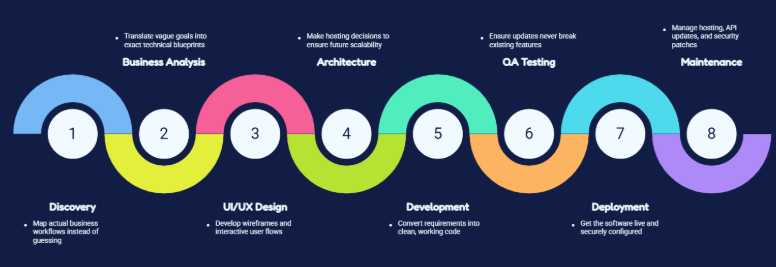
- Discovery: This is where a team maps your actual business workflows instead of guessing. Skip this phase, and you pay for it twice—once in the build, and once in the expensive rework.
- Business Analysis: The crucial translation phase. Someone has to translate “we need this to be easier for our team” into an exact technical blueprint a developer can build from.
- UI/UX Design: Wireframes, interactive user flows, and a visual design system. Poor design work here shows up as confused users six months after launch.
- Architecture: The structural blueprint. Database schemes, API designs, and hosting decisions. Get this wrong, and scaling later will cost more than building it right the first time.
- Development: The largest line item, typically 50% to 60% of the total cost. This is where your requirements actually turn into clean, working code.
- QA Testing: Teams that treat QA as an afterthought ship buggy software to production and burn user trust. For complex systems, this involves setting up scripted QA (automated testing) to automatically run regressions on your codebase every time a developer commits new code, ensuring updates never break existing features.
- Deployment: Getting the software live, securely configured, and actively monitored. It sounds simple, but rarely is, especially when compliance regulations are in play.
- Maintenance: The phase that most cheap quotes leave out entirely. Software is not a static product; it is an active system that requires hosting management, API updates, and security patches.
The Bottom Line: You are paying for outcomes, not hours. You’re not buying 800 hours of typing; you are buying a custom system that replaces the five messy spreadsheets your team currently juggles.
That distinction is where the biggest cost savings hide. You don’t save money by cutting features your users actually care about. Instead, you save it by planning your architecture correctly on day one, automating your testing, and scoping features against real business impact. Teams that follow this blueprint routinely slash total development costs by 20% to 30%.
Average Custom Software Development Cost by Project Type
“How much does it cost” is the wrong question until you answer “what kind.” A CRM and a healthcare compliance platform share almost nothing in common except the word software.
Software development services pricing splits cleanly by category when you look at real project data rather than averages that blend everything together. Custom software pricing for a booking platform looks nothing like pricing for an AI application, and treating them the same is how business owners end up shocked by a quote.
| Software Type | Typical Cost | Timeline | Best For |
|---|---|---|---|
| CRM | $40,000 – $120,000 | 3–5 months | Sales teams needing custom pipelines, SaaS tools can’t match. |
| ERP | $150,000 – $500,000+ | 8–14 months | Multi-department operations with complex data flows. |
| Healthcare Platform | $100,000 – $350,000 | 6–12 months | HIPAA-regulated patient or provider systems. |
| Logistics System | $80,000 – $250,000 | 5–9 months | Route optimization, fleet tracking, dispatch. |
| Manufacturing Software | $90,000 – $300,000 | 6–10 months | Inventory, production scheduling, quality control. |
| SaaS Product | $70,000 – $300,000 | 5–10 months | Subscription businesses building a core product. |
| Marketplace | $80,000 – $250,000 | 5–9 months | Two-sided platforms connecting buyers and sellers. |
| Booking Platform | $50,000 – $150,000 | 3–6 months | Appointment or reservation-based businesses. |
| AI Application | $100,000 – $400,000+ | 6–12 months | Predictive tools, automation, generative features. |
| Mobile App | $40,000 – $180,000 | 3–7 months | Consumer or field-service teams needing native access. |
These ranges assume a US-based custom software development company handling full-cycle delivery. Offshore teams can undercut every figure by 30 to 50 percent, and the section below on why quotes vary explains exactly what that discount usually costs you later.
Factors That Influence Custom Software Development Pricing
Every quote you receive is really just a custom software development company running a private version of the calculator above against eight variables. Learn those variables, and you stop needing anyone to explain a proposal to you. This is also where web app development decisions get made, since most of these factors apply the same way whether you’re building a browser product, a mobile app, or both.
Project Complexity
A client once described his project as “just a simple app” for forty-five straight minutes, and by minute ten, he’d mentioned real-time inventory sync, three user roles, and a payment gateway. None of that is simple. Complexity isn’t about how the idea sounds in a sentence; it’s about how many decisions the software has to make on its own, and how many systems it has to talk to while making them.
| Complexity | Definition | Cost Range |
|---|---|---|
| Simple | Single-user role, basic CRUD, no external integrations. | $20,000 – $60,000 |
| Medium | Multiple roles, 2–5 integrations, moderate business logic. | $80,000 – $200,000 |
| Complex | Real-time data, AI/ML components, regulatory compliance. | $250,000 – $500,000+ |
Features and Functionalities
Every feature you add is a small promise the software has to keep forever, not just on launch day. Authentication alone can run from a basic login form to a full identity system with role-based permissions, and that gap is thousands of dollars wide before a single business feature gets touched.
Authentication, payments, messaging, dashboards, reports, notifications, file uploads, and offline mode each carry their own build cost, testing cost, and long-term maintenance cost. Payment integration alone often adds 40 to 80 hours once you account for PCI compliance, error handling, and refund logic that has to work the first time correctly, every time.
Technology Stack
A junior developer once picked React for a client’s internal tool. He didn’t choose it because it fit the project; he chose it because it was the framework he knew best. Eighteen months later, that client had to hire three additional developers just to keep the codebase maintainable.
React, Node.js, .NET, Flutter, Python, and AWS each come with different developer availability, different hourly rates, and different long-term scaling costs. Popular stacks cost less to staff but face more competition for the same talent. Specialized stacks cost more per hour but often deliver faster for the right use case.
A software development company that defaults to the same stack for every client, regardless of project, is optimizing for their own hiring pipeline, not your outcome.
Third-Party Integrations
Stripe, QuickBooks, SAP, Salesforce, Google Maps, and Twilio all promise a quick integration in their marketing copy, and every one of them hides real work behind that promise. Authentication tokens expire. APIs change without warning. Error states multiply the moment two systems have to agree on the same piece of data.
Each integration typically adds 20 to 60 hours, depending on the API’s documentation quality and how much your business logic depends on getting the data right the first time. Five integrations on a single project are not five times the work of one; it’s closer to eight, because each new connection has to be tested against every existing one.
Security and Compliance
A healthcare client once assumed HIPAA compliance meant “don’t email patient records,” and that assumption alone would have failed an audit within a year. Compliance work is invisible until the day it isn’t, and that day is always more expensive than building it right from the start.
HIPAA, GDPR, PCI DSS, SOC 2, role-based access, encryption, and audit logs each add development time that never shows up in a demo but shows up in every audit. Healthcare software development projects routinely carry a 15 to 25 percent premium over comparable non-regulated builds, and that premium buys you the difference between passing an audit and rebuilding after failing one.
AI Features
Chatbots, predictive analytics, OCR, recommendation engines, and generative AI features are being pitched by every vendor right now, and half of them are pitching decoration rather than function. A custom software development company that knows how to build autonomous AI systems designs those features around a measurable outcome- fewer support tickets, faster data entry, better forecasting- not around a slide that says “AI-powered.”
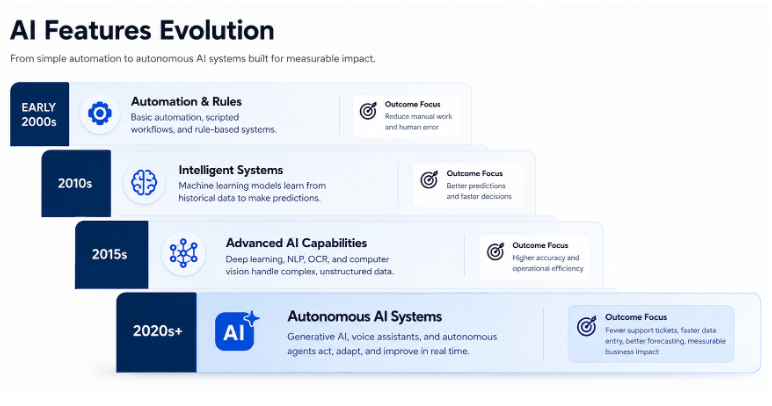
Voice assistants sit at the expensive end of this category because they combine natural language processing, real-time audio handling, and integration work all at once. Budget accordingly, and ask any vendor pitching AI features to name the specific metric it’s supposed to move.
Team Structure
A five-person team costs more per week than a two-person team, and still finishes faster, because a business analyst catching a requirements gap in week two saves the backend developer from rebuilding a data model in week twelve. Team size isn’t overhead; it’s insurance against the most expensive kind of mistake: the one you don’t find until launch.
Business analyst, designer, frontend developer, backend developer, QA engineer, DevOps engineer, and project manager each protect a different part of the build. Skip QA to save money, and you pay for it in support tickets. Skip a project manager, and you pay for it in scope creep nobody tracked.
Why Does One Company Quote $20,000 While Another Quotes $200,000?
This is the question that actually keeps people up at night, more than the raw dollar figure ever does. Two proposals with the same project description and a 10x gap between them. Here’s what that gap is usually made of.
- Experience: A team that has shipped fifty similar projects has learned from the mistakes they already know to avoid. A team, on their first version of your type of project, prices it low because they don’t yet know what they don’t know, and you find out together, on your dime.
- Discovery: The $20,000 quote often skipped discovery entirely and is pricing the project you described in one email. The $200,000 quote asks 40 questions first and prices the project you actually need.
- QA: Manual testing by one junior developer costs almost nothing to quote and almost everything to fix later. Structured QA with real test coverage costs more upfront and prevents the six-figure production incident that would otherwise cost more than the entire original build.
- Documentation: Undocumented code is cheap to write and expensive to hand off, maintain, and have the next developer touch without breaking something.
Price is only one part of choosing the right partner. The best software development companies are not always the cheapest; they are the ones that bring strong communication, technical expertise, transparent processes, and the ability to understand your business goals.
Before choosing a vendor, look for the qualities of the best software development companies that separate reliable partners from companies that simply compete on price.
Freelancer vs Software Development Company vs In-House Team
| Option | Typical Cost | Pros | Cons | Best For |
|---|---|---|---|---|
| Freelancer | $25–$100/hr | Low cost, direct access. | No QA backup, single point of failure. | Small, well-defined tasks. |
| Software Development Company | $85–$200/hr | Full team, QA, project management, accountability. | Higher hourly rate. | Full builds, ongoing products, regulated industries. |
| In-House Team | $120,000–$180,000/yr per developer | Full control, institutional knowledge. | Slow to hire, expensive to scale, benefits overhead. | Long-term products with continuous development needs. |
Investing in the right engineering partner pays off in the long term. Research from McKinsey shows that enterprise-grade systems built on sound architecture can slash business operational costs by 20% to 25% once deployed.
That’s why for businesses looking for a full-cycle development partner, the right company should offer more than coding. Look for a team that can handle discovery, architecture, UI/UX, development, testing, deployment, and long-term support under one process. At Unique Software Development, we follow this approach by helping businesses move from initial requirements to a complete, scalable software solution.
Final Thoughts
Custom software development cost isn’t a mystery once you know what you’re actually paying for. A simple tool runs $20,000 to $60,000. A mid-complexity platform runs $80,000 to $250,000. A regulated, AI-driven enterprise system runs $250,000 to $500,000 and up.
The number moves based on complexity, features, integrations, compliance, and who’s actually building it: a freelancer, a software development company, or an internal team. Progressive web apps and mobile builds each carry their own math, but the same eight cost drivers apply across every version of the question.