

Between gridlocked roads and strict specimen time limits, healthcare logistics is a race against the clock. A missing lab sample or delayed medical delivery can force repeat testing, slow down treatment, and disrupt workflows. This also adds hundreds or even thousands of dollars in avoidable costs.
The way around this is to have medical courier apps. That keeps operations secure, fully HIPAA-compliant, and running like clockwork. But finding the right app isn’t easy when every platform on the market promises the world.
To help you separate real-world performance from slick marketing claims, we reviewed the leading medical courier apps, comparing their features, pricing, strengths, and limitations. We also looked at when buying an off-the-shelf platform makes sense and when building a custom solution may be the better fit.
What Is a Medical Courier App?
A medical courier app is software that tracks, routes, and proves the delivery of medical items. From lab specimens and prescriptions to donor blood. If you equip your team with the right medical courier app, you can cut fuel costs by up to 30% while slashing delivery delays by 75%. More importantly, it safeguards the lab results that directly drive 70% of all clinical decisions.
However, not every medical courier app does the same job. The market splits into three distinct categories, and knowing which one you need saves months of wasted evaluation.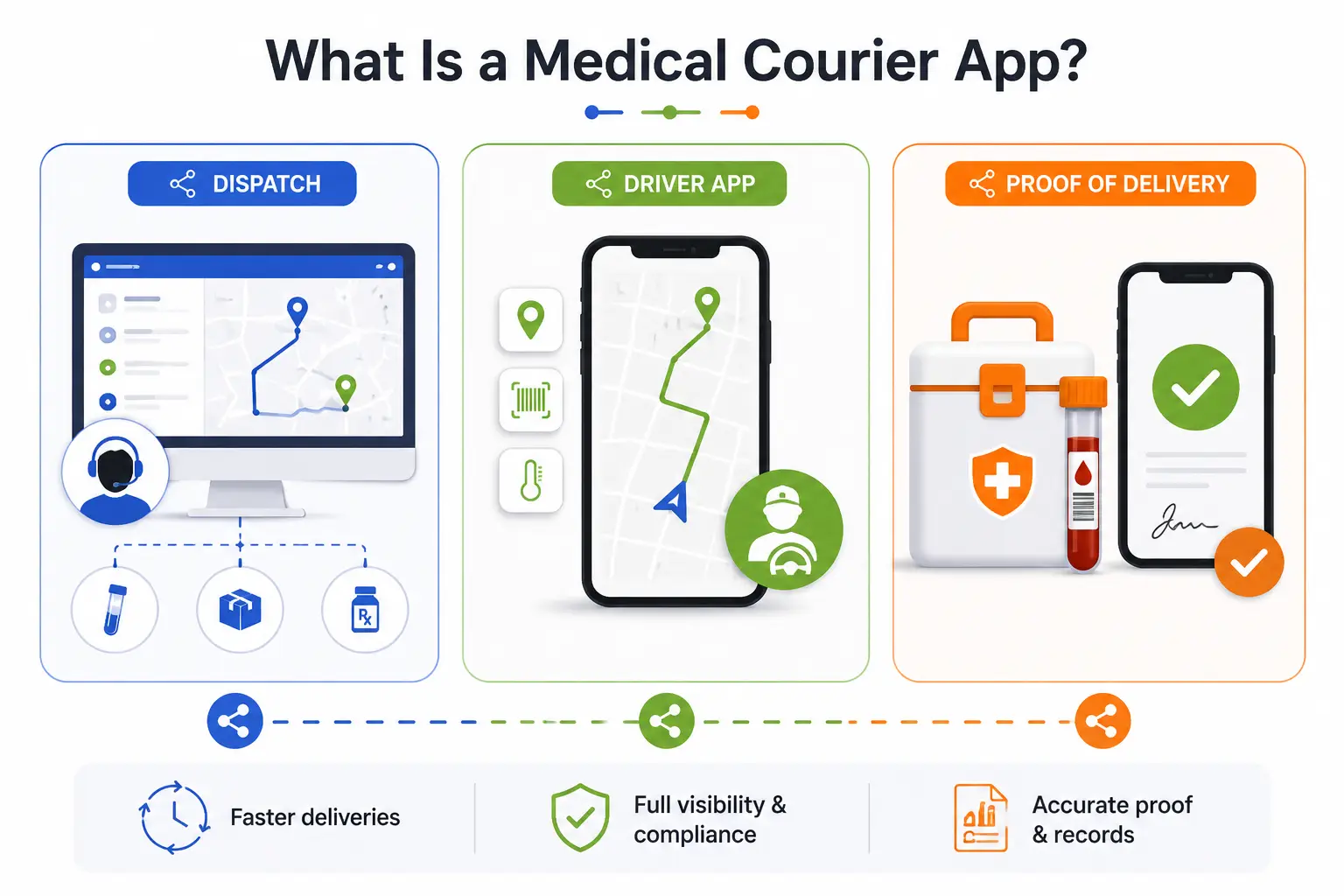
Dispatch Platforms
Dispatch platforms assign routes, track drivers in real time, and manage the full delivery operation as field dispatch software. Healthcare organizations building this in-house often turn to custom logistics software development to match internal compliance and reporting needs exactly.
Driver Apps
A medical courier driver app relies on standard components of a mobile app like GPS navigation, scanning, and offline sync. The difference is that every feature is built for high field reliability and HIPAA compliance.
Complete Courier Management Systems
Complete courier management systems combine dispatch, a driver app, customer portals, and reporting into a single connected platform. They suit organizations running high delivery volumes across multiple facilities, where separate tools for scheduling, tracking, and billing create more friction than they solve.
Quick Comparison of the Best Medical Courier Apps for Healthcare Logistics
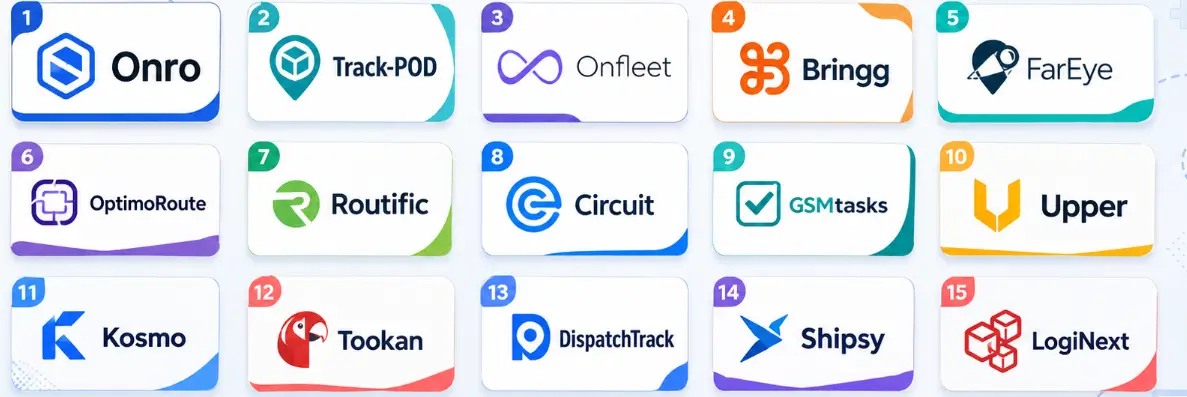
Fifteen platforms claim to serve healthcare, but only a handful were actually built for it. Here’s how the top medical courier apps stack up before we break each one down.
| Software | Best for | Starting Price | HIPAA (Vendor-Stated) | Cold Chain | Proof of Delivery | Rating* |
|---|---|---|---|---|---|---|
| Onro | On-demand medical delivery | ~$29/driver/mo | Yes | Limited | Yes | 4.6 |
| Track-POD | Audited proof of delivery | ~$29/driver/mo | Yes | No | Advanced | 4.7 |
| Onfleet | Mid-size dispatch + driver | ~$500/mo | Yes | No | Yes | 4.6 |
| Bringg | Enterprise orchestration | Custom | Yes | Partner-based | Yes | 4.5 |
| FarEye | Large logistics networks | Custom | Yes | Partner-based | Yes | 4.4 |
| OptimoRoute | Route/schedule optimization | ~$39/driver/mo | Verify | No | Yes | 4.6 |
| Routific | Multi-stop route planning | ~$49/driver/mo | Verify | No | Basic | 4.5 |
| Circuit | Simple last-mile routing | ~$49/mo | Verify | No | Yes | 4.4 |
| GSMtasks | Field service + delivery | ~$23/driver/mo | Verify | No | Yes | 4.3 |
| Upper | Fast route planning | ~$40/driver/mo | Verify | No | Basic | 4.4 |
| Kosmo | Small courier fleets | ~$19/driver/mo | Verify | No | Yes | 4.3 |
| Tookan | On-demand delivery ops | ~$29/mo | Verify | No | Yes | 4.2 |
| DispatchTrack | Delivery-experience mgmt | Custom | Verify | No | Yes | 4.3 |
| Shipsy | Supply-chain visibility | Custom | Verify | No | Yes | 4.3 |
| LogiNext | Enterprise TMS | Custom | Yes | Partner-based | Yes | 4.4 |
* These ratings were assigned based on user reviews, software quality reports, and rankings on different platforms.
Off-the-shelf delivery tools seem cheap initially at $30 to $150+ per month. But recurring per-driver fees stack up quickly as you scale. Unique Software Development flips this model; while the upfront build cost is higher, it is a one-time investment with no monthly licensing penalties. You get an app 100% per your operational design, built to scale effortlessly alongside your fleet.
15 Best Medical Courier Apps for Healthcare Delivery
Every platform below solves a different piece of the puzzle, so the right pick depends on your fleet size, compliance needs, and how much control you want over the workflow. Here’s how each of these medical courier apps actually performs in practice.
Onro
- Best for: On-demand and scheduled medical delivery
- Key features: Live GPS tracking, automated dispatch, driver app, digital proof of delivery, route optimization
- Pricing: Starts around $29 per driver per month
- Ideal users: Labs, pharmacies, and mid-size courier fleets
Onro pairs automated dispatch with live GPS and digital proof of delivery, and offers white-label options useful for courier firms serving healthcare clients. On G2/Capterra, reviewers most often cite the dispatch dashboard reducing coordination overhead.
Track-POD
- Best for: Proof of delivery and compliance documentation
- Key features: Electronic signatures, photo capture, barcode scanning, route optimization, real-time ETAs
- Pricing: Starts near $29 per driver per month
- Ideal users: Labs and pharmacies handling audited deliveries
Timestamped electronic signatures, photo capture, and barcode scanning create an audit trail that stands up to inspection. Reviewers highlight faster audit prep once every delivery carries a digital record.
Onfleet
- Best for: Mid-size teams needing dispatch and driver coordination together
- Key features: Real-time tracking, automated notifications, route optimization, analytics dashboard, driver chat
- Pricing: Plans start around $500 per month
- Ideal users: Growing healthcare logistics teams
Onfleet bundles real-time tracking, automated customer notifications, route optimization, and a clean analytics layer. The notification system is the feature reviewers credit most with cutting “where’s my delivery?” calls. It’s a step up in price from per-driver tools, which makes it a better fit once you’re past a handful of drivers than for a two-person clinic.
Bringg
- Best for: Enterprise delivery orchestration across multiple locations
- Key features: Advanced routing, real-time visibility, customer portal, full API access, analytics
- Pricing: Custom, based on delivery volume
- Ideal users: Hospital networks and large pharmacy chains
Bringg is built for scale: advanced routing, network-wide visibility, a customer portal, full API access, and deep analytics. Enterprise reviewers cite multi-location visibility as the reason they consolidate off spreadsheets and disconnected tools. Cold-chain is typically handled through sensor partners rather than natively, so scope that integration early.
FarEye
- Best for: Large logistics networks with complex delivery chains
- Key features: Predictive ETAs, route optimization, real-time tracking, compliance reporting
- Pricing: Custom enterprise pricing
- Ideal users: Large diagnostic labs and multi-region distributors
Reviewers most often highlight ETA accuracy that makes customer communication proactive instead of reactive. Like most enterprise platforms here, verify healthcare-specific compliance and the BAA rather than assuming it from the feature list.
OptimoRoute
- Best for: Route and schedule optimization at scale
- Key features: Advanced route planning, driver tracking, delivery windows, reporting
- Pricing: Starts around $39 per driver per month
- Ideal users: Fleets running high stop counts daily
OptimoRoute handles tight delivery windows and last-minute changes well, which reviewers mention often. It is a routing-first tool with strong planning features but lighter healthcare compliance, so verify HIPAA and BAA support directly if handling PHI. It works best when efficiency, rather than regulation, is your main goal.
Routific
- Best for: Complex multi-stop route planning
- Key features: AI-powered route optimization, delivery windows, driver tracking, reporting
- Pricing: Starts around $49 per driver per month
- Ideal users: Fleets managing dozens of daily stops
Routific focuses narrowly on route quality: delivery windows, driver tracking, and optimization that reviewers say cuts real hours from daily planning. Proof-of-delivery and compliance depth are basic compared to purpose-built medical tools, so it fits best as the routing layer in a stack where documentation lives elsewhere. Verify HIPAA before use with PHI.
Circuit
- Best for: Simple, fast last-mile routing
- Key features: One-click route optimization, driver app, delivery tracking, customer alerts
- Pricing: Starts around $49 per month
- Ideal users: Small teams wanting simplicity over depth
Circuit’s appeal is minimal training, reviewers note new drivers running their first route almost immediately. It covers one-click optimization, a driver app, tracking, and customer alerts. Compliance features are limited, making it a lean entry point for small operations rather than a fit for regulated, high-documentation specimen transport.
GSMtasks
- Best for: Field service teams that also handle delivery
- Key features: Task scheduling, route optimization, live tracking, driver app, integrations via Zapier
- Pricing: Around $23 per driver per month
- Ideal users: Home healthcare and field-based medical teams
GSMtasks blends task scheduling with delivery, so drivers can mix service appointments and drop-offs on one schedule. It offers route optimization, live tracking, and Zapier/API integrations. Compliance is limited out of the box; confirm what’s required for any PHI-carrying workflow before rollout.
Upper
- Best for: Fast route planning with minimal setup
- Key features: Route optimization, driver app, delivery proof, real-time tracking
- Pricing: Starts around $40 per driver per month
- Ideal users: Small to mid-size delivery fleets
Upper rebuilds routes quickly when stops change mid-day, which reviewers cite as its standout. It covers optimization, a driver app, delivery proof, and real-time tracking. Compliance depth is limited, so it slots in best as a routing tool for operations whose documentation and chain-of-custody needs are modest.
Kosmo
- Best for: Small courier operations getting organized
- Key features: Route planning, driver tracking, delivery confirmation, basic reporting
- Pricing: Around $19 per driver per month
- Ideal users: Independent couriers and small clinics
Kosmo sits on the affordable end of the market, offering route planning, driver tracking, proof of delivery, and basic reporting. Reviewers note you can start dispatching within a day. However, HIPAA support is limited and needs direct verification, as the tool suits teams upgrading from spreadsheets rather than regulated multi-site networks.
Tookan
- Best for: On-demand delivery operations
- Key features: Dispatch automation, driver app, live tracking, proof of delivery
- Pricing: Starts around $29 per month
- Ideal users: Courier companies handling on-demand requests
Tookan’s on-demand dispatch speed is its most-cited strength for urgent medical runs, alongside a driver app, live tracking, and proof of delivery. Compliance is limited by default, so verify HIPAA/BAA for PHI. It’s a practical, budget-friendly option for operations juggling scheduled and same-day deliveries.
DispatchTrack
- Best for: Managing the full delivery experience end to end
- Key features: Real-time tracking, automated dispatch, customer notifications, analytics
- Pricing: Custom pricing based on fleet size
- Ideal users: Pharmacies and medical supply distributors
DispatchTrack centers on the customer experience with automated dispatch, real-time tracking, notifications, and analytics. Reviewers note that its tracking links cut down on status calls. However, check its healthcare compliance details directly, as the platform prioritizes general delivery over regulated specimen tracking.
Shipsy
- Best for: Logistics visibility across a broader supply chain
- Key features: Fleet tracking, route optimization, analytics, API integrations
- Pricing: Custom pricing
- Ideal users: Medical device companies and distributors
Shipsy adds value once volume climbs into the thousands of deliveries per month, with fleet tracking, route optimization, and reporting depth reviewers single out. It’s supply-chain-oriented rather than specimen-oriented, so validate chain-of-custody and compliance features against your specific requirements before committing.
LogiNext
- Best for: Enterprise transportation management
- Key features: Advanced routing, real-time tracking, compliance tools, full integration suite
- Pricing: Custom enterprise pricing
- Ideal users: Large hospital systems and national courier networks
LogiNext offers advanced routing, real-time tracking, compliance tooling, and a full integration suite. Enterprise reviewers cite the compliance tooling as what sets it apart from lighter competitors. As with all enterprise platforms here, treat compliance as vendor-stated until you’ve confirmed the BAA and healthcare-specific configuration.
Custom Solution: Building Your Own Medical Courier App
Pre-made apps rarely match how a hospital actually tracks specimens or how a pharmacy handles deliveries. That mismatch is why custom software is worth the investment. It lets the app fit your real process, not the other way around.
This is where partnering with a logistics software development company changes the trajectory of the whole operation. When you build custom, the software naturally follows the seven phases of the SDLC. That means strict HIPAA rules and chain-of-custody tracking get baked into the app right from the start, rather than retrofitted after a problem pops up.
12 Essential Features Every Medical Courier App Should Have
Some features are nice extras. These twelve are non-negotiable for anything moving specimens, prescriptions, or medical supplies, because each one closes a specific failure point that costs time, money, or patient safety.
- Real-time GPS tracking location visibility when a specimen is minutes from losing viability.
- Intelligent dispatching auto-assigns the nearest driver, cutting manual coordination.
- Route optimization recalculates as stops change, keeping tight windows realistic.
- Electronic proof of delivery timestamped digital confirmation that survives an audit.
- Barcode / QR scanning ties every package to a patient or order at handoff.
- Chain-of-custody tracking records everyone who touched a regulated shipment.
- Temperature monitoring protects vaccines and blood products in transit.
- HIPAA-ready security + BAA encrypts PHI end to end; the BAA is the part that makes it real.
- Driver mobile app navigation, task list, and proof capture in one place.
- Automated notifications cut status-check calls to facilities and patients.
- Analytics dashboard turns delivery data into route and timing improvements.
- API / EHR-LIS integration moves data between the app, EHR, LIS, and pharmacy systems without re-keying.
A flashy feature list looks great on paper, but it means nothing if the software chokes during peak delivery hours. Before committing to any platform, you need to understand how to measure software quality in practice. That means testing how fast location pings sync back to dispatch, verifying SOC 2 security compliance, and making sure the driver app stays stable.
How Medical Courier Apps Improve Operational Efficiency
Medical courier apps improve efficiency by replacing manual dispatch and paper tracking with automated routing, live visibility, and digital proof of delivery. The result is less time spent coordinating deliveries, fewer missed handoffs, and better control over every shipment.
Lower Delivery Costs
Optimized routes help drivers cover more stops while spending less time and fuel on the road. For medical courier operations running dozens or hundreds of deliveries a day, those savings can add up quickly.
Faster Dispatch and Route Changes
Instead of calling drivers or manually assigning every pickup, dispatchers can assign jobs automatically. When a new request comes in or a driver gets delayed, the system can adjust the route without rebuilding the entire schedule.
Faster Specimen Transport
Medical specimens often have strict delivery windows. Real-time routing helps dispatchers and drivers react to traffic, delays, and changing priorities so time-sensitive shipments keep moving.
Fewer Failed Deliveries
Live tracking gives dispatchers visibility into where drivers are and whether a delivery is progressing as planned. Digital delivery records also make it easier to confirm what happened when a drop-off goes wrong.
Better SLA Compliance
Automated alerts can flag deliveries that are approaching their deadlines. That gives dispatchers time to intervene instead of discovering a missed SLA after the delivery is already late.
Less Paperwork
Electronic proof of delivery replaces paper signatures and manual logs with digital records. Dispatchers can access timestamps, signatures, photos, and other delivery details without chasing paperwork across different locations.
Higher Driver Utilization
Better route planning can put more stops into each driver’s schedule without simply adding more driving time. That helps courier companies get more productive hours from the fleet they already have.
Better Patient Experience
For prescription and home healthcare deliveries, reliable ETAs and delivery notifications give patients more certainty about when their order will arrive. Fewer missed deliveries also mean fewer calls and repeat delivery attempts.
Complete Delivery Visibility
A medical courier app connects the delivery chain from pickup to final handoff. Dispatchers can track the shipment, driver, delivery status, and proof of delivery from one system instead of piecing the information together from calls, texts, and spreadsheets.
Build vs Buy: Which Option Is Right for Your Organization?
The right choice depends less on budget and more on how specific your delivery workflow already is.
| Factor | Off-the-Shelf | Custom Built |
|---|---|---|
| When it works | Standard workflows, smaller fleets | Unique compliance or integration needs |
| Cost | Lower upfront | Higher upfront, lower long-term waste |
| Timeline | Live in days | Weeks to months depending on scope |
| Maintenance | Vendor-managed | Requires an ongoing dev relationship |
| Scalability | Limited by vendor’s roadmap | Built to grow with the organization |
| Healthcare workflows | Generic, adapted after the fact | Modeled on the real process from day one |
You can launch faster with an off-the-shelf app. The vendor handles updates, and you avoid a large upfront development cost.
Building takes more investment, but you control the workflow, integrations, user roles, reporting, and compliance rules. For standard courier work, buying is often easier. For complex healthcare operations, building can save headaches as you grow.
Medical Courier Apps for Different Healthcare Organizations
Different healthcare organizations lean on medical courier apps for very different reasons, and the best fit changes based on delivery volume, regulatory weight, and how specialized the workflow is.
- Hospitals use them to move specimens between departments and satellite labs on tight timers.
- Diagnostic labs rely on them for chain-of-custody accuracy across dozens of daily pickups.
- Pharmacies use them to deliver prescriptions directly to patients with proof of receipt.
- Blood banks depend on cold chain monitoring to keep donor units viable in transit.
- Medical device companies use them to move time-sensitive equipment between facilities.
- Home healthcare providers coordinate supply and medication drop-offs across scattered patient addresses.
- Clinical trial organizations need airtight documentation for every specimen and drug shipment.
- Independent courier companies serving healthcare clients use them to prove compliance to every client they work with.
Conclusion
The right medical courier app depends on how your operation actually works. Fleet size, compliance needs, integrations, and delivery workflows matter more than a long feature list.
For standard operations, an off-the-shelf app can get the job done without a major investment. But when your workflow needs custom integrations, reporting, or compliance controls, a standard app may start to feel restrictive. Unique Software Development can build a solution around the way your team actually operates.