

There is no single investment that offers both maximum safety and maximum return. In general, investments with greater potential for income or capital appreciation also involve greater risk. The safest options tend to prioritize capital preservation, predictable income, and liquidity rather than maximizing returns.
When evaluating an investment, it helps to look beyond the headline return. Investors may need to balance several objectives, including preserving their principal, generating income, achieving long-term growth, maintaining access to their money, and protecting purchasing power against inflation.
For that reason, the right approach may not be choosing one “safest” investment. Instead, investors can consider combining lower-risk assets with carefully selected growth investments based on their goals, time horizon, liquidity needs, and tolerance for losses.
This article examines five low-risk investment and cash-management options, followed by three growth-oriented assets that can play a role in a diversified portfolio. It also explores why diversification makes portfolio monitoring more complex and how a centralized investment dashboard can simplify the process.
What Is the Safest Investment With the Highest Return?
No investment can guarantee both maximum safety and maximum returns.
In investing, safety generally refers to a lower probability of losing your principal, while a high return refers to greater potential for income or capital appreciation. These objectives often conflict. An asset designed primarily to preserve capital may offer less growth potential than an investment whose value can fluctuate significantly.
For example, cash and short-term government securities may offer relatively predictable returns and high liquidity, but they may not provide the same long-term growth potential as stocks or real estate. On the other hand, growth-oriented assets can potentially generate higher returns but may also experience substantial losses over shorter periods.
The right choice depends on factors such as:
- Time horizon: When will you need the money?
- Liquidity: How quickly might you need access to it?
- Risk tolerance: How much temporary or permanent loss can you tolerate?
- Inflation: Could rising prices reduce the purchasing power of your returns?
- Tax considerations: How much of the investment’s return will remain after taxes?
- Financial goals: Are you prioritizing capital preservation, income, growth, or a combination?
For many investors, the safest overall strategy may involve combining lower-risk assets with diversified growth investments rather than relying on one asset to provide everything.
5 Low-Risk Investments to Consider
If capital preservation and predictable income are priorities, several types of investments and cash-management products may be worth considering.
None is completely risk-free, and each involves different trade-offs between return, liquidity, inflation protection, and market exposure.
U.S. Treasury Bills
U.S. Treasury bills, or T-bills, are short-term U.S. government securities that generally mature in one year or less. Common maturities include four, eight, 13, 17, 26, and 52 weeks.
T-bills are generally considered among the lower-risk investments because they are backed by the U.S. government. Investors typically purchase them at a discount to their face value and receive the face value when the bills mature.
For example, a 3-month T-bill can provide a relatively short-term way to earn a return while keeping the investment horizon limited.
However, “low risk” does not mean “no risk.” Investors should consider inflation, reinvestment risk, and opportunity cost. If inflation rises or other investments become more attractive, the real value or relative attractiveness of a T-bill return may decline.
T-bill yields also change over time, so any quoted rate should be verified against current Treasury data before making an investment decision.
High-Yield Savings Accounts
A high-yield savings account (HYSA) can be useful for investors who prioritize liquidity while still wanting to earn interest on their cash.
Unlike many investments whose market value can fluctuate, a savings account generally provides a more predictable balance while allowing relatively easy access to funds. This makes HYSAs particularly useful for emergency reserves and short-term financial goals.
The interest rate, however, is not necessarily permanent. Annual percentage yields (APYs) can change, meaning today’s highest-paying account may not remain the highest-paying option later.
When comparing HYSAs, investors can look beyond the advertised rate and consider:
- Deposit insurance eligibility
- Fees
- Minimum balance requirements
- Withdrawal restrictions
- Customer service
- Accessibility of funds
- Whether the APY is variable
An HYSA is therefore better viewed as a low-risk cash-management option than as a high-return investment.
Certificates of Deposit
Certificates of deposit (CDs) offer another way to earn a relatively predictable return on cash.
Unlike many savings accounts, a CD can lock in an interest rate for a specified term. Terms can range from several months to several years, depending on the institution and product.
The trade-off is flexibility. With a savings account, funds can generally be accessed more easily. A CD may impose an early-withdrawal penalty if money is removed before maturity.
In other words, CDs trade flexibility for greater rate certainty.
For investors who know they will not need their money during the CD term, this trade-off may be attractive. As with savings accounts, investors should also check applicable deposit insurance coverage and account terms.
Treasury Inflation-Protected Securities (TIPS)
Treasury Inflation-Protected Securities, or TIPS, are U.S. government securities designed to help protect investors against inflation.
The principal value of TIPS adjusts based on changes in the Consumer Price Index. Because the principal can change with inflation, TIPS can play a role in protecting purchasing power over time.
That makes them different from a conventional fixed-rate security whose payments may not adjust with inflation.
However, TIPS are not immune to market risk. Their market price can fluctuate before maturity, particularly as interest rates change. Inflation protection also does not mean investors are guaranteed a positive real return in every circumstance.
TIPS may therefore be worth considering when inflation protection is an important part of an investor’s strategy.
Short-Term Government Bond Funds
Short-term government bond funds invest in portfolios of short-duration government securities or other relatively short-term debt instruments.
One advantage is diversification. Instead of purchasing and managing individual securities, an investor can gain exposure to a basket of securities through a single fund.
These funds can also provide relatively high liquidity compared with holding individual bonds to maturity.
However, a bond fund is not the same thing as holding an individual Treasury security to maturity. The fund’s share price can fluctuate as interest rates and bond prices change. Investors can therefore experience gains or losses when selling fund shares.
This distinction matters when evaluating risk: short-term government bond funds can be relatively conservative, but they are not identical in risk characteristics to individual Treasury bills.
Comparison of Low-Risk Options
| Investment | Main Benefit | Liquidity | Key Risk |
|---|---|---|---|
| Treasury bills | Capital preservation | High | Inflation and rate changes |
| High-yield savings accounts | Liquidity and interest | Very high | Variable APY |
| Certificates of deposit | Rate certainty | Low–moderate | Early withdrawal penalties |
| TIPS | Inflation protection | Moderate | Market-price fluctuations |
| Short-term government bond funds | Diversification and liquidity | High | Fund value can fluctuate |
The most appropriate choice depends on what the investor is trying to accomplish. An emergency fund, a short-term savings goal, and a long-term investment portfolio may require very different approaches.
Why Safe Investments Alone May Not Be Enough
Low-risk investments can play an important role in protecting capital and providing stability. But focusing exclusively on safety can create another challenge: insufficient long-term growth.
Inflation is one reason.
When inflation exceeds an investment’s after-tax return, the investment may lose purchasing power in real terms. In other words, an account balance can increase while the amount of goods and services that balance can buy lags behind, or even declines.
Lower-risk investments can also have limited growth potential compared with assets such as stocks or real estate.
That does not mean investors should simply take on more risk. Instead, it highlights the importance of balancing different objectives.
For someone with a short time horizon, capital preservation and liquidity may be more important than maximizing growth. A long-term investor, meanwhile, may have more capacity to tolerate market fluctuations in pursuit of higher potential returns.
This is where diversification becomes important.
That means $100 worth of purchasing power in 2010 corresponds to only about $67.69 of purchasing power in 2025.
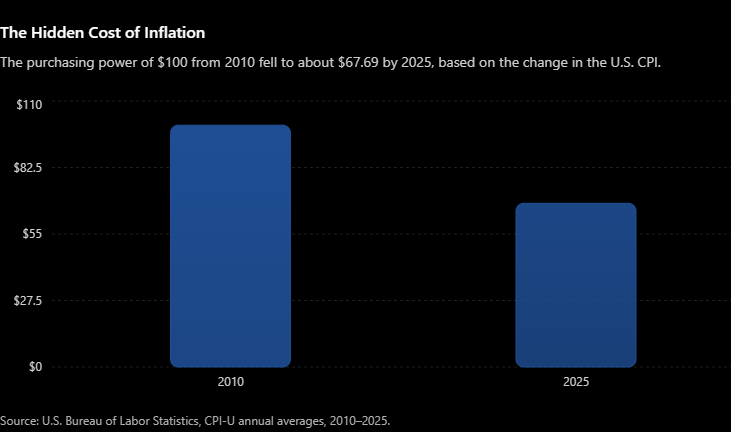
Inflation can reduce the real value of money even when its nominal balance does not fall.
Financial disclaimer: This article provides general educational information and is not personalized financial advice. Investment returns, risks, taxes, and regulations vary by market and individual circumstances.
How Diversification Can Balance Risk and Growth
Diversification means spreading money across different asset classes, sectors, markets, or securities rather than relying on a single investment.
The goal is not to eliminate risk. Instead, diversification can reduce the impact that poor performance in one investment or asset class has on the overall portfolio.
Alongside lower-risk assets, some investors may consider growth-oriented investments such as broad-market index funds, dividend-paying stocks, and real estate.
Broad-Market Index Funds
Broad-market index funds provide exposure to a large group of companies through a single fund.
Rather than trying to select individual companies, an investor can gain exposure to an entire market or a broad segment of it. This can provide diversification and long-term growth potential while reducing the company-specific risk associated with holding only a few individual stocks.
However, index funds are still subject to market risk. Their value can fall significantly during market downturns, and past performance does not guarantee future results.
Investors should also consider the fund’s fees, tracking methodology, tax implications, and underlying holdings.
Dividend-Paying Stocks
Dividend-paying stocks can provide two potential sources of return: dividend income and capital appreciation.
Companies may distribute part of their earnings to shareholders through dividends. But dividends are not guaranteed, and companies can reduce or eliminate them.
Individual stocks also carry company-specific risk. A business can experience declining earnings, competitive pressure, regulatory challenges, or other events that affect its share price.
For that reason, dividend-paying stocks can potentially complement a diversified portfolio but should not automatically be treated as low-risk investments simply because they pay dividends.
Real Estate
Real estate assets and REITs can provide potential rental income and long-term appreciation.
It can also provide diversification because property performance does not always move in exactly the same way as financial markets.
However, real estate has its own risks and costs, including:
- Maintenance and repairs
- Property taxes
- Insurance
- Vacancies
- Financing costs
- Transaction costs
- Local market conditions
- Lower liquidity than publicly traded securities
Investors can therefore consider real estate as another component of a broader strategy rather than assuming that property automatically provides safe, high returns.
Depending on the country and applicable account rules, investors may also hold stocks, bonds, and funds through retirement accounts. The account is a tax or legal structure; the underlying investments determine much of the portfolio’s risk and return characteristics.
The Challenge of Managing a Diversified Portfolio
Diversification can improve how an investor manages risk, but it also creates a practical problem: more information needs to be monitored.
An investor might hold Treasury securities, a high-yield savings account, a brokerage account, index funds, individual stocks, and real estate across different institutions or platforms.
Each account may display different information, such as:
- Account balances
- Interest rates
- Bond yields
- Asset prices
- Portfolio allocations
- Investment performance
- Market indicators
Reviewing each account separately can make portfolio monitoring more time-consuming.
Some investors may respond by maintaining spreadsheets or manually recording balances. While this can work for a small portfolio, keeping information synchronized across multiple accounts can become increasingly difficult as the number of investments grows.
The issue is not necessarily a lack of investment information. It is having that information in one useful view.
How a Unified Investment Dashboard Simplifies Portfolio Tracking
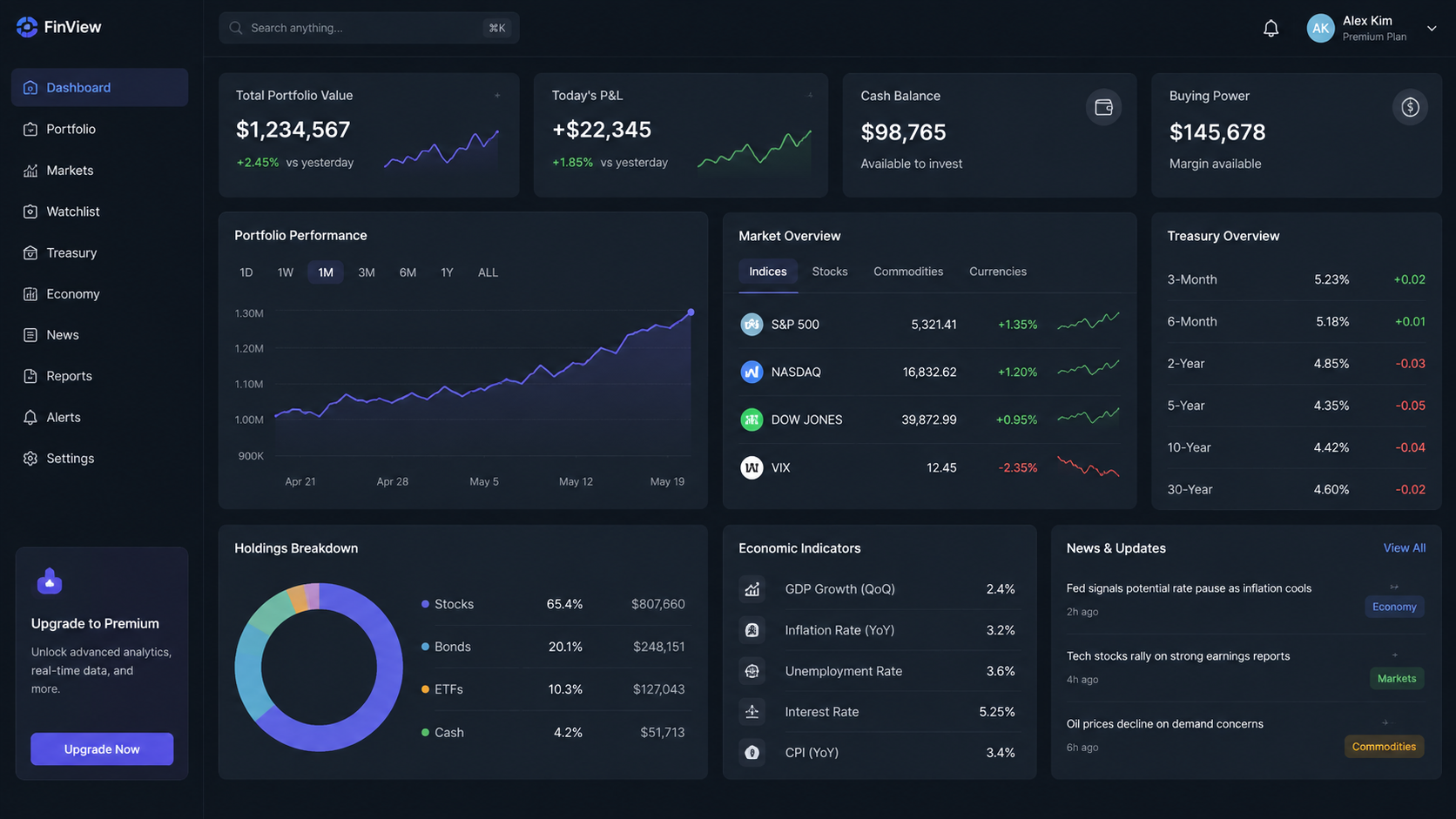
A centralized investment dashboard can make it easier to view portfolio information without switching between multiple platforms.
Instead of repeatedly checking individual accounts, investors can use a unified interface to monitor relevant investment and market information in one place.
A dashboard can potentially bring together information such as:
- Multiple asset classes
- Portfolio positions
- Bond yields
- Stock movements
- Macroeconomic indicators
- Portfolio-level information
- Relevant market data
The exact functionality depends on the platform, so investors should verify which assets, data sources, integrations, and update frequencies are actually supported.
From Multiple Screens to One View
Consider an investor who wants to check a Treasury position, review stock-market movements, monitor portfolio performance, and look at broader economic indicators.
Without a centralized tool, this information may require several websites, applications, or spreadsheets.
A unified dashboard can reduce the need to switch between those sources and manually consolidate information.
That does not make investment decisions automatically. Instead, it can make the information-gathering process more efficient, giving investors a clearer view of the information they use when reviewing their portfolios.
Reducing Repetitive Portfolio Tasks
Portfolio management can involve repetitive activities such as checking different platforms, comparing balances, copying figures into spreadsheets, and reviewing market movements.
A centralized view can reduce some of this manual work by bringing relevant information together.
The value is particularly apparent as a portfolio becomes more diversified. The more accounts and asset classes an investor monitors, the more useful a consistent overview can become.
Software disclaimer: The dashboard is a data and portfolio-tracking tool. It does not provide personalized financial advice or guarantee investment results. Past performance does not guarantee future results.
Turn Portfolio Tracking Into a Recurring Revenue Opportunity
Portfolio-tracking technology can also have applications beyond personal investment management.
If a platform supports features such as white-labeling, reseller functionality, sub-accounts, or subscription management, entrepreneurs and businesses may be able to offer a customized portfolio-tracking experience to their own audiences.
For example, a financial educator, investment community, advisory business, or content creator could potentially use a customizable platform to provide portfolio-monitoring functionality as part of a paid service.
The business model could involve subscription fees or other recurring SaaS revenue, depending on the platform’s capabilities and commercial terms.
The opportunity is not a guaranteed source of income. Its viability depends on factors such as:
- Who the target customers are
- What functionality they receive
- How much customization is available
- How subscriptions are structured
- What the platform provider manages
- Customer acquisition and retention costs
Before presenting this as a business opportunity, it is important to verify that the specific platform actually supports white-label, reseller, sub-account, and recurring subscription functionality.
Applying Investment Principles to Business Technology
Investment decisions are not limited to personal finances. Businesses also invest capital with the expectation of generating measurable value.
Companies may invest in software, automation, infrastructure, data systems, cybersecurity, and other technologies to improve efficiency, reduce costs, increase visibility, or support future growth.
This creates a useful connection between investment thinking and business technology.
Digital Transformation Strategies
Effective digital transformation strategies help businesses determine how technology can support broader operational and financial objectives.
For example, a transformation strategy might prioritize:
- Automating repetitive processes
- Improving data visibility
- Reducing operational costs
- Connecting disconnected systems
- Improving customer experiences
- Creating scalable workflows
The objective is not simply to purchase new technology. It is to determine where technology can create measurable business value.
Digital Transformation Services
Once priorities have been identified, digital transformation services can help businesses implement the required technologies and processes.
Depending on the organization, this could involve software implementation, system integration, automation, data management, cloud technologies, or workflow redesign.
The right implementation approach depends on the company’s existing technology environment, resources, objectives, and constraints.
Digital Transformation Consultation
Digital transformation consultation can help businesses evaluate technology priorities before committing significant resources.
A consultation can be useful when a company needs to determine which processes should be automated, which systems need to be modernized, or where technology investments are most likely to deliver measurable value.
The same principle applies to both financial and technology decisions: a good investment is not necessarily the one with the biggest headline return. It is the one that aligns with the objective, risk tolerance, resources, and time horizon.
How to Choose the Right Investment Mix
Rather than searching for one perfect investment, investors can evaluate how different assets work together.
A practical framework includes:
- Define your financial goal. Determine whether the priority is capital preservation, income, growth, or a combination.
- Determine your investment time horizon. Money needed soon may require a different approach from money intended for long-term goals.
- Build an appropriate emergency reserve. Accessible cash can help reduce the need to sell long-term investments unexpectedly.
- Assess your tolerance for losses. Consider how you might respond if part of your portfolio declined substantially.
- Consider inflation and purchasing power. Evaluate whether potential returns are sufficient to meet your long-term objectives after considering inflation.
- Compare fees, taxes, liquidity, and expected returns. The headline yield or return is only one part of the decision.
- Diversify across suitable assets. Combining different asset classes can help avoid excessive dependence on a single source of return or risk.
- Review and rebalance periodically. Portfolio allocations can change over time as markets move and financial circumstances evolve.
There is no universal allocation that works for every investor. The appropriate mix depends on individual circumstances and may change as goals, income, time horizon, and risk tolerance change.
Final Thoughts
No investment simultaneously provides the highest possible return and the lowest possible risk.
Lower-risk options such as Treasury bills, high-yield savings accounts, CDs, TIPS, and short-term government bond funds can provide stability, liquidity, or income. Growth-oriented assets such as broad-market index funds, dividend-paying stocks, and real estate may offer greater long-term return potential but also introduce additional risk.
That is why the more useful question may not be, What is the safest investment with the highest return? Instead, investors can ask how different investments can work together to balance safety, liquidity, income, inflation protection, and growth.
As portfolios become more diversified, keeping track of accounts, asset prices, yields, and market information can become more demanding. A centralized investment dashboard can simplify that process by bringing relevant information into one place.
And for businesses, the same investment mindset can extend to technology decisions: identify the objective, evaluate the trade-offs, measure potential value, and choose solutions that support sustainable growth.