

Every day, a patient walks into a specialist’s office while their primary care notes sit locked in a different system across town. A nurse documents a drug allergy in one platform that never syncs to the pharmacy module. A discharge summary takes 48 hours to reach the next provider. These are not edge cases. They are daily operational realities inside U.S. healthcare networks that still rely on disconnected, siloed technology.
The business cost of that fragmentation is staggering. Duplicate healthcare services alone cost the U.S. healthcare system an estimated $200 billion annually, with information inaccessibility identified as a primary driver.
This is exactly why hospital systems, multi-site physician groups, and integrated health networks across the United States are accelerating investment in centralized patient record tracking systems. The technology is no longer a roadmap item. It is a clinical and operational imperative.
What Is a Centralized Patient Record Tracking System?
A centralized patient record tracking system is a technology framework that consolidates patient information from multiple departments, facilities, and software platforms into a single, continuously updated environment. Every authorized provider sees the same record, in real time, regardless of which application originally captured the data.
A modern patient record management system typically brings together:
- Clinical documentation and physician notes
- Diagnostic reports and laboratory results
- Medication histories and allergy flags
- Treatment plans and care protocols
- Imaging and radiology records
- Appointment scheduling and referral activity
- Billing, coding, and administrative data
- Care coordination records across the continuum
This unified architecture transforms the electronic patient record system from a passive storage tool into an active clinical asset. Providers stop chasing records and start using them.
Healthcare leaders who have implemented centralized patient records consistently report that the shift changes how care teams operate. Decisions get made faster. Communication improves. Gaps in care become visible before they cause harm.
Why Fragmented Patient Records Create Operational and Clinical Problems
Most U.S. healthcare organizations run multiple software applications simultaneously. Hospitals typically operate an EHR, a billing platform, a laboratory information system, an imaging platform, a patient portal, and often a separate telehealth solution. These systems serve distinct functions well. What they fail to do, in most cases, is talk to each other reliably.
The result is information fragmentation, and it costs organizations far more than most executive teams realize.
Limited Visibility Across Care Settings
Patients routinely move between primary care, specialists, hospitals, rehabilitation facilities, and outpatient centers. Without centralized patient records, providers at each stop make decisions without the full clinical picture. Nearly 20% of patients experience an adverse event within three weeks of hospital discharge, and a significant portion of those events trace back to incomplete information transfers.
Duplicate and Inconsistent Data
When a patient information management system stores records in silos, duplicate entries multiply. Different departments hold different versions of the same patient data. Staff spend hours reconciling information that should have been consistent from the start.
Effective healthcare data management eliminates these inconsistencies at the source rather than managing their downstream consequences.
Delayed Clinical Decisions
Providers who cannot immediately access a complete patient history lose time during every encounter. In high-acuity settings, that delay is measured in patient outcomes, not just productivity metrics. A disconnected medical record tracking system does not just create friction; it creates clinical risk.
Poor Care Coordination
Care coordination depends on information sharing. Specialists who cannot see what the hospitalist documented. Discharge planners who cannot see what the SNF needs. These communication gaps extend the length of stay, increase readmissions, and drive up the cost per episode of care.
Key Features of Modern Patient Record Management Systems
Healthcare organizations evaluating a patient record management system should look beyond feature checklists. The right platform operationalizes data across the enterprise and connects to existing infrastructure without requiring wholesale replacement of functioning systems.
Unified Patient Profiles
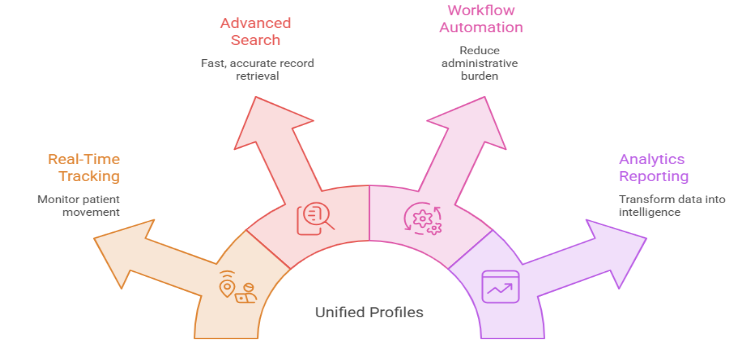
A unified patient profile draws information from every connected source into one longitudinal view. This is the architectural foundation of effective centralized patient record tracking systems; one record, one source of truth, accessible to every authorized provider.
Real-Time Patient Tracking
Modern patient tracking software enables healthcare organizations to monitor patient movement across the care continuum. Admissions, transfers, discharges, referrals, and follow-up activity all become visible in a single operational view. For multi-facility networks, this visibility transforms how care management teams work.
Advanced Search and Retrieval
Fast, accurate record retrieval directly affects clinical productivity. The best medical record tracking system surfaces relevant records in seconds, reducing the time clinicians spend on documentation review and increasing the time they spend on patient interaction.
Workflow Automation
Manual data entry and paper-based hand-offs introduce errors. Automation closes those gaps. Organizations using advanced workflow tools within their patient information management system consistently report reductions in administrative burden and improvements in documentation completeness.
Analytics and Reporting
Healthcare data management at scale generates enormous volumes of information. Analytics tools transform that raw data into operational intelligence; tracking outcomes, identifying high-risk patients, measuring utilization, and supporting value-based care reporting.
How Centralized Patient Record Tracking Systems Improve Patient Care
The clinical return on investment from centralized patient records is well documented. Organizations that implement connected, unified record systems report measurable improvements across multiple patient care dimensions.
- Faster Access to Critical Information: Providers review complete patient histories without switching between applications. When a physician in the ED can see the cardiology notes from last week’s outpatient visit, they make better decisions faster.
- Better Care Coordination: Connected information systems strengthen collaboration among physicians, nurses, specialists, and discharge planners. Care teams operate from a shared context, which reduces duplicated effort and closes hand-off gaps that currently lead to preventable readmissions.
- Reduced Medical Errors: Accurate, centralized records reduce duplicate testing, prevent medication conflicts, and eliminate documentation discrepancies. This directly and measurably improves patient safety outcomes.
- Improved Patient Experiences: Patients interacting with providers who already have their complete history report stronger satisfaction. They spend less time repeating themselves and more time receiving coordinated, personalized care.
The Role of Healthcare Interoperability Solutions
The U.S. healthcare IT market was valued at $312.92 billion in 2024 and is projected to reach $981.23 billion by 2032, growing at a CAGR of 15.7%. North America accounts for over 42% of that market. The investment is significant, and much of it is being driven by the demand for healthcare interoperability solutions that make centralized data strategies actually function in the field.
Healthcare interoperability solutions allow different technology platforms to exchange information securely, accurately, and without manual intervention. They are the connective tissue between systems that were not originally designed to work together.
Without healthcare interoperability solutions, organizations experience:
- Persistent information silos despite multiple EHR implementations
- Duplicate patient records that consume staff time and create clinical risk
- Delayed access to clinical data during high-stakes care moments
- Increased administrative workload for record reconciliation
- Reduced effectiveness of care coordination programs
With interoperability, patient information follows the patient. Data generated during a specialist visit reaches the primary care physician before the patient even leaves the building. Lab results flow directly into the clinical workflow without a fax machine in between.
For healthcare organizations investing in centralized patient record tracking systems, interoperability is not a feature. It is the technical foundation that makes centralized visibility possible across a distributed care network.
If your organization is operating multiple platforms that do not communicate reliably, Unique Software Development builds healthcare interoperability solutions that integrate your existing systems without disrupting clinical workflows. Our team understands both the technical and regulatory complexity of healthcare data exchange.
Why Custom Healthcare Software Delivers Better Long-Term Value
Off-the-shelf patient record management systems are built to serve a broad market. Healthcare organizations that operate complex workflows, manage multiple facilities, run specialized departments, or carry legacy system infrastructure frequently discover that generic platforms create as many problems as they solve.
Custom healthcare software aligns technology with your operations, not the other way around. Organizations that partner with experienced development teams to build purpose-built solutions gain:
- Direct integration with existing infrastructure without forced migrations
- Workflow design that reflects actual clinical and administrative processes
- Reporting and analytics built around your specific operational metrics
- Scalability paths designed around your growth strategy
- Ongoing support from a team that understands your environment
Unique Software Development works with hospitals, health systems, and multi-site healthcare organizations to design and build centralized patient record tracking systems and healthcare data management platforms that integrate with your existing infrastructure. If your current systems are creating gaps in visibility, care coordination, or compliance, that is a problem we solve.
Looking Ahead
The global EHR market is projected to grow from $29.84 billion in 2025 to $45.55 billion by 2035. That trajectory reflects a healthcare industry that has accepted the digital transformation of patient information as permanent infrastructure, not a temporary initiative.
The organizations positioned to lead in this environment are those investing now in centralized patient records, healthcare interoperability solutions, EHR integration solutions, and enterprise healthcare data management capabilities. Not because regulators require it, but because connected information is the operational foundation of every other clinical and strategic priority.
Patient safety, care quality, operational efficiency, financial performance, and workforce productivity all improve when providers work from a shared, accurate, complete picture of the patient. That picture only exists inside centralized patient record tracking systems built on sound architecture, strong integration, and real clinical understanding.
The future of healthcare runs on connected data. The organizations building that connection today will define how care is delivered tomorrow.