

Selecting a warehouse management system or WMS is no longer a simple back-office software procurement task. For high-growth enterprise operators and mid-market supply chain logistics, it is a high-stakes choice that directly impacts margins, long-term capital efficiency, and scaling capacity. With the new investment projections of $30 billion, there’s limitless potential for growth.
The choice is mainly split into two models: custom WMS software vs SaaS WMS. Cloud-based Software-as-a-Service platforms offer rapid implementation and predictable baseline expenses. However, relying on an external multi-tenant infrastructure introduces long-term liabilities. It poses seat-license cost inflation, vendor lock-in, and forced process alterations that destroy an enterprise’s unique competitive advantages.
For complex logistics hubs juggling heavy distribution metrics across regional centers, deploying a proprietary, custom warehouse inventory management system offers absolute control. The best solution is custom software development. It eliminates recurring licensing fees, offers total data security, enhances control, and ensures maximum ROI.
Custom WMS Software vs SaaS WMS
The primary argument for choosing a subscription-based platform is the preservation of initial capital. There’s a single goal: to avoid upfront development costs. It looks brilliant on a quarterly balance sheet. However, a deeper look at the long-term total cost of ownership reveals a massive financial pivot. That’s why enterprises rarely invest in SaaS platforms. Costs eventually rise, outgrowing the total investment of developing custom software.
The SaaS Illusion: How Scaling Erodes Long-Term ROI
SaaS pricing structures have many variables. They track the number of users, transaction volumes, barcode scans, and API access. In warehouses with fewer users, the cost is usually affordable. It feels safe. But as an enterprise scales to hundreds of pickers, packers, dispatchers, and supervisors across multiple regions, recurring fees explode. They scale linearly and indefinitely.
It creates a persistent, compounding drain on your profitability. Costs usually explode in peak seasons when demand is high. An additional workforce increases the expense of license bundles, and you burn capital for basic operations.
Amortization of Proprietary Asset Ownership
In contrast, custom software development is an investment to build an asset. After deployment, the only expense is maintenance. You only cover basic server hosting and IT support. One efficient way to optimize resource allocation and control costs is through AI automation. Smart warehouses with custom IoT infrastructure and connectivity facilitate robotic automation, autonomous stock handling, and smart dispatch.
With a typical 36- to 60-month amortization period, the financial benefit of a custom platform becomes clear. It pays off heavily. Every single internal optimization, extra user profile, and new facility integration is executed without incurring a penny in incremental fees, allowing your logistics network to scale cost-effectively.
Year-on-Year Cost Comparison – Custom WMS Software vs SaaS WMS
| Timeline | Custom Software | Off-the-shelf Cloud SaaS | Strategic Financial Impact / ROI Shift |
|---|---|---|---|
| Year 1 | $475,000 (Dev: $450k + $25k Hosting) |
$111,000 (50 users + Vendor Setup) |
SaaS appears cheaper. Custom requires significant initial investment, while SaaS preserves immediate cash flow. |
| Year 2 | $25,000 (Hosting & Baseline Maintenance) |
$141,750 (75 users + 5% Vendor Price Hike) |
The Inflection Point Begins. Custom ongoing costs drop drastically. SaaS costs spike due to headcount scaling and price increases. |
| Year 3 | $20,000 (Minor Optimization + Infrastructure) |
$207,900 (100 users + Tiered Volume Upcharges) |
Custom Achieves Parity. Cumulative SaaS costs ($460,650) officially cross the total development cost of custom software ($450,000). |
| Year 4 | $30,000 (Infrastructure Scale) |
$283,500 (125 users + Advanced API Fees) |
SaaS Scaling Penalty. The enterprise pays a steep margin penalty simply for adding headcount and scaling operations. |
| Year 5 | $50,000 (System Audit & Upgrades) |
$378,000 (150 users + Peak Season Overages) |
Uncapped Margin Erosion. Cumulative 5-Year SaaS cost reaches $1,122,150, compared to an overall 5-Year investment of $600,000 in Custom Solution. |
Operational Autonomy vs. Forced Process Alteration
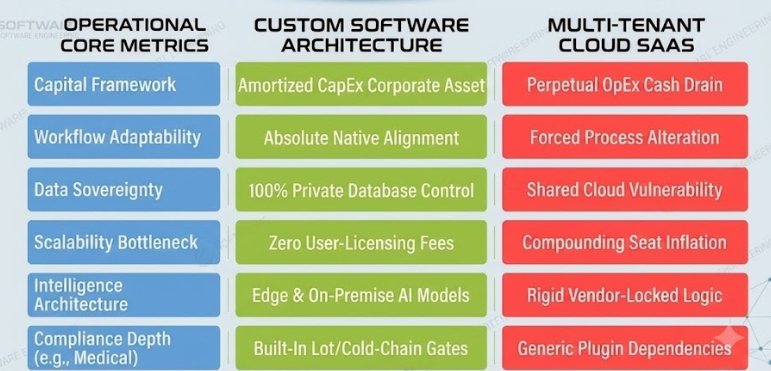
Each warehouse has a distinct workflow, pick-path logic, and slotting strategy, which is a unique competitive edge. Choosing between a custom proprietary architecture and an off-the-shelf solution depends heavily on how much operational friction your supply chain can tolerate. Here is a quick review of competitive penalties, vulnerabilities, and regulatory safeguards for Custom WMS Software vs SaaS WMS.
Competitive Penalty of Standard Enterprise Supply Chain Solutions
Multi-tenant SaaS products are engineered for the average user, built around standard, rigid workflows. If you handle special kitting protocols, value-added services, temperature-sensitive routing zones, or complex cross-docking matrices, generic software platforms typically fall short.
When a system covers only 75% of your native requirements, the vendor advises altering your physical workflow to match the software’s flow. Forcing a high-velocity warehouse to modify its optimized processes simply to satisfy a software configuration destroys efficiency. It introduces order latency and compromises core marketplace advantages.
Multi-Tenant Vulnerabilities and the Demand for Enterprise Security
In an industry driven by strict compliance and data security, where supply chain transparency is non-negotiable, relying on shared cloud servers poses external risk. Hosting critical transaction history, client details, and proprietary operational flowcharts on a multi-tenant framework exposes your organization to downstream supply chain vulnerabilities.
Engineering a proprietary, closed-loop security for data protection eliminates this exposure. Custom development allows your organization to implement absolute data sovereignty. Internal teams set security parameters, execute protocols, maintain compliance, and protect ownership.
Regulatory Safeguards within Healthcare Inventory Management
The highest level of control is critical for industries with strict regulatory requirements, such as medicine or food. Operating a healthcare inventory management system through SaaS is very risky due to strict policies for tracking, expiration, cold-chain monitoring, and audits.
Custom solutions allow embedding validation checks into the code. It ensures that every asset, device, and shipment is logged and verified as per Federal and State guidelines.
Migration Architecture for Warehouse Scaling
Modern digital supply-chain hubs rely on integrations with legacy systems and third-party tools. The software must qualify for zero downtime while also having a solid migration plan for scaling.
Whatever tech you choose must also support user-friendliness and a frictionless experience. This way, fewer resources get the most work done, keeping costs in check. This section explains the role of cloud integrations, on-premise models, and the shift from SaaS to custom.
Direct Integrations Over Cloud Inventory Management Ecosystems
Warehouses can’t afford friction. They must sync perfectly with ERPs, CRMs, Transportation Management Systems, and third-party shipping networks. Unfortunately, most ready-made cloud inventory management systems lean on generic, out-of-the-box integrations. The result? Frustrating data latency or massive bills for premium high-priced APIs.
Custom software development fixes this mess through targeted solution engineering. By deploying provisional APIs and custom-built data pipelines, you slash database latency down to zero. That speed is non-negotiable for high-speed picking, instant real-time adjustments, and automated sorting. Suddenly, your applications are talking to each other in real time, catching and fixing data errors on the fly.
On-Premise AI Inventory Management Models and AI Forecasting
A generic inventory management system treats your warehouse like a static spreadsheet, relying heavily on manual data entry just to keep track of basic stock levels. Custom solutions are completely different. They learn. They adapt. They actually think ahead. By embedding machine learning and AI forecasting directly into your workflow, stockouts and costly over-ordering finally become a thing of the past.
Today’s busiest logistics hubs are aggressively deploying AI frameworks to automate their entire inventory controls and ordering processes. They don’t rely on generic tools; they use dedicated on-premise or cloud AI models.
A custom solution built for automation and scaling from day one integrates these AI inventory management models straight into its core design. It runs internally, quietly watching everything. It maps out patterns in real time to navigate massive load spikes and seasonal demand shifts without breaking a sweat. The ultimate goal of these on-premise solutions is simple: automate your replenishment orders and predictive slotting behind closed doors, without ever exposing your data to public networks. When choosing between on-premise and cloud infrastructure, it is best to consult professional agencies.
Strategic Workflows: When to Transition from SaaS to Custom Software
How do you know when it’s time to ditch your standard cloud ecosystem? The exact operational scale required to make the move depends entirely on your long-term growth forecasts. Look at it realistically: a baseline subscription model makes total sense for an early-stage startup or a simple, single-facility operation. It gets the job done.
But things change fast. The moment your business scales into a true omnichannel model, takes on complex third-party logistics, or juggles thousands of unique SKUs across multiple regions, those SaaS constraints turn into a massive growth bottleneck. Smart operations directors spot these warning signs early. Recognizing the ceiling allows you to map out a proactive engineering roadmap well in advance. That way, you completely avoid the chaotic, emergency migrations that happen when a rigid SaaS platform suddenly buckles under high transaction volumes.
Develop a High-Yield, Scalable Warehouse Infrastructure
Renting a generic subscription software forces your enterprise to compromise on operational efficiency. You wind up bending your processes to fit their tool. Building a custom, high-performance warehouse management system reverses that dynamic, obliterating the administrative bottlenecks and hidden profit leaks that quietly drain complex logistics chains.
This reduces the Custom WMS Software vs SaaS WMS debate to a logical conclusion of choosing customization. Investing in secure proprietary software is the cleanest path to enterprise application integration with your existing ERP. Best of all? It completely eliminates recurring user seat-licensing fees while locking in maximum long-term supply chain ROI.
At Unique Software Development, we design and deploy custom software development solutions tailored specifically for ambitious logistics enterprises. We handle the heavy lifting: proprietary AI integration, advanced route & load optimization, and agile web app development. Stop settling for platforms you don’t own. Reach out to us with your ideas, queries, or operational challenges today, and let’s build an infrastructure optimized for pure growth.