

If your organization handles patient health data, HIPAA compliance is not something you can afford to treat as a once-a-year checkbox. The regulatory environment has tightened significantly. HHS Office for Civil Rights (OCR) enforcement has hit historic highs, and healthcare data breaches now cost an average of $7.42 million per incident, remaining the most expensive sector for data breaches for 15 consecutive years.
The reality? Most organizations with documented policies still have serious compliance gaps at the application level. Cloud environments change. Integrations multiply. Access permissions drift. That is why smart compliance leaders are moving away from passive policy reviews and toward active, application-level HIPAA auditing. This article also features a HIPAA compliance checklist for secure healthcare apps that would help auditors and compliance managers. If you are looking for custom HIPAA compliance software, you may skip to the last section.
What Is a HIPAA Compliance Audit and Why Does It Matter?
A HIPAA compliance audit is a structured, evidence-based examination of how your systems, applications, and people handle Protected Health Information (PHI). It goes far beyond a baseline policy review to evaluate whether your technical controls, administrative processes, and physical safeguards actually function in production.
HIPAA auditing covers three core pillars:
- Administrative safeguards: Workforce training, risk analysis, security policies
- Technical safeguards: Access controls, encryption, audit logs
- Physical safeguards: Device security, facility access, workstation controls
The OCR conducts HIPAA audits under the HITECH Act. They can audit covered entities and business associates at any time, not just after a data breach. The question is not whether your application will face scrutiny, but whether your architecture will be ready when you do.
HIPAA compliance is an ongoing operational state, not a one-time destination. That is a critical distinction most organizations miss until a security incident forces the issue.
The Best Way to Audit an Application for HIPAA Compliance
The ways to audit an app for HIPAA Compliance:
Define the Scope Before You Start
Unfocused audits waste engineering resources and miss real risks. Before running a single vulnerability scan, define exactly what falls within your compliance boundary.
Identify Every Application That Touches PHI
Start with a full inventory. List every application that directly handles patient records, such as EHRs, billing systems, telehealth platforms, and patient portals. Then, identify indirect exposure points: analytics dashboards, internal data pipelines, and reporting tools. Both categories carry equal compliance risk.
Map Data Flow Across Systems
Where does PHI enter your environment? How does it move between microservices? Where does it exit? Map every API connection, database query, and third-party data transfer. Cloud-to-cloud integrations are a common blind spot in application architecture. Custom HIPAA compliance software can map your workflows and data flow with the highest accuracy.
Review Every Vendor and Integration
Each vendor with access to PHI is a business associate under HIPAA. This requires a signed Business Associate Agreement (BAA) and technical validation of their security controls. Many organizations sign a BAA and never verify the underlying compliance, a gap that OCR auditors explicitly look for. When building these ecosystems, understanding the Key Traits of the Best Software Development Companies helps you choose partners who natively design secure, ring-fenced integrations.
Assign Clear Ownership
Compliance does not happen by committee. Assign named technical owners across engineering, DevOps, and compliance teams for each system component. Accountability during remediation is where most audit programs break down.
Perform a Technical HIPAA Security Audit
The technical HIPAA security audit is where most compliance risks are either caught or missed entirely. This section requires functional, rigorous testing of your active controls.
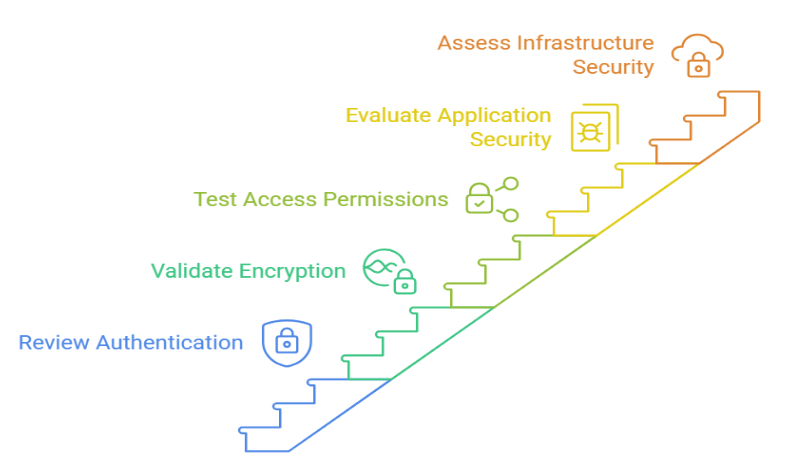
Review Authentication Controls
Multi-factor authentication (MFA) is mandatory for any system containing ePHI. Beyond MFA enforcement, audit your session timeouts, identity federation settings, and single sign-on (SSO) configurations. Weak authentication mechanisms remain the leading entry point for malicious actors.
Validate Encryption Standards
HIPAA requires “appropriate” encryption mechanisms. In 2026, this means utilizing AES-256 at rest and TLS 1.3 in transit (with TLS 1.2 maintained only as a legacy baseline). Audit your database storage, backups, and message queues separately. Review your key management life cycle: check how keys are rotated, where they are stored, and what mitigation steps occur during a suspected key compromise.
Test Access Permissions
The principle of least privilege should govern your entire application stack. Run a comprehensive permissions audit to check who has access, what level of access they hold, and whether that access remains justified. Actively look for privilege escalation paths, shared credentials, and dormant developer accounts.
Evaluate Application Security
Run vulnerability assessments against every application in scope. Review secure coding practices, dependency management, and patch status. Check specifically for SQL injection, cross-site scripting (XSS), and insecure API endpoints. Your audit should combine automated static application security testing (SAST) with manual code reviews for critical modules.
Assess Infrastructure Security
Cloud misconfigurations introduce severe data exposure vectors. Review your AWS, Azure, or GCP security postures for public storage bucket exposure, misconfigured security groups, and unencrypted snapshots. Validate server hardening, backup isolation, and disaster recovery execution procedures.
Review HIPAA Audit Controls and Logging
Under 45 CFR § 164.312(b), HIPAA audit controls require organizations to implement mechanisms that record and examine activity in information systems containing or using ePHI. Gaps in your log management are treated by regulators as clear evidence of non-compliance.
What Should Be Logged
Every single interaction with PHI must generate an immutable log entry. This includes successful and failed login attempts, database queries, file downloads, permission modifications, and administrative actions.
Required Retention
HIPAA mandates documentation retention for six years from its creation date. While active SIEM tools cycle hot data frequently, ensure you have an automated archiving pipeline to push historical compliance documentation and audit trail summaries to long-term cold storage.
User Activity Monitoring
Log collection is the baseline, not the goal. Your security team must actively monitor access patterns. Implement real-time behavioral alerts for anomalous access times, bulk data exports, or authentication attempts from unexpected geographic locations to stop insider threats early.
Evidence Integrity
Logs are worthless if they can be altered or deleted by the very accounts they are tracking. Ensure your application logs are instantly streamed to an isolated, write-once-read-many (WORM) environment utilizing hash validation to guarantee data integrity.
Apply the HIPAA Audit Protocol Systematically
The OCR’s official HIPAA audit protocol covers 169 specific audit procedures across Privacy, Security, and Breach Notification rules. You do not need to run all 169 procedures for every application audit, but you do need a structured operational framework.
| Domain | What to Review | Evidence Required |
|---|---|---|
| Administrative Controls | Policies, training records, risk assessments | Written policies, employee training completion logs |
| Technical Controls | Authentication, encryption, and access controls | Production system configs, vulnerability scan results, and access reports |
| Audit Logging | Log completeness, retention, and WORM integrity | Log samples, retention policies, and SIEM monitoring alerts |
| Incident Response | Response plans, testing history, escalation paths | Documented IR plans, tabletop exercise records |
| Vendor Management | BAAs, third-party vendor security reviews | Signed BAAs, independent vendor assessments |
| Risk Management | Risk registers, vulnerability remediation tracking | Active risk assessment documentation, remediation timelines |
For each domain, collect your evidence before an official audit begins. Organizations that scramble to assemble documentation during an active OCR investigation run a much higher risk of penalization.
HIPAA Compliance Checklist for Secure Healthcare Apps
A practical HIPAA compliance checklist helps healthcare organizations consistently verify that their applications, infrastructure, and operational processes remain aligned with regulatory requirements. While no checklist replaces a formal audit, reviewing the following items every quarter helps identify compliance gaps before they become security incidents or audit findings:
Governance Controls
- Named compliance owner assigned to each PHI-handling system.
- Security and privacy policies reviewed and approved within the last 12 months.
- Comprehensive risk assessment executed annually.
- An active risk register has been established with documented remediation tracking.
Security Controls
- MFA is strictly enforced for all internal and external system access.
- Encryption standards validated at rest (AES-256) and in transit (TLS 1.3).
- Least-privilege access permissions reviewed and documented.
- Vulnerability scans and dependency checks are automated in the CI/CD pipeline.
- The patch management process is actively applied to all production servers.
Audit Logging
- Logging is enabled across all applications, databases, and cloud infrastructure.
- Log archiving is configured to meet the 6-year documentation retention standard.
- Behavioral monitoring alerts are configured and tested for anomalous activity.
- Write-protected, tamper-evident storage is enabled for all audit trails.
Incident Response
- Incident response plan updated with clear HIPAA breach notification procedures.
- Tabletop testing exercises have been conducted within the last 12 months.
- Escalation paths defined directly to legal, engineering, and compliance leadership.
Vendor Management
- Valid BAAs signed and archived for every third-party service touching PHI.
- Vendor security postures are reviewed annually.
- Automated vendor access provisioning and de-provisioning processes validated.
Translate to Business Impact: Inflation-adjusted annual caps for HIPAA violations can reach up to $2,190,294 per tier violation category. Frame your findings in these financial terms. Connecting application vulnerabilities directly to breach mitigation costs, cyber insurance premiums, and patient market trust commands executive attention far better than a raw list of bugs. Follow our HIPAA compliance checklist to ensure the security of healthcare apps.
Ready to close your compliance gaps before your next audit cycle?
Unique Software Development’s HIPAA compliance consulting team helps healthcare organizations build secure, audit-ready applications from the ground up, reducing risk while supporting long-term regulatory compliance.
HIPAA Compliance Best Practices for Application Teams
The most secure healthcare organizations do not treat HIPAA auditing as a periodic project; they treat it as an ongoing operational discipline.
- Move from Annual Reviews to Continuous Compliance: Annual HIPAA audits show your security posture on a single day out of the year. Continuous monitoring shows your posture every second. The space between those two models is where data breaches occur.
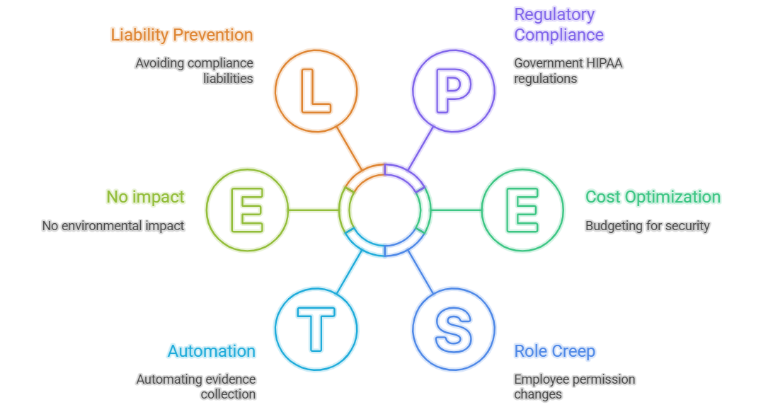
- Automate Evidence Collection: Manual evidence gathering is slow, expensive, and error-prone. Build automated compliance logging, infrastructure-as-code (IaC) scanning, and automated report generation directly into your cloud environments.
- Review Access Quarterly: Role creep occurs naturally as engineering teams scale. Employees shift projects, vendors finish contracts, and permissions remain behind. A rigorous, quarterly access review catches over-privileged accounts before they present a compliance liability.
- Build Audit Readiness into Development Cycles: Every new feature or API endpoint that interacts with PHI should undergo a security and privacy review before deployment, not months after. Integrate security champions directly into your sprint planning cycles. Security teams must account for rising Mobile App Development Costs by baking security architecture early into the budget, keeping code compliant without exploding development cycles. This forward-looking mindset is a defining characteristic of elite Web App Development Companies in 2026.
- Track Remediation Metrics: Monitor how long it takes your engineering teams to patch a critical or high vulnerability. Tracking these metrics tells you whether your risk management program is actively improving or stagnating.
Common HIPAA Audit Requirements Organizations Miss
Compliance failures rarely stem from a total lack of policy knowledge. They occur due to inconsistent technical execution. The OCR frequently identifies these common mistakes:
- Weak Access Governance: Provisioning access is simple; de-provisioning or reviewing it is frequently forgotten. Former employees retaining system credentials or teams relying on shared database passwords represent the most common Security Rule violations.
- Missing Logs and Evidence: Many organizations claim they log all access to patient data, but cannot produce the immutable audit trails when requested by an investigator. In a regulatory review, a lack of documentation is treated as a lack of compliance.
- Incomplete BAA Coverage: Overlooking secondary integrations happens easily. Cloud hosting providers, third-party analytics tools, CRM extensions, and SaaS communication platforms all require thorough BAA verification if they transmit or store ePHI.
- Delayed Remediation: Discovering a security vulnerability and leaving it unpatched for months can be interpreted by regulators as willful neglect, which triggers the highest tier of financial penalties.
- Lack of Ongoing Infrastructure Monitoring: Conducting an annual audit while ignoring configuration changes during the other 364 days leaves a massive window of vulnerability for modern cloud applications.
Need help building an application compliance program that works year-round?
Our team at Unique Software Development designs custom healthcare software with enterprise-grade HIPAA security controls baked directly into the codebase, helping you stay secure, compliant, and audit-ready throughout the year.
Get a Custom HIPAA Compliance Software for Your Workflows
Off-the-shelf solutions can help with individual compliance tasks, but they rarely align perfectly with your organization’s workflows, integrations, or security requirements. Investing in HIPAA compliance software that is purpose-built for your environment allows you to embed encryption, role-based access controls, audit logging, and secure data management directly into your daily operations rather than relying on disconnected tools.
At Unique Software Development, we provide custom web app development services for healthcare organizations, designing scalable applications that support regulatory requirements from the architecture stage through deployment and ongoing maintenance. If you’re modernizing an existing platform or building a new one, our team develops custom HIPAA compliance software. One that actually adheres to your operational needs and workflows, helping simplify audits while strengthening long-term security.
Pairing a custom-built solution with a structured HIPAA compliance checklist also makes it easier to monitor controls, document evidence, and maintain continuous compliance as your systems and business evolve.