

You approved the budget. The vendor promised 10–15% freight cost savings. Twelve months later, finance is asking what the transport management software actually returned, and nobody has a clean number.
Only 24% of companies can demonstrate the financial impact of their transportation software after go-live, per EVEREST’s 2025 logistics analysis. The other 76% are guessing.
The issue isn’t the software. It’s that most ROI tracking stops at freight cost reduction, one metric borrowed from a vendor’s sales deck. That number doesn’t capture what transportation software actually does to your P&L.
This guide covers the five metrics that decision-makers, CFOs, VPs of Operations, and fleet owners need to track before implementation, at go-live, and across the full lifecycle of any transportation software investment. And at the end, there’s a case for why generic TMS platforms structurally limit how high your transportation software ROI can go.
The One Baseline Metric You Need Before Anything Else
Before any software goes live, you need one number documented: Cost Per Shipment.
Cost Per Shipment is your total transportation spend, freight, admin labor, fuel, and handling, divided by the number of shipments processed in a given period. If you moved 4,000 shipments last quarter and spent $800,000 doing it, your Cost Per Shipment is $200.
Why this metric and not total freight spend? Total freight spend rises when volume rises; it tells you nothing about efficiency. Cost Per Shipment stays honest. It captures gains across freight rates, admin labor, fuel, and audit accuracy at once, and it moves in one clean direction regardless of market conditions or volume fluctuations.
Pull this number for the last 12 months before go-live. Break it down by lane, mode, and carrier. That’s your measurement anchor. Every other metric in this article feeds into it.
The teams that skip this step, measuring transportation software ROI after go-live with no baseline, end up with exactly the 76% problem above. They can feel the system is working, but they can’t prove it.
Freight Cost Reduction & the Hard Dollar Savings that Actually Matter
A properly configured transportation system reduces annual freight costs by 5–15% through carrier selection optimization, load consolidation, and route efficiency. On multi-tenant cloud platforms with real-time rate shopping, the upper range sits closer to 15–25%, according to Mordor Intelligence’s January 2026 market data.
Those percentages mean nothing without a number behind them. Here’s how it plays out at scale:
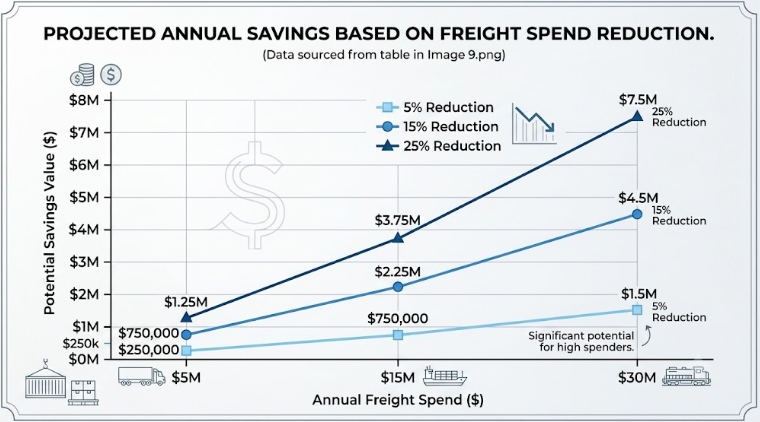
The range is wide because the outcome depends heavily on your current setup. The less digitized your operation is today, the more room there is to gain.
If you’re benchmarking ROI at the six-month mark and feeling underwhelmed, that’s by design, not a signal to change platforms.
What to track: Freight cost per shipment (the baseline metric), carrier rate vs. market benchmark, and load consolidation rate.
Admin Labor Cost per Transaction
Transportation management software typically delivers 20–30% administrative productivity gains, according to EVEREST. Priced out, that’s significant. Take a logistics operation where dispatchers and coordinators spend 35–40% of their time on tasks the software handles: quote assembly, carrier tendering, shipment tracking, and invoice reconciliation.
At a loaded labor cost of $65,000 per coordinator, a 25% productivity improvement across a team of six returns roughly $97,500 per year in recovered capacity alone.
That’s before accounting for error cost. Manual data entry errors in freight billing result in overpayment on affected invoices. With a team processing hundreds of shipments a week, that’s not a rounding error; it’s a budget line.
Custom-built transportation software closes this gap more effectively than generic platforms because the workflows are built around how your operation actually runs, not how the software vendor imagined it would run. Every process that doesn’t fit the off-the-shelf mold becomes a manual workaround, and manual workarounds are where time and margin disappear.
What to track: Admin hours per shipment, invoice error rate, percentage of processes that are touchless vs. manually handled.
Driver Turnover: The $10,500 Line Item Hiding in Your P&L
What Driver Turnover Actually Costs Per Year
The trucking industry runs at 90%+ annual driver turnover at major truckload carriers, per Geotab’s 2025 fleet analysis.
FleetRabbit’s April 2026 analysis puts the replacement cost per driver at $10,500, covering recruiting fees, onboarding administration, initial training, and the productivity gap during the first 60 days.
For a 50-truck carrier replacing 45 drivers per year, that’s $472,500 annually before service disruption or insurance premium changes from a less experienced driver population.
The Hidden Fuel Cost That Compounds the Problem
A 10% fuel efficiency differential between experienced and new drivers, conservative by most fleet standards, adds another $288,000 per year on that same 50-truck fleet running 120,000 miles annually at $0.48 per mile.
Add both together, and driver turnover is quietly costing that operation $760,500 per year. That figure almost never appears in a transportation software ROI calculation.
How Transportation Software Directly Reduces Turnover
The connection to software is more direct than most operators realize. Dispatch tools that factor in driver preferences and home time requirements cut the day-to-day frustration that pushes drivers toward competitors.
Mobile apps that simplify POD scanning and settlements remove the friction that new drivers hit hardest. Predictive maintenance keeps trucks running reliably, and drivers who trust their equipment stay longer.
Why the First 90 Days Are the Highest-Risk Window
Nearly 40% of driver turnover happens within the first 90 days. That’s the window where the technology experience either builds confidence or destroys it. A custom-built fleet mobile application shaped around your drivers’ actual workflow increases ROI in this window in a way off-shelf tools structurally can’t.
What to track: Voluntary driver turnover rate (quarterly), first-90-day attrition rate separately from overall turnover, and cost per replacement event.
Your operation has a driver turnover cost, a freight rate baseline, and an admin labor overhead that no generic TMS was built to address together.
Fuel Efficiency and Predictive Maintenance
Fuel is typically 60% of the total fleet operating budget. A 15% reduction in fuel costs, a consistently cited outcome of route optimization and driver behavior monitoring, directly increases profit margins at a scale most other transportation software ROI categories can’t match.
Route Optimization and Driver Behavior Coaching
AI-powered route planning reduces travel distances by 15–25%. Driver behavior monitoring, speeding, harsh acceleration, and excessive idling save an estimated $275+ per vehicle per month through coaching programs, per telematics industry data. On a 50-vehicle fleet, that’s $165,000 per year from behavioral coaching alone.
Predictive Maintenance (The Savings Nobody Budgets For)
Data-driven maintenance scheduling based on actual vehicle usage cuts unplanned downtime by 25%, extends vehicle lifespan by up to 20%, and saves $3,800+ per vehicle annually in avoided emergency repairs. For a 50-truck fleet, that’s $190,000 per year.
The Combined Impact on Your Bottom Line
Fuel efficiency plus maintenance optimization together increase ROI by $355,000 annually on a 50-truck operation, with no carrier negotiations, no contract renegotiations, and no market dependency.
This is where IoT hardware integration shifts from a visibility tool to a direct revenue lever. Real-time telemetry feeding into custom-built dispatch and maintenance logic, not bolted on as a third-party add-on, is what separates operations that capture these gains from those that see marginal results.
What to track: Fuel cost per mile, unplanned maintenance events per quarter, vehicle availability rate, and idle time percentage.
Freight Audit Recovery Rate
Between 20% and 25% of freight bills contain billing errors, costing businesses tens or even hundreds of thousands in unnecessary freight costs annually. Most of those errors go undetected because manual review can’t handle the volume.
Automated freight audit closes this gap. A working audit process protects 1–5% of total freight spend that would otherwise be lost to overbilling, duplicate charges, and rate discrepancies.
The table below shows how audit recovery compounds over three years on $10M in annual freight spend:
| Audit Recovery Rate | Year 1 | Year 2 | Year 3 | 3-Year Total |
|---|---|---|---|---|
| 1% recovery | $100,000 | $100,000 | $100,000 | $300,000 |
| 3% recovery | $300,000 | $300,000 | $300,000 | $900,000 |
| 5% recovery | $500,000 | $500,000 | $500,000 | $1,500,000 |
Note: Year-over-year figures reflect consistent audit performance. In practice, recovery rates improve in years 2–3 as audit logic is refined against carrier patterns, meaning the 3-year total is typically conservative.
That’s before accounting for the compounding effect: Clean audit data sharpens carrier performance scoring, which strengthens negotiation leverage, which lowers rates on future contracts. It’s a data quality improvement that increases profit on every subsequent cycle.
Off-shelf audit modules are designed for standard billing structures. When your carrier contracts, accessorial rules, or lane-specific pricing don’t fit the template, exceptions pile up and recovery drops. Custom-built audit logic, matched to your actual contracts, is what keeps recovery rates from eroding the moment your network gets complex.
What to track: Invoice error detection rate, overcharge recovery as a percentage of freight spend, and time-to-resolution on billing disputes.
Why Generic TMS Caps Your ROI & What Custom-Built Software Changes
Here’s the honest version of what most TMS vendors won’t tell you.
Off-Shelf Platforms Are Built for the Median Operation
Generic TMS platforms are engineered to serve the widest possible customer base. Their routing logic, carrier selection rules, and dispatch workflows are designed for the average fleet, which means they fit your specific operation imperfectly, at best.
The Result: A Hard Ceiling on Your Returns
When your workflows don’t match the software’s assumptions, teams build manual workarounds. Those workarounds quietly undo the efficiency gains the software was supposed to create and cap your ROI at whatever the platform’s standard configuration produces.
Custom Software Inverts This Entirely
The solution is engineered from scratch to match your specific freight model, dispatch logic, carrier relationships, and reporting requirements. Every workflow is your workflow. Every integration is purpose-built, not bolted on.
What Unique Software Development Builds
Not a transportation SaaS platform adapted to your needs, custom transportation software built from the ground up, shaped by your operation’s actual structure, from the first line of code. There’s no median to compromise toward.
The ROI Gap Is an Architecture Problem
EVEREST’s research found that companies that master their transportation software ROI grow 2.3x faster than competitors. That gap between the 24% who can demonstrate financial impact and the 76% who can’t is largely structural. Generic software creates generic outcomes. Custom software creates yours.
The Market Rewards Operations That Get This Right
The Transportation Management System market is projected to reach $68.4B by 2033, growing at 17.8% CAGR. The operations winning in that market aren’t the ones with the best SaaS subscription; they’re the ones whose software matches their competitive model.
We build custom transportation software from scratch. No templates, no middleware compromises, no ROI ceiling.
The Compound ROI Most Operators Leave On the Table
Transportation software gains compound over time, and year one is not the right benchmark.
Expect 60% of target gains in year one, 100% in year two, and 120% in year three, because the data quality improves. Historical freight patterns become visible. Carrier performance records accumulate. Anomaly detection gets more accurate because the baseline strengthens. Decisions that require manual analysis in month three are automated by month eighteen.
A TMS that looks marginally positive in a 12-month model can look dramatically positive in a 36-month model. Not because anyone changed the math, but because the compound effect was never built into the original business case. Build it in. The operations that are growing at 2.3x are the ones.
Let’s Tie Everything Together
Transportation software ROI should never be reduced to a single payback number. The better question is where the system removes cost, protects margin, reduces risk, and gives managers faster control over daily operations.
The companies that win connect the right metrics to the right decisions. They measure before go-live. They track Cost Per Shipment, not total freight spend. They price out driver turnover, not just freight rates. And they choose software architecture that fits their operation, not the other way around.
Ready to build? Evaluating whether custom makes more sense than your current TMS? Our team at Unique Software Development scopes your operation before writing a line of code. Reach out to Unique Software Development to discuss your requirements.