

Dispatch software is the ultimate heartbeat of a high-performing fleet. It keeps your operations moving, tracks assets in real time, and ensures your inventory is exactly where it needs to be. But here is the catch: you can’t just build or buy any generic platform.
However, there are several critical dispatch software features you must include when integrating custom software; otherwise, you risk incurring unexpected costs.
Whether you are ready to invest in a brand-new system or upgrading an outdated legacy platform, make sure your next move includes the non-negotiable features we’ve broken down below.
Quick List of the 15 Dispatch Software Features for Fleet
Modern dispatch platforms pack a lot of power under the hood. Before diving deep into each one, here is a snapshot of the features that separate high-performing fleets from the ones still chasing their own tails.
- Automated Dispatch Scheduling
- Intelligent Route Optimization
- Real-Time GPS Fleet Tracking
- Dynamic Route Adjustments
- Driver Mobile Application
- Automated Notifications and Alerts
- Digital Proof of Delivery (POD)
- Customer Self-Service Portal
- Dispatch Automation Workflows
- Real-Time Analytics Dashboard
- Multi-Vehicle and Fleet Management
- Third-Party Integrations
- Driver Performance Monitoring
- Compliance and Regulatory Management
- Scalability and Customization
While core tools like real-time tracking and automated dispatching are non-negotiable, many platforms come weighed down with expensive, low-utility extras, such as hyper-granular geofencing alerts for non-serviced zones. These features do nothing but clutter your dashboard and inflate your invoices.
In logistics, you don’t pay for noise; you pay for performance. Investing in precision-engineered custom logistics software from a battle-tested development partner ensures you strip away the costly fat, leaving your team with a lean, ruthlessly efficient platform built to maximize operational velocity and protect your margins.
How Dispatch Software Supports Daily Fleet Operations
In general cases, around 7 AM, 40 drivers are checking in, 200 stops are queued up, three route changes from the night before, and a customer is already calling to ask where their order is. Without dispatch software, that dispatcher is a superhero fighting an avalanche with a teaspoon.
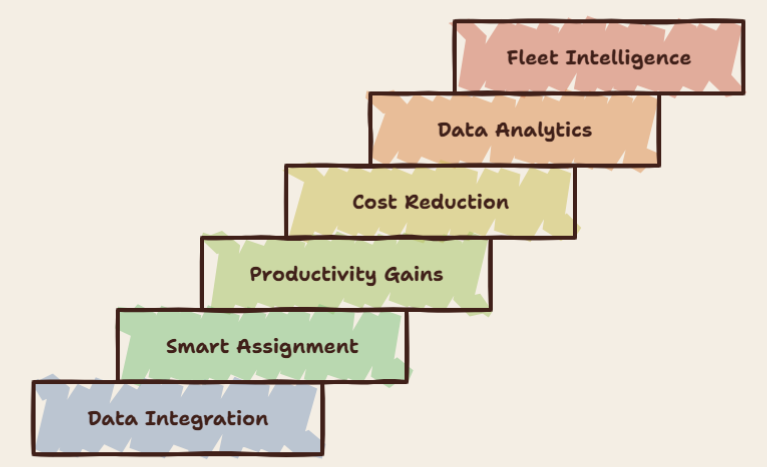
Dispatch software pulls every piece of operational data into one place and makes smart decisions faster than any human team can. The moment a new job hits the system, it gets assigned to the right driver based on location, availability, and vehicle capacity.
Fleets using modern dispatch systems report 30% productivity gains and 15–20% cost reductions, while dispatchers stop drowning in phone calls.
Dispatch software also creates a feedback loop. Every completed stop, every fuel spend, every on-time delivery gets logged automatically. That data feeds the analytics dashboard, which tells management exactly where the money is going and where it is being wasted. Day by day, the fleet gets smarter.
Industries That Depend on Dispatch Software
Dispatch software is not a one-industry tool. Virtually any business that moves people, vehicles, or goods depends on reliable dispatching to stay competitive.
- Transportation companies use dispatch software to coordinate long-haul routes, manage driver hours, and stay compliant with federal regulations.
- Trucking operations rely on it for load assignment, deadhead reduction, and making sure no truck leaves the yard without a full and optimized plan for the day.
- Delivery businesses, from e-commerce fulfillment to food delivery, need it to handle high delivery volumes, tight time windows, and the relentless pressure of customer expectations.
- Field Services companies like HVAC, plumbing, and electrical contractors use dispatch software to match technicians to jobs based on skill set, location, and parts availability. No more wasted drives. No more double-bookings.
- Logistics providers managing warehouses, carriers, and freight movements use dispatch software as the connective tissue between every moving part of their supply chain.
Why Traditional Dispatch Methods Cost More Than You Think
Manual dispatching is an expense disguised as a process. The costs are real; they are measurable, and they compound every single day.
Manual dispatch costs fleets two to three hours daily in coordination time alone. Multiply that by your dispatcher’s hourly rate and the number of working days in a year, and you have a significant salary expense dedicated entirely to tasks software could handle in minutes. The real damage, however, runs much deeper than labor time.
Building custom logistics mobile app solutions for your dispatch workflow replaces these manual coordination costs with automated, always-on intelligence that works across every device your drivers carry.
Missed Deliveries
One failed delivery costs between $8 and $14 in re-dispatch expenses. One churned customer costs over $180 in lifetime value. With 8–12% of urban residential deliveries failing on the first attempt, the losses compound daily.
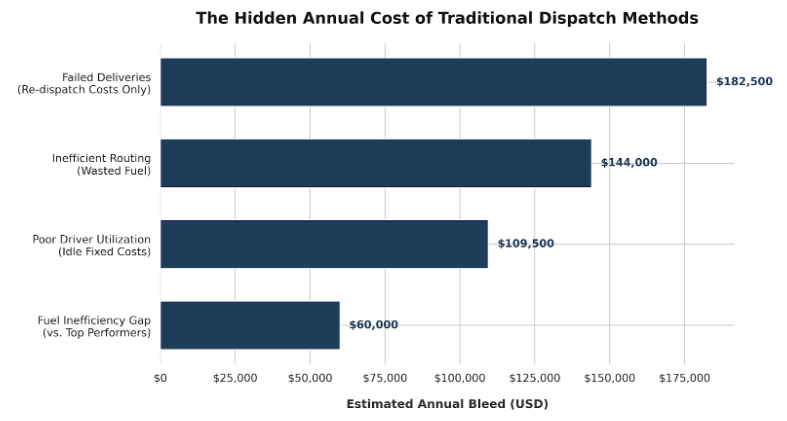
For a mid-size fleet handling 500 deliveries per day with a 10% failure rate, that is 50 failed deliveries every single day. At $10 average re-dispatch cost, that equals $500 daily, or $182,500 annually, from missed deliveries alone. Add customer churn at $180 per lost customer, and the number becomes catastrophic fast.
Inefficient Route Planning
A fleet of just fifty trucks driving ten extra miles a day can burn through thousands of gallons of fuel in the span of a year. Multiply that by fuel prices averaging $3.80–$4.20 per gallon across the US in 2026, and the math gets ugly quickly.
A 50-truck fleet wasting 10 miles per vehicle per day burns roughly 36,000 extra gallons annually; that is anywhere from $136,800 to $151,200 in pure waste, year after year.
Higher Fuel Costs
Fuel represents the single largest controllable expense in trucking operations, consuming 21–30% of total operating costs according to the 2025 ATRI Operational Costs report.
The gap between top-performing fleets averaging 7.8 MPG and the national average of 6.9 MPG represents hundreds of thousands of dollars in preventable fuel waste annually. For a fleet spending $400,000 a year on fuel, even a 15% inefficiency gap equals $60,000 in avoidable costs.
Poor Driver Utilization
Fleets using intelligent dispatch platforms report driver utilization rates 18 percentage points higher than those using manual dispatch processes. Poor utilization means drivers waiting, trucks sitting idle, and capacity going completely unused.
For a 20-truck fleet where each idle truck costs roughly $150 per day in fixed costs, even two consistently underutilized vehicles drain $109,500 annually.
Limited Visibility Into Operations
Without real-time data, every management decision is a guess. A fleet of just 20 trucks wasting 30 minutes daily on poorly sequenced stops loses over 2,500 productive hours annually. Fuel burned, driver pay wasted, and delivery slots missed, all from a planning gap that fleet dispatch software eliminates before the morning shift begins.
Limited visibility also means compliance blind spots, no driver accountability, and zero ability to catch problems before they become expensive emergencies.
15 Essential Dispatch Software Features with the Highest ROI
Not all dispatch software features carry the same weight. These fifteen are the ones that generate measurable, compounding returns. The kind that show up on the balance sheet and keep showing up year after year.
Automated Dispatch Scheduling
Advantages: Work assignment, Driver allocation, Load balancing
Automated scheduling takes the guesswork out of who drives what, when, and where. It assigns jobs based on driver availability, vehicle capacity, and proximity.
Automated dispatching increases dispatcher productivity by 60% and allows one dispatcher to manage three times more vehicles. For growing fleets, that means scaling operations without scaling your headcount, turning what used to take hours of phone calls and spreadsheet shuffling into a process that runs on its own.
Intelligent Route Optimization
Advantages: Traffic-aware routing, Multi-stop planning, Fuel reduction benefits
Route optimization does not just find the shortest path. It factors in live traffic, delivery windows, vehicle weight limits, and fuel efficiency simultaneously. AI-powered dispatch software improves on-time delivery by 20–30% compared to manual planning methods.
For a fleet completing 300 stops daily, a 25% improvement in on-time rates means 75 more successful deliveries per day, and the fuel savings stack on top of that.
Real-Time GPS Fleet Tracking
Advantages: Vehicle visibility, Driver monitoring, ETA accuracy
Knowing where your trucks are at any given second is not a luxury. It is the baseline for every other smart decision your fleet makes. Among 1,899 verified fleet management software reviewers, 96% rated vehicle tracking as important or highly important, the highest rating of any feature.
Real-time GPS feeds accurate ETAs to customers, flags route deviations instantly, and gives dispatchers the visibility to act on problems before they turn into complaints.
Dynamic Route Adjustments
Advantages: Last-minute changes, Road closures, Emergency dispatches
Static routes are plans built for a perfect world. The real world has accidents, road closures, priority pickups, and weather delays. Dynamic route adjustment means your system re-optimizes on the fly, pushing updated instructions to drivers in seconds.
Modern AI monitors conditions in real time and adjusts routes automatically when circumstances change. When a driver becomes unavailable mid-shift, the system instantly reassigns remaining stops across the fleet based on proximity, vehicle capacity, and delivery windows.
Driver Mobile Application
Advantages: Job updates, Communication, Navigation support
Your drivers are the front line of your operation. A dedicated driver mobile app keeps them connected, informed, and moving efficiently without radio calls or back-and-forth texts. Mobile access earned a 90% important or highly important rating from fleet software reviewers, reflecting how central mobile tools have become to field operations.
Drivers receive job details, turn-by-turn navigation, customer notes, and real-time updates all in one place; fewer mistakes, faster completions, happier customers.
Automated Notifications and Alerts
Advantages: Driver alerts, Customer updates, Delivery status notifications
Customers who know exactly when their delivery is arriving are customers who do not call your support line. Automated notifications handle driver alerts for schedule changes, customer updates for ETAs, and status notifications for completed deliveries. All without a human touch. Fewer “where is my order” calls mean less support overhead, and proactive communication directly lifts customer satisfaction scores.
Digital Proof of Delivery (POD)
Advantages: Signatures, Photos, Timestamp verification
Paper delivery logs get lost, damaged, and disputed. Digital proof of delivery captures e-signatures, geo-stamped photos, and precise timestamps the moment a delivery is completed.
For businesses managing high delivery volumes, digital POD eliminates disputes, speeds up billing cycles, and creates an auditable record that holds up in any customer disagreement. It also removes the manual step of reconciling paper logs at the end of every shift.
Customer Self-Service Portal
Advantages: Order tracking, Service updates, Transparency
Today’s customers expect Amazon-level tracking for every delivery, regardless of your fleet’s size. A self-service portal lets customers check order status, track vehicles in real time, and access delivery updates without ever contacting your team.
This single feature can eliminate a significant portion of inbound support calls, freeing your staff to focus on higher-value interactions and complex problem-solving.
Dispatch Automation Workflows
Advantages: Auto-assignment rules, Trigger-based actions, Reduced manual work
Dispatch automation workflows let you define rules once and let the system execute them every time. When a new order comes in, it gets assigned based on your predefined criteria: driver zone, vehicle type, shift availability.
Trigger-based actions can notify customers, update statuses, and log data without anyone lifting a finger. Businesses using integrated fleet management ecosystems report a 35% reduction in manual data entry and a 40% improvement in data accuracy.
Real-Time Analytics Dashboard
Advantages: Fleet KPIs, Productivity metrics, Cost visibility
A real-time analytics dashboard transforms raw operational data into decisions. Fleet managers can track on-time delivery rates, fuel spend per route, driver productivity, and cost-per-stop. When a problem surfaces, the dashboard shows it immediately, not at the end of the month when it is too late to recover. Data-driven fleets consistently outperform intuition-driven ones, and the analytics dashboard is the engine behind that advantage.
Multi-Vehicle and Fleet Management
Advantages: Vehicle utilization, Capacity tracking, Resource allocation
Managing one vehicle is easy. Managing fifty across multiple depots, service areas, and shift patterns requires a system built for that complexity. Multi-vehicle management tools track utilization rates across the entire fleet, flag underused assets, and ensure capacity is allocated where demand is highest.
For growing operations, this feature prevents the chaos that comes with scale and keeps every vehicle working as hard as it should.
Third-Party Integrations
Advantages: ERP, CRM, Accounting software, Telematics platforms
Dispatch software that sits in isolation creates information silos. The best platforms connect with your existing tech stack: ERP systems for order data, CRM tools for customer history, accounting software for billing, and telematics platforms for deeper vehicle insights.
Seamless integrations mean your data flows freely, your teams work from the same information, and you avoid the double-entry errors that waste time and corrupt reporting.
Driver Performance Monitoring
Advantages: Safety metrics, Productivity tracking, Compliance management
Knowing that a driver completed their route is different from knowing how they completed it. Driver performance monitoring tracks speeding events, harsh braking, idle time, and stop completion rates, giving managers the data to coach, reward, and improve their teams.
Safety metrics also reduce accident liability, and productivity tracking ensures every driver is contributing at their full capacity rather than coasting under the radar.
Compliance and Regulatory Management
Advantages: Driver logs, Hours of service, Documentation
Federal compliance is non-negotiable. Hours of service rules, electronic logging device requirements, and DOT documentation all carry serious penalties when they slip.
Compliance management features automate driver log tracking, flag HOS violations before they happen, and store documentation digitally so audits become straightforward instead of stressful.
Scalability and Customization
Advantages: Growth readiness, Industry-specific workflows, Custom business logic
The best iOS mobile app development and dispatch platforms grow with your business rather than holding it back. A fleet of 10 vehicles today might be 100 vehicles in three years. Scalable, customizable dispatch software accommodates that growth without requiring a complete system overhaul.
Industry-specific workflows let you configure the platform around your actual processes, not the generic template the vendor built for everyone else. Custom business logic means the software works for your operation, not the other way around.
Which Dispatch Software Features Matter Most by Business Type?
Different fleet types have different priorities. A trucking company cares deeply about HOS compliance and load optimization. A last-mile delivery provider lives and dies by route efficiency and customer notifications. Understanding which features carry the most weight for your specific business saves time, money, and the headache of paying for capabilities you will never use.
The table below maps essential dispatch software features to five major fleet categories, and also covers the long-tail search realities each business type faces, from “best dispatch software for small trucking companies” to “field service scheduling and dispatch tools”.
| Feature | Trucking Companies | Last-Mile Delivery | Logistics Companies | Freight Brokers | Field Service |
|---|---|---|---|---|---|
| Automated Scheduling | Critical | Critical | Critical | Important | Critical |
| Route Optimization | Critical | Critical | Critical | Moderate | Important |
| Real-Time GPS Tracking | Critical | Critical | Critical | Important | Critical |
| Dynamic Route Adjustments | Important | Critical | Important | Low | Important |
| Driver Mobile App | Critical | Critical | Important | Low | Critical |
| Digital Proof of Delivery | Important | Critical | Important | Low | Critical |
| Compliance Management | Critical | Important | Important | Critical | Moderate |
| Third-Party Integrations | Important | Important | Critical | Critical | Important |
| Customer Self-Service Portal | Low | Critical | Moderate | Low | Important |
| Analytics Dashboard | Important | Important | Critical | Critical | Important |
| Scalability | Important | Critical | Critical | Critical | Important |
| Driver Performance Monitoring | Critical | Important | Important | Low | Critical |
For freight brokers searching for “dispatch software with carrier integration” or “load tracking for freight brokerages,” the integration and compliance columns matter most.
For field service businesses running searches like “dispatch software for HVAC companies” or “best technician scheduling software,” mobile app quality and automated scheduling are the clear priorities.
How Much Can the Right Dispatch Software Save Your Business?
The ROI conversation around dispatch software is not abstract. The numbers are documented, the savings categories are clear, and the calculations are replicable across fleet types and sizes. The global fleet management market hit $27 billion in 2025 and is accelerating toward $122 billion by 2035, with AI-powered dispatch capabilities driving the majority of that growth.
Businesses investing now are locking in competitive advantages that will be very hard to close in three years. Here is a breakdown of exactly where the savings land.
Reduced Fuel Costs
Optimized routing directly cuts fuel spend by eliminating unnecessary miles, reducing idle time, and improving load efficiency across every route.
Calculation: A fleet spending $20,000 per month on fuel with a conservative 20% reduction from route optimization saves $4,000 per month, or $48,000 annually. A 20–30% fuel reduction is a conservative benchmark for fleets adopting route optimization software.
Increased Driver Productivity
Automated scheduling and mobile apps eliminate dead time between jobs, reduce coordination calls, and keep drivers moving efficiently throughout their shifts.
Calculation: One documented delivery service saw 30 minutes per driver per day in productive gains from automated dispatch and navigation. For a 30-driver fleet at an average wage of $ 22 per hour, that is $9,900 per month, or $118,800 in recovered productivity annually.
Faster Dispatch Times
Automated dispatch cuts the time from job creation to driver assignment from hours to seconds, allowing fleets to handle more volume with the same resources.
Calculation: Fleets using intelligent dispatch platforms report 31% faster response times on urgent jobs. For service businesses where faster response directly converts to additional completed jobs, even two extra jobs per day at $150 average value equals $108,000 in additional annual revenue.
Lower Administrative Work
Eliminating manual data entry, paper logs, and spreadsheet reconciliation frees dispatcher and admin time for higher-value tasks, or simply reduces headcount requirements.
Calculation: Integrated fleet management ecosystems reduce manual data entry by 35%. For a team spending 20 hours per week on dispatch administration at $25 per hour, a 35% reduction saves 7 hours weekly; that is $9,100 annually from administrative efficiency alone.
Your Fleet’s Dispatch Software Feature Checklist: Check Off Before You Commit
Two lines can save you a lot of vendor meetings: before you sign anything, run your shortlisted platforms against this list. Every unchecked box is either a gap you live with or a workaround you pay for.
This checklist also maps directly to how you measure software quality in dispatch platforms; each feature represents a functional requirement that should be testable, trackable, and tied to a measurable performance outcome.
- Route Optimization
✔ - GPS Tracking
✔ - Mobile Driver App
✔ - Automated Scheduling
✔ - Digital POD
✔ - Reporting Dashboard
✔ - Integrations
✔ - Compliance Tools
✔ - Customer Portal
✔ - Scalability
✔
Why More Transportation Companies Are Investing in Custom Dispatch Software
The transportation technology landscape is changing fast. The dispatch software market stood at $25.5 billion and is projected to reach $52.4 billion by 2030.
That is the core argument for custom dispatch software in 2026: competitive advantage, process automation built around your actual workflows, full data ownership, and operational flexibility that no generic platform can match.
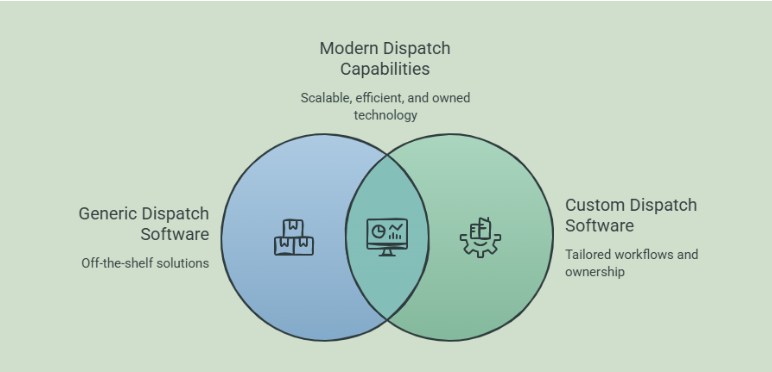
Custom-built systems also deliver long-term ROI that compounds differently, because every workflow improvement you make belongs to you, not a vendor roadmap. And the good news for businesses concerned about budget? Modern development approaches and cloud-native architectures have significantly helped reduce mobile app development costs while delivering enterprise-grade capabilities.
A custom dispatch solution today costs a fraction of what it did five years ago, with faster build timelines and lower ongoing maintenance expenses.
If your fleet has grown beyond what off-the-shelf tools handle cleanly, or if you operate in a specialized logistics niche that generic platforms simply do not accommodate. A custom-built dispatch platform from Unique Software Development’s transportation software development team is the move that separates long-term leaders from perpetual followers.
The Bottom Line: Future-Proof Your Fleet’s Efficiency
Dispatch software is not a single feature; it is an ecosystem of connected capabilities that work together to make your fleet faster, smarter, and more profitable. The fifteen dispatch software features covered in this guide represent the full spectrum of what modern fleet operations need in 2026: from intelligent route optimization and real-time GPS tracking to compliance management, digital POD, and scalable customization.
If your fleet has outgrown what off-the-shelf tools offer, or if you are building from scratch and want something that actually fits the way you work, Unique Software Development’s custom transportation software development team is ready to build it with you. Your operation is not generic. Your dispatch software should not be either.