

Your trucks are losing you money right now. Not tomorrow. Right now, while you read this. Every minute of idling, every wasted mile, every dispatcher guessing a driver’s location, and every customer calling for an ETA has a direct dollar value attached to it.
This isn’t marketing fluff. An FMCSA field test proved that telematics-based systems cut fuel use by up to 8% and slashed serious, unsafe driving events by 60%. For a 1,000-truck fleet, that fuel cut alone saves $4.5 million annually.
This federal data proves that dispatch software with GPS tracking isn’t a nice-to-have gadget; it’s a profit engine. If you are done guessing, this guide will show you how to leverage integrated telematics to stop the bleeding.
What Is Dispatch Software?
Dispatch software is the operational nervous system that decides who does what job, when, and how. “Old-school” dispatch relies on a stressed manager on a radio, a whiteboard, or a messy spreadsheet trying to guess which driver is closest to the next job.
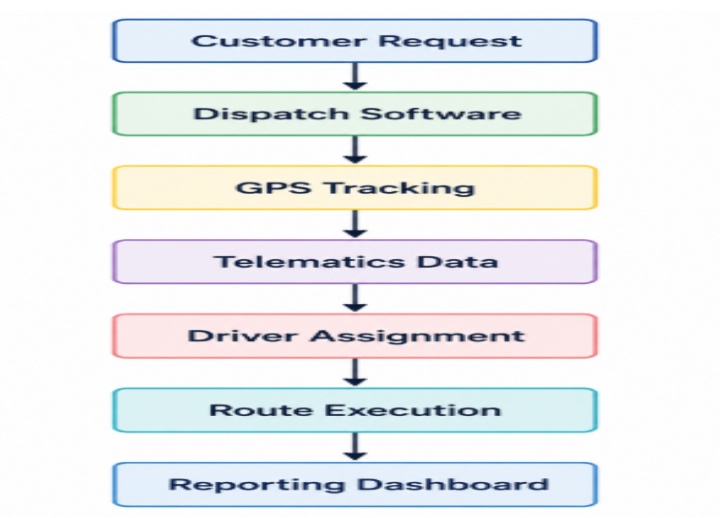
Modern dispatch systems replace manual guesswork with live intelligence powered by Dispatch Software with GPS tracking and a telematics system. It automatically assigns jobs, tracks vehicles in real-time, and tells your team exactly who is free, who is stuck in gridlock, and who is finishing early.
Manual dispatch works fine when you are running three trucks. It completely falls apart once you hit fifteen, fifty, or five hundred.
To understand the marketplace, it helps to understand the specific flavors of this technology:
- Dispatch Management Software: The broad umbrella. It covers job assignment, scheduling, driver communication, and reporting in a single dashboard. It is the brain of your operation.
- Service Dispatch Software: Built specifically for field service trades (HVAC, plumbing, electrical, pest control) where a technician needs the right tools, parts list, and address without a dozen back-and-forth phone calls.
- Dispatch Scheduling Software: Focuses strictly on calendar optimization, managing shift rotations, booking jobs, and ensuring your top technician isn’t double-booked on opposite sides of town.
- Dispatch Software for Small Business: The exact same core data engine, scaled and priced so a 5-truck operation can reap enterprise-level rewards without needing a dedicated IT department.
Growth-stage businesses that adopt this technology stop losing revenue to the phrase, “We couldn’t get a free truck to you in time.” The real cost of staying manual isn’t just wasted fuel; it’s missed market share. To maximize these returns, it is essential to look for specific capabilities, such as those detailed in Dispatch Software Features Every Modern Fleet Needs in 2026.
How Dispatch, GPS, and Telematics Work Together
Let’s strip away the tech jargon and look at how these three distinct layers interact:
- GPS Tracking tells you where a vehicle is, right now, on a map (location, speed, direction).
- Telematics Systems tell you how the vehicle is being treated. It pulls direct engine diagnostics, harsh braking events, idle times, fuel consumption, and battery health.
- Dispatch Software sits on top of both. It uses the location data and vehicle health to make automated, intelligent decisions, like routing the closest truck or flagging a vehicle for service before it breaks down on a job.
The entire system depends on Dispatch Software with GPS as the central layer that connects vehicles, drivers, and operations.
Key Insight:
When businesses adopt Dispatch Software with GPS, they gain real-time visibility, faster dispatching, and lower operational costs.
The Workflow in Action
A high-value customer calls in with an emergency. The dispatch software instantly checks live GPS coordinates. It sees that Truck 7 is 4 minutes away and Truck 12 is 20 minutes away. It assigns Truck 7 instantly; no radio calls, no delays, no awkward “let me call you back” responses.
Meanwhile, the telematics system notices that Truck 7’s engine oil pressure has been throwing soft codes for 48 hours. It automatically flags the vehicle for a garage check tomorrow morning, preventing a catastrophic engine failure that would have stranded your technician on the highway during a peak work week.
| Technology | Primary Role | Operational Outcome |
|---|---|---|
| Dispatch Software | Assigns, automates, and schedules work | Faster operations, zero missed jobs |
| GPS Tracking | Tracks asset locations in real time | Total route visibility, flawless ETAs |
| Telematics System | Collects deep engine and driver behavior data | Proactive maintenance, reduced liability |
When these three components function as a single, connected ecosystem, known as integrated dispatch, your business stops firefighting emergencies and starts preventing them.
5 Ways Integrated Dispatch Software Transforms Fleet Operations
These are the five ways:
Lightning-Fast Dispatch and Response Times
Every minute a dispatcher spends manually plotting routes is a minute a customer is getting frustrated. Automated assignment deletes this latency. Field service businesses utilizing real-time tracking report radically faster response times because the right driver gets the job pushed to their mobile device instantly.
Aggressive Route Optimization and Fuel Savings
This is the metric that turns heads in the boardroom. Fleets leveraging advanced GPS tracking saw an average decrease of roughly 12% in fuel costs, with wider industry benchmarks showing savings anywhere between 10% and 25%, depending on their baseline.
The ROI:
For a mid-sized fleet spending $300,000 annually on fuel, a conservative 12% reduction drops $36,000 back to your bottom line in year one, without buying a single new asset.
Absolute Driver Accountability
Driver tracking isn’t about micromanaging good employees; it’s about protecting your business liability. Telematics-based driver behavior monitoring drastically reduces harsh braking and speeding incidents. One logistics outfit saved $200,000 annually simply by presenting its clean telematics safety logs to its commercial insurer to negotiate heavily discounted premium rates.
Precision Customer Communication
The modern consumer will not accept a vague “between 9 AM and 5 PM” arrival window. Live GPS integration allows your system to send automated, Uber-style ETA updates directly to the customer’s phone. This eliminates “where is my technician” phone calls and elevates your brand equity.
Weaponized Operational Data
Every completed delivery, every hard brake, and every idle minute becomes a data point. Over time, comprehensive fleet management reporting transforms vague operational hunches into indisputable facts: here is exactly where we are losing margin, and here is the fix.
Industry-Specific Dispatch Software Use Cases
Not every business needs the same tool. Let’s break down real use cases by industry.
- Trucking dispatch software is built for long-haul and regional freight. It needs to handle load matching, ELD compliance, IFTA fuel tax reporting, and multi-stop routes across state lines. If you’re asking “what is trucking dispatch software,” this is the answer: it’s dispatch built around compliance and long-distance logistics, not just local job assignment.
- Service dispatch software is the right fit for HVAC, plumbing, electrical, pest control, and similar field service trades. The priority here is matching the right technician’s skill set to the right job, plus fast rescheduling when something runs long. Eliminating traditional dispatch whiteboards or spreadsheets can save severe operational overhead, as seen in the clear data from a dispatch software vs. manual dispatching cost comparison.
- Emergency dispatch software is a different animal entirely, built for split-second decisions where seconds matter. It prioritizes the absolute fastest, most accurate location data and direct communication, because lives are on the line, not just service windows.
- Delivery and courier operations lean heavily on route optimization and live customer-facing tracking links, since the entire customer experience hinges on “where’s my package, right now.”
If you are searching for software to aid renewable dispatch, be aware that this refers to grid-level utilities balancing solar, wind, and battery storage. It is an entirely separate software vertical from commercial fleet management. If your team is evaluating the creation of a specialized, proprietary platform for these sectors, partnering with an experienced custom transportation software development company ensures your compliance and scaling needs are fully taken care of.
Common Mistakes Businesses Make When Implementing Integrated Dispatch Systems
Here’s what to avoid:
- Buying Over-Engineered Software: A software platform built for an international 500-truck freight carrier will completely paralyze a nimble, 10-van plumbing company. Match the software complexity to your actual daily workflow.
- Ignoring Integration Capabilities: If your new dispatch platform refuses to talk to your existing accounting software (like QuickBooks), your CRM, or your current vehicle hardware, you haven’t solved a problem; you’ve just built a secondary data silo. To avoid operational bottlenecks, review strategies on how to implement WMS ERP integration without downtime in legacy Systems.
- Skimping on Driver Onboarding: The most sophisticated AI-driven dispatch system on earth will fail if your drivers and field technicians don’t understand how to use the mobile app on day one.
- Failing to Plan for Scale: Ensure your technology partner can easily scale from 8 trucks to 80 without requiring you to wipe the slate clean and buy an entirely new enterprise system later.
Dominate Your Market with Custom Infrastructure
The data is clear. The financial return on integrated dispatch software and telematics typically realizes itself within 60 to 90 days of clean deployment. The operators still running their businesses out of spreadsheets are bleeding margin every single day.
Partnering with top-tier Web App Development Companies allows you to bypass generic, off-the-shelf software and build a tool perfectly calibrated to your specific workflows.
At Unique Software Development, we build custom, high-performance dispatch and telematics platforms tailored precisely to your fleet’s operational DNA. We don’t force your business into a rigid, subscription-heavy template. We build the competitive advantage you need to outpace, out-route, and out-profit your competition.