

A $5 million ERP program can become a $10 million problem without a single line of bad code.
The overrun often starts much earlier: an incomplete application inventory, underestimated data migration, undocumented integrations, weak legacy dependencies, or a business case that counts implementation cost but ignores the technology estate around it.
For a large enterprise, an ERP decision is not simply a software purchase. It is a capital allocation decision that can affect finance, procurement, supply chain, inventory, sales, compliance, reporting, security, and operational continuity for years.
Consider a company with $100 million in annual operating activity. If fragmented systems create only a 1% avoidable process cost, the implied leakage is $1 million per year. Over five years, that becomes $5 million before any increase in labor costs, infrastructure, or transaction volume.
That is why the real question is not:
“How much will the ERP cost?”
It is:
“What will the entire transformation cost, what risk will it remove, and what will happen if we do nothing?”
This guide examines the financial and technical factors behind that answer, from hidden application costs and legacy dependencies to data migration, integrations, security, rollout risk, and five-year total cost of ownership.
Where Is Your ERP Budget Actually Leaking? – A Solid Overview
An ERP proposal can look financially controlled because the major costs appear clearly defined: development, integration, migration, security, and rollout. The problem is that these figures often describe the new ERP itself, not the technology environment that must connect to it, feed it, support it, and eventually replace parts of the old infrastructure.
That distinction can create a substantial gap between the approved budget and the actual cost of transformation. Existing applications may require modernization, historical data may need extensive cleansing, undocumented integrations may surface during implementation, and specialized systems may need to remain operational throughout the transition.
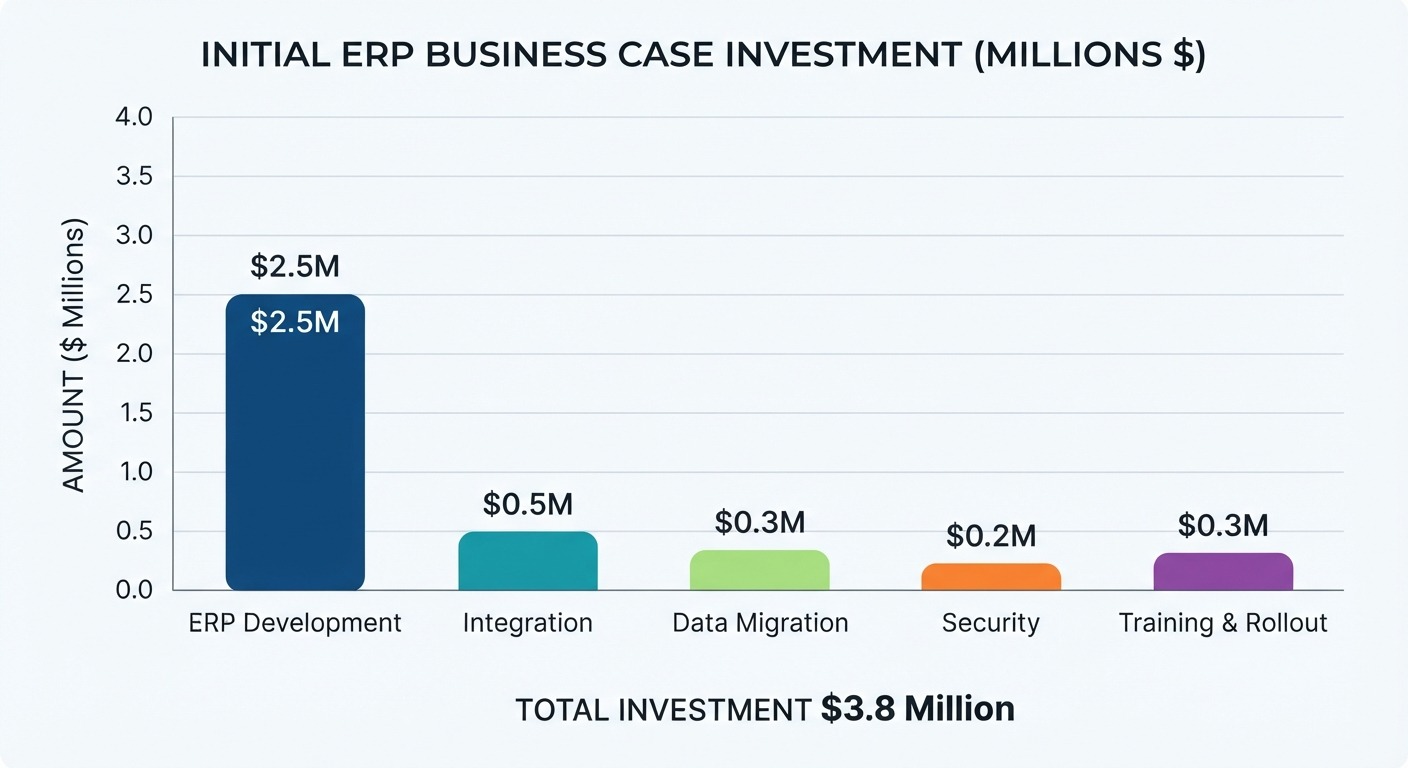
For example, suppose the initial business case contains:
- ERP development: $2.5 million
- Integration: $500,000
- Data migration: $300,000
- Security: $200,000
- Training and rollout: $300,000
The proposed investment appears to be $3.8 million. But that figure may exclude the systems that surround the ERP.
A warehouse application may contain inventory rules that never made it into the requirements document. A finance application may contain years of transaction history that cannot move without cleansing. A regional office may depend on a separate procurement workflow. A reporting platform may pull data from systems that executives did not even know existed.
Now the project has another problem. The company is not replacing one system. It is changing an ecosystem.
This is where custom ERP software development must begin with technology discovery rather than feature lists. Before approval, leadership needs a credible picture of applications, databases, integrations, data stores, user groups, security dependencies, and operational workflows.
A $3.8 million ERP proposal without that assessment may be a $3.8 million estimate for only part of the actual program.
The $1 Million Question Hidden Inside Your Old Applications
Legacy applications are rarely expensive because of their licenses alone. The higher cost often sits outside the technology budget.
Imagine an enterprise application with an annual direct cost of $100,000. It requires two specialist employees at an effective annual cost of $90,000 each, generates $70,000 of integration maintenance, and causes approximately $100,000 in manual reconciliation and reporting work.
Its visible technology cost is $100,000. Its practical annual burden is closer to $450,000.
Over five years, that becomes approximately $2.25 million.
Now ask a different question:
Would replacing that application for $1.2 million create a stronger five-year financial position?
That is the type of analysis executives need before an ERP program receives approval.
A legacy system should not remain in place simply because its annual license appears inexpensive. Its full economic burden belongs in the business case.
What Is Hidden From the Board?
The technology team may understand the dependencies. The investment committee may see only the headline ERP figure.
And this is the exact gap that creates risk.
A typical integrated enterprise environment can contain applications acquired at different times, built by different teams, and supported through different technology stacks. Some may have formal documentation. Others may depend on institutional knowledge held by two or three employees.
The most dangerous systems are not necessarily the oldest.
They are the systems nobody fully understands, but the business still needs.
That is why Legacy App Modernization should form part of the ERP investment discussion when existing applications influence data, workflows, security, or integration.
The question should not be, “Is this application old?”
The stronger question is:
“What financial and operational exposure does this application create if we keep it for another five years?”
That distinction can change the investment decision.
Your New ERP Does Not Erase Old Architecture
A modern ERP may become the central system of record, but it does not automatically eliminate every surrounding application. Consider a manufacturer with:
- 10,000 employees
- 15 operating sites
- 5 finance systems
- 4 warehouse platforms
- 2 customer platforms
- 20 years of historical data
- 50+ external interfaces
The ERP can centralize core processes while those surrounding systems continue to supply information or perform specialized functions.
Leadership therefore faces five possible paths for each significant legacy application:
- Retire it if its capability has no strategic value.
- Replace it if another platform can deliver the capability more effectively.
- Replatform it if the application remains useful, but its infrastructure creates risk.
- Refactor or rebuild it if the business capability matters but the architecture cannot support future requirements.
- Integrate it if replacement cost exceeds the value of removal.
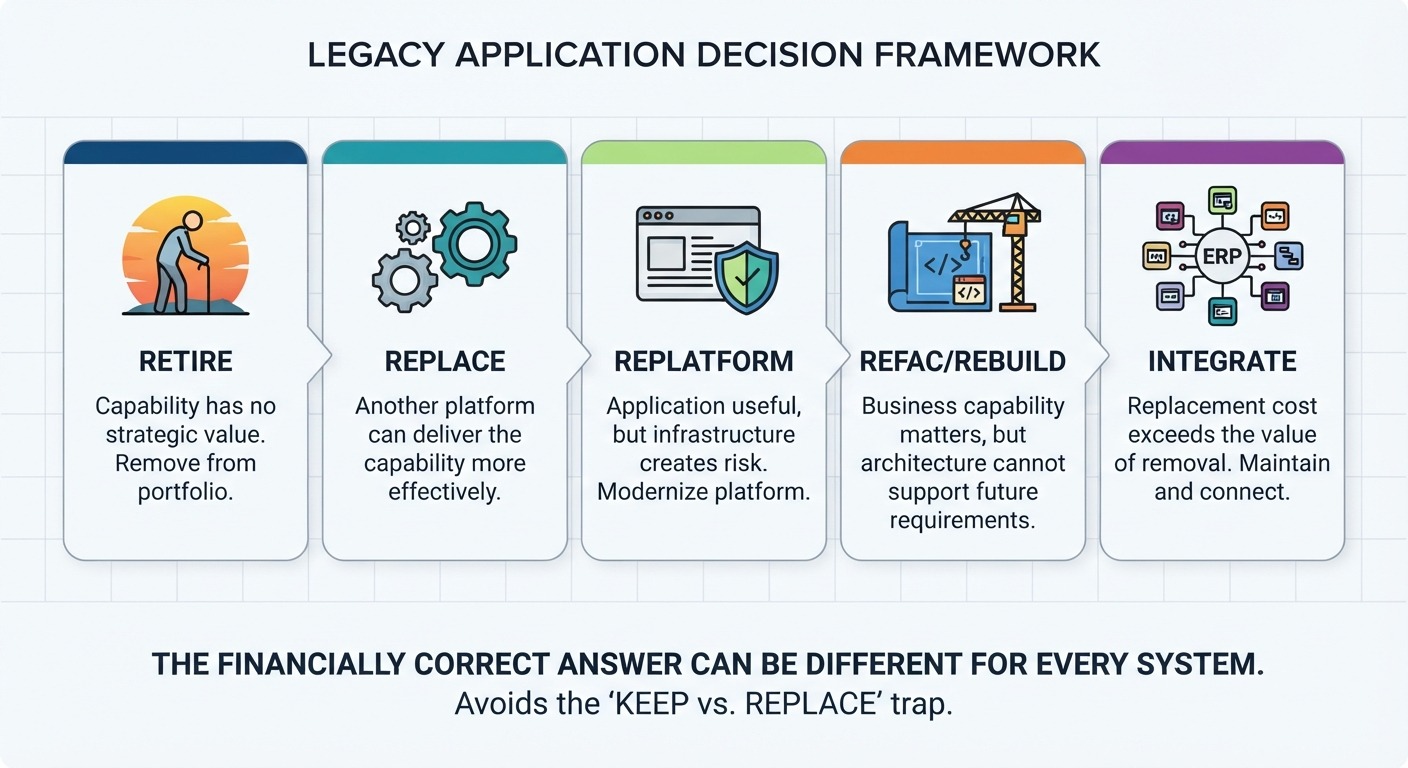
This decision framework prevents a common mistake: treating every old application as either “keep” or “replace.”
The financially correct answer can be different for every system.
Featured Article: What Really Makes an Agency an Enterprise App Development Company?
When Is Legacy App Modernization Better Than Replacement?
Consider a hypothetical logistics company with a 12-year-old order management platform. A complete replacement could require:
| Workstream | Illustrative Cost |
|---|---|
| Discovery and architecture | $200,000 |
| Application development | $1.2M |
| Data migration | $350,000 |
| Integrations | $450,000 |
| Testing | $250,000 |
| Training and rollout | $200,000 |
| Estimated total | $2.65M |
A targeted modernization route might look different:
| Workstream | Illustrative Cost |
|---|---|
| Architecture assessment | $120,000 |
| Infrastructure migration | $300,000 |
| Security remediation | $180,000 |
| API layer | $250,000 |
| Targeted refactoring | $400,000 |
| Data improvements | $200,000 |
| Estimated total | $1.45M |
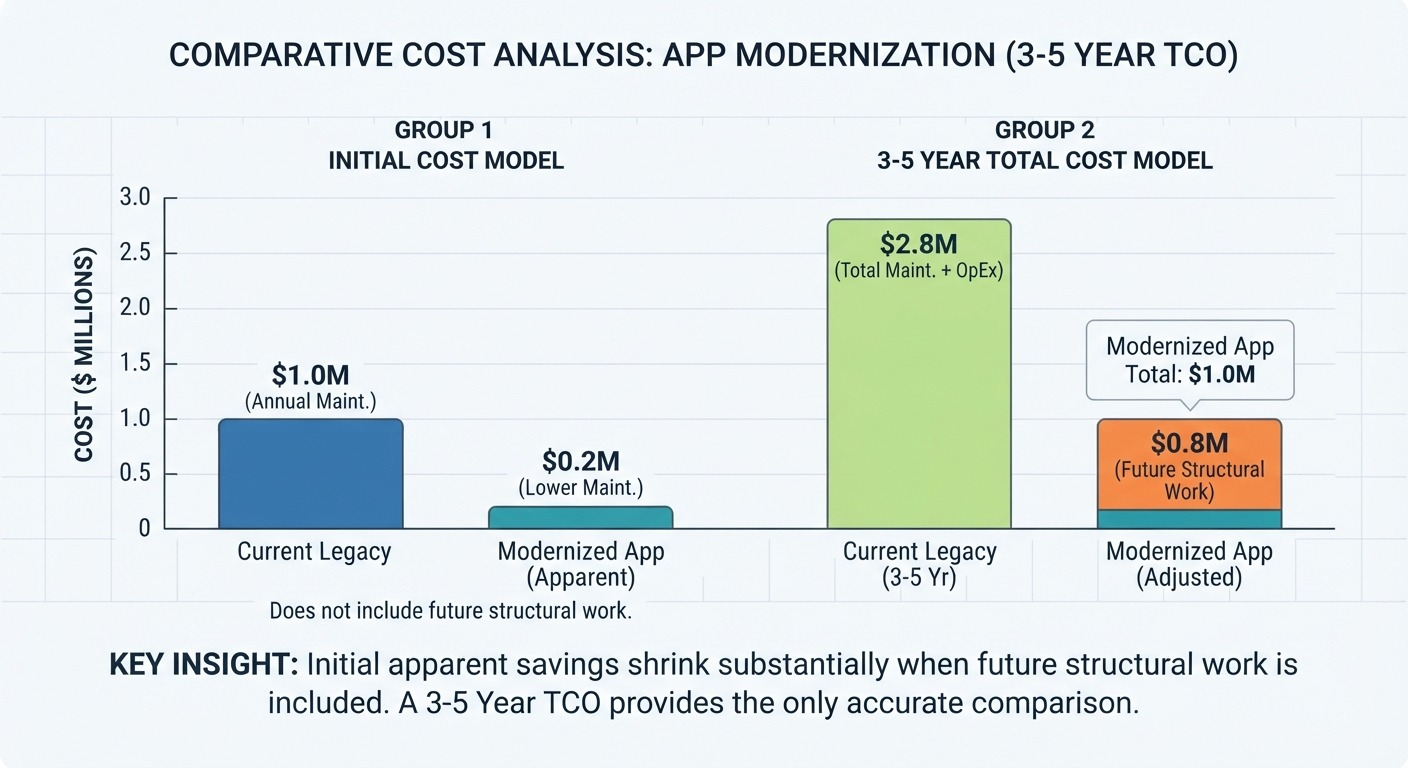
At first glance, modernization creates a $1.2 million difference. But that does not automatically make it the correct choice.
If the modernized application will require another $800,000 of structural work within three years, the apparent saving shrinks substantially.
The right comparison therefore uses a three- to five-year total cost model.
Data Migration Can Turn a Fixed Budget Into a Moving Target
Data migration deserves executive attention because the volume is rarely the hardest part. The difficult question is whether the data is trustworthy.
Imagine an enterprise with 20 million historical customer, order, inventory, and financial records. If only 4% require duplicate review, correction, or reconciliation, that creates 800,000 records requiring attention.
At an average of 3 minutes per manual review, that equals approximately 40,000 hours.
That is more than 20 full-time employee-years.
Automation can reduce the burden, but the underlying issue remains: poor source data does not become reliable merely because it enters a modern ERP.
Before approval, leadership should require clear answers to four questions:
- Which system owns each critical data domain?
- How much historical data must move?
- Which records should remain in an archive?
- What validation standard determines migration success?
Without those answers, the migration estimate is closer to an assumption than a budget.
Integration May Be the Most Expensive Part Nobody Sees
ERP discussions often focus on modules. Integration can create the larger architectural challenge. A large enterprise may connect its ERP to banks, payment platforms, CRM, HR, tax systems, supplier portals, warehouse systems, e-commerce platforms, logistics providers, identity platforms, analytics tools, and regional applications.
Each interface creates requirements for authentication, data mapping, monitoring, failure handling, testing, version control, and security.
Suppose 35 external systems require an average of two significant integration paths each.
That creates roughly 70 integration paths.
If each path requires $25,000–$75,000 across design, development, testing, monitoring, and support, the implied range is approximately $1.75 million to $5.25 million.
The exact figure will vary widely by architecture and complexity, but the point is important:
Integration cannot remain a footnote in a multimillion-dollar ERP proposal.
A single failure can also create financial consequences. If an integration outage delays $400,000 of daily invoicing and remains unresolved for three business days, $1.2 million of billable activity could face delay.
The technology failure and the financial exposure are directly connected.
Security Risk Can Survive an ERP Transformation
A modern ERP can have strong security controls while an old connected application remains vulnerable. That application may rely on unsupported libraries, outdated operating systems, weak authentication, exposed interfaces, or credentials that no longer meet corporate security standards.
This makes Legacy App Modernization relevant to security strategy as well as application strategy.
The assessment should cover:
- Authentication and authorization: Verify who can access each system and what they are permitted to do. Weak access controls can expose sensitive ERP, financial, customer, or operational data.
- Encryption: Check whether sensitive data is protected both while stored and while moving between systems. Missing or outdated encryption can increase breach exposure and compliance costs.
- API exposure: Identify every external and internal API connected to the application and assess how securely each endpoint operates. Unprotected or outdated APIs can create direct entry points into enterprise systems.
- Privileged access: Review administrator accounts and determine who has elevated permissions and why. Excessive privileges increase the potential impact of compromised credentials or insider misuse.
- Secrets management: Examine how passwords, API keys, tokens, and database credentials are stored and accessed. Credentials buried in code or configuration files can expose multiple systems through one compromised secret.
- Dependency age: Identify outdated libraries, frameworks, and third-party components within the application. Unsupported dependencies can introduce known vulnerabilities and make future maintenance increasingly expensive.
- Operating-system support: Confirm whether the application still runs on supported operating systems with current security patches. Unsupported environments can force emergency migration costs when vendors end security coverage.
- Database support: Assess the database version, security posture, scalability, backup process, and vendor support status. An outdated database can become both a performance constraint and a security liability.
- Audit trails: Verify whether the system records meaningful user, administrator, transaction, and security events. Without reliable logs, investigating fraud, unauthorized access, or compliance incidents becomes significantly harder.
- Third-party connections: Map every external service, vendor, platform, and integration that exchanges data with the application. Each connection introduces another dependency that can affect availability, security, and regulatory exposure.
- Vulnerability history: Review previous security findings, unresolved weaknesses, incidents, and remediation records. A repeated vulnerability pattern can indicate deeper architectural problems rather than isolated technical defects.
The important financial question is;
“What is the expected cost of retaining the exposure?”
A $250,000 remediation program can appear expensive until the alternative involves a material breach, regulatory response, operational shutdown, or contractual loss.
Remember the Word: A Good ERP Can Still Fail at Rollout
Technology does not determine whether an ERP rollout succeeds. Operational readiness matters just as much.
Finance may use different approval rules from procurement. Warehouses may rely on specialized workflows. Regional offices may maintain local processes. Executives may depend on reports that do not exist in the new environment.
A single global cutover can therefore create unnecessary concentration of risk.
A phased model may reduce exposure:
- Phase 1: Finance and master data
- Phase 2: Procurement and inventory
- Phase 3: Operations and warehouse
- Phase 4: Sales and customer workflows
- Phase 5: Advanced analytics and optimization
The sequence should follow the organization’s dependencies rather than a generic implementation template.
A six-month delay also deserves a financial model.
Suppose a $6 million ERP program carries $350,000 of monthly fixed project costs and the business expects $250,000 of monthly operational benefit after launch. A six-month delay creates a potential economic impact of approximately $3.6 million between additional program cost and deferred benefit.
That figure alone can justify serious schedule-risk analysis before the project begins.
Related Article: How to Implement WMS ERP Integration Without Downtime in Legacy Systems
How Much Contingency Does the Business Case Need?
No credible enterprise program should assume that its first estimate will remain untouched. For a $6 million program, a 10% contingency represents $600,000. The contingency should address identifiable uncertainty such as:
- undocumented interfaces
- data quality problems
- regulatory requirements
- regional process differences
- security remediation
- infrastructure constraints
- unexpected application dependencies
- additional testing requirements
It should not become a hidden pool for uncontrolled scope.
A useful executive rule is simple:
Every dollar in contingency should have a reason to exist, and every dollar spent from it should have a documented reason.
That preserves financial discipline without pretending that a complex enterprise transformation has zero uncertainty.
What Should Executives Demand Before Approval?
A serious ERP business case should answer at least six questions.
What is the five-year total cost?
Include development, licenses, infrastructure, migration, integrations, security, support, training, modernization, and expected expansion.
Which applications will disappear?
If the answer is unclear, the organization may be adding another platform instead of simplifying its technology estate.
Which applications will remain?
Each retained application should have an owner, business justification, risk assessment, and defined future path.
What happens if the program slips six months?
Quantify additional project cost, deferred savings, delayed revenue, staffing requirements, and operational impact.
What is the measurable return?
Savings, revenue enablement, risk reduction, productivity improvement, faster reporting, reduced maintenance, and working-capital improvements should all have measurable assumptions.
What is the exit strategy?
An ERP roadmap without an application retirement or modernization plan can reproduce the fragmentation it was supposed to remove.
This is where Legacy App Modernization becomes part of the long-term capital plan rather than a technical side project.
The Stronger Investment Model to Help You Make Decisions
A useful ERP investment model separates cost, risk, and value. Consider this illustrative five-year scenario:
| Investment / Value | Estimate |
|---|---|
| ERP program | $4.0M |
| Data migration | $700K |
| Integration | $1.0M |
| Legacy modernization | $1.3M |
| Training and rollout | $500K |
| Contingency | $750K |
| Total investment | $8.25M |
| Process savings | $5.0M |
| IT cost reduction | $2.0M |
| Risk reduction | $1.5M |
| Revenue enablement | $4.0M |
| Estimated value | $12.5M |
The headline ERP price is $4 million.
The actual transformation investment is $8.25 million.
The estimated five-year value is $12.5 million.
That is the difference between an ERP quotation and an executive business case.
It also explains why custom ERP software development should be assessed against the entire enterprise technology portfolio. The right question is not whether the software can be built within a certain budget. The question is whether the resulting architecture produces enough measurable value to justify the capital, risk, and disruption.
What Does the Right Technology Partner Actually Need to Deliver?
The right partner should provide more than a development estimate.
For a large enterprise, the engagement should connect business objectives with architecture, application dependencies, data, security, integrations, migration, rollout, and financial outcomes.
That may require a technology assessment before the final development scope.
The output should give decision-makers enough clarity to understand:
- What should be built
- What should be retired
- What should be modernized
- What should remain
- What should integrate
- What data should move
- What risks require mitigation
- What the five-year financial picture looks like
Organizations seeking Custom enterprise software development services should therefore evaluate providers on their ability to reason across the entire technology environment, not simply their ability to produce application code.
The same principle applies when selecting a partner for custom ERP software development: technical delivery matters, but enterprise judgment matters just as much.
The Question to Ask Before Signing the Approval
Do not ask whether the proposed ERP is modern. Ask whether the entire technology environment can support the business the company intends to operate five years from now. If critical processes still depend on undocumented applications, fragile interfaces, outdated databases, or systems that only two employees understand, the ERP proposal is incomplete.
A transformation can modernize the core while leaving the same structural problems around it. The result is a newer ERP surrounded by an old technology estate, with a larger budget and many of the same risks.
The stronger approach treats Legacy App Modernization as part of the investment architecture where legacy systems influence security, integration, data, cost, or operational continuity.
At Unique Software Development, the objective is to turn that analysis into a practical enterprise roadmap: one that gives decision-makers visibility into cost, application dependencies, modernization priorities, risk, and measurable business value before substantial capital is committed.