

You invested in custom ecommerce software development to automate the work. Yet the team still uses spreadsheets and handles manual tasks. Instead of reducing the workload, the software has given the team more work to manage.
An ecommerce platform can check all the obvious boxes and still miss the tasks that keep your team busy. Inventory may not update fast enough. Customer data may sit across separate systems. Fulfillment may still depend on manual updates. Orders and payments can run smoothly while these gaps keep showing up behind the scenes. Someone has to fill them.
Those gaps are easy to miss before development starts and expensive to fix later. That’s why the essential features matter before development begins. Here are 7 worth checking first.
When Is Custom Ecommerce Software Development Worth the Investment?
Every extra step in a daily task costs time, and that time costs money. Custom ecommerce software development with the right features makes sense when the software you use doesn’t fit how your business actually works.
The problem isn’t always that your ecommerce software lacks features. Sometimes, it has the wrong ones. That mismatch can leave your team spending time working around the platform instead of letting the platform do the work.
Here’s what teams can achieve when their ecommerce solution has the features they actually need.
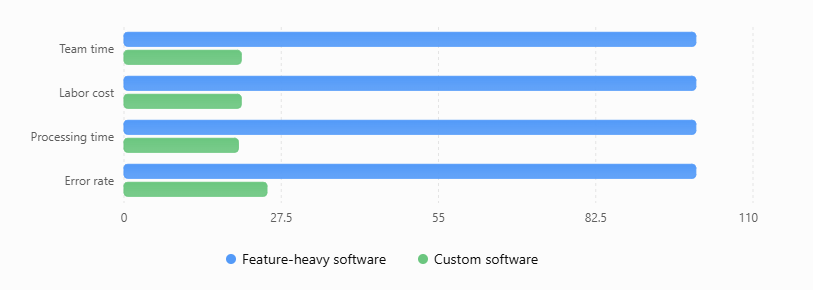
This information is taken from McKinsey. Its research shows how automation can improve operational efficiency when the right processes and capabilities are built into the system. But there is another side to consider. Software that does not fit your processes can leave teams relying on workarounds and manual tasks. This can add to the effort involved in running the operation.
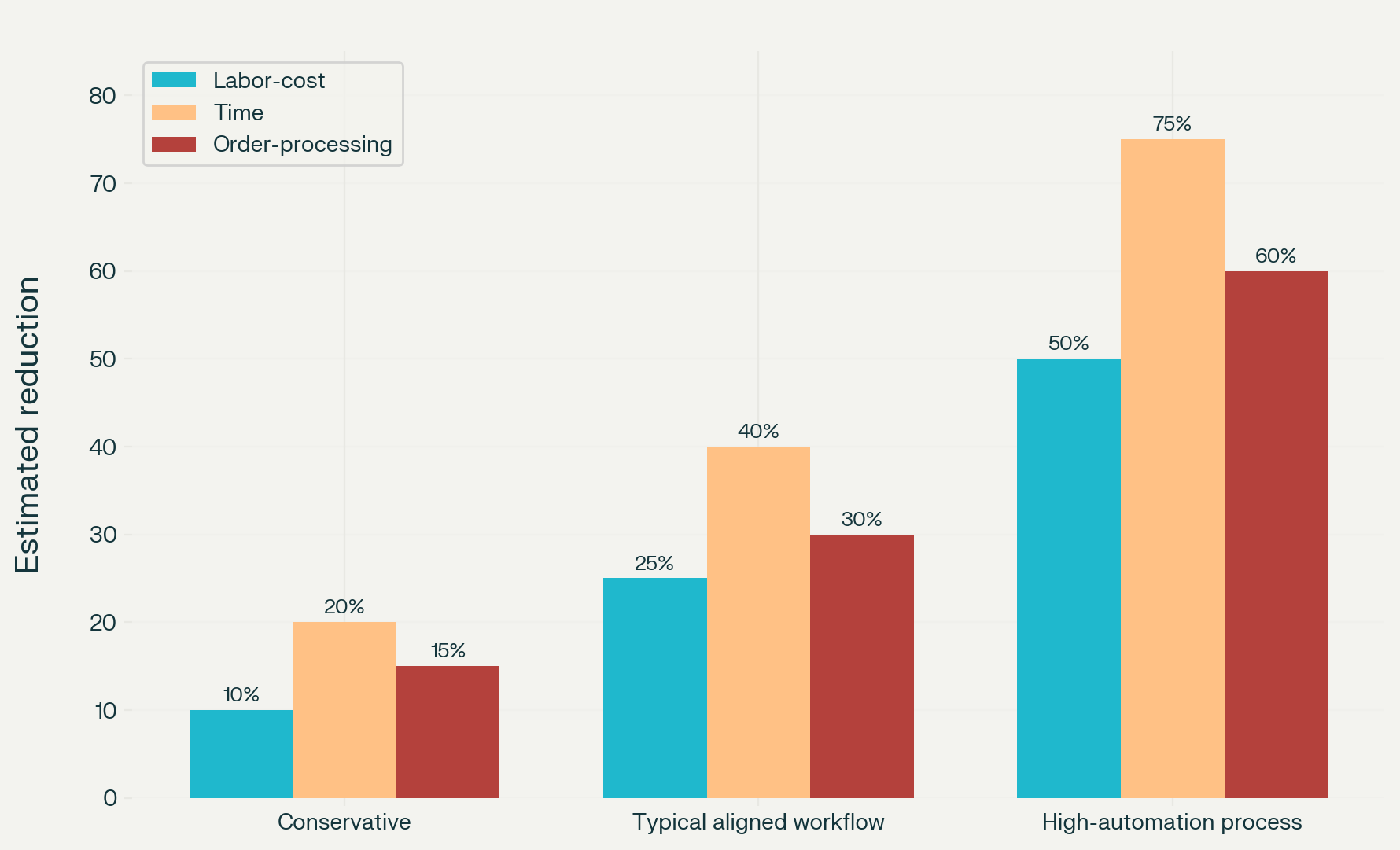
That is where custom ecommerce software development becomes valuable. The software can be built around the features your operation actually needs, from reducing manual work to connecting the systems your team relies on. For businesses replacing older platforms, modernizing legacy systems can also remove some of those limitations without replacing everything at once.
7 Must-Have Features to Look for in Custom Ecommerce Software Development
Every business runs differently. One ecommerce operation may need tighter inventory control, while another may need stronger CRM or fulfillment capabilities. Requirements differ because each business works differently.
But some features are hard to skip. Leave them out, and the team may end up paying in extra time, manual work, or another round of custom ecommerce software development later.
Connect Every System Without Creating More Manual Work
Your ecommerce software should not become harder to change every time the business changes. API-first architecture keeps the storefront, commerce logic, payments, inventory, ERP integration, CRM, and other systems connected without tying every change to the entire platform.
A headless commerce setup takes this further by separating the customer-facing storefront from the back end. Composable architecture lets businesses change individual services, such as search, payments, tax, or order management, without rebuilding everything.
This approach follows the core ideas of the MACH Alliance: microservices, API-first, cloud-native, and headless. The result is a custom ecommerce platform that can adapt as new channels, integrations, and business requirements come in.
Manage Complex Products, Pricing and Catalog Rules
Not every customer gets the same product or price. A distributor may have different pricing from a national account, while promotions, regional rates, and volume discounts add more rules to the mix.
This is where advanced product catalog and pricing management becomes important. The ecommerce platform should handle customer-specific pricing, discounts, product variants, bundles, and regional pricing. Your team should not have to manage these details across spreadsheets.
A Product Information Management (PIM) system can also keep product data consistent across the ecommerce storefront, marketplaces, and other sales channels. The goal is simple: let the software handle the pricing and product rules instead of leaving them to the team.
Keep Inventory Accurate Across Every Sales Channel
Selling through a website, mobile app, physical stores, and marketplaces can get messy when each channel sees different inventory. One system says an item is available while another has already sold it.
Real-time inventory management keeps stock information connected across every sales channel. Your ecommerce platform can sync inventory with warehouses, physical stores, ERP systems, and warehouse management systems (WMS), so orders work from the same stock information.
With omnichannel commerce, customers get more accurate availability, while teams spend less time checking systems and fixing stock errors. Features such as buy online, pick up in store (BOPIS) and ship-from-store also become easier to manage.
Build Workflows Around How the Business Actually Sells
B2B ecommerce does not work like a normal retail checkout. A wholesale buyer may need approval before placing an order, have contract-based pricing, purchase through a PO, or reorder large quantities without browsing the catalog again.
Custom B2B workflows can build these rules into the ecommerce platform. Account roles, approval flows, customer-specific pricing, purchase orders, credit terms, and invoicing can work within the same system.
For B2C, the same platform can support a simpler buying journey while sharing the same product catalog, inventory, and order management behind the scenes. This is also where custom retail software development can help businesses support more specialized customer and operational workflows.
Turn Customer Data Into More Relevant Buying Experiences
Not every customer comes to your ecommerce store looking for the same thing. A returning buyer, a first-time customer, and a high-value customer may all need a different experience.
Personalization uses customer behavior, browsing history, and purchase data to show more relevant products, recommendations, search results, and offers. Machine learning can help the system adjust these experiences as customer behavior changes.
Intelligent merchandising also gives the team control over what gets promoted based on margin, inventory, customer segments, and business goals.
As a result, customers can reach relevant products faster, while the business gets more control over cross-sells, upsells, and product discovery.
Keep the Platform Fast, Secure, and Ready to Scale
A custom ecommerce platform has to do more than process orders. It needs to stay secure, fast, and reliable as traffic and order volume grow.
Security should cover payment data, customer information, access controls, and compliance requirements such as PCI DSS, GDPR, and CCPA. Performance also matters. Slow pages can hurt the buying experience, especially during high-traffic sales or product launches.
Scalability means the ecommerce software can handle more customers, orders, products, and integrations without forcing another rebuild. Core Web Vitals, load testing, uptime, monitoring, and recovery planning give the team concrete ways to measure that performance.
Give Leadership One Version of the Truth
Customer data sits in the CRM. Order data sits in the ecommerce platform. Inventory lives in the ERP. Marketing and financial data often sit in separate systems.
Each system may work fine on its own. The problem starts when leadership needs one clear picture of the business. Teams waste time comparing numbers, checking reports, and figuring out which data to trust.
A unified data layer brings customer, order, product, inventory, marketing, and financial data into one consistent structure. Business intelligence dashboards can then turn that data into a single view of key ecommerce metrics.
AI analytics can take that a step further. It can spot patterns across sales, customer behavior, inventory, and marketing data that may be difficult to notice across separate reports. Leadership gets a clearer picture of what is happening and where attention is needed.
The value of ecommerce data is not how much you collect. It is how quickly you turn it into a decision.
What Does Custom Ecommerce Software Development Cost?
Total cost of ownership matters more than the build number. A five-year view should account for platform and license fees, extension and plugin costs, integration maintenance, and upgrade cycles. It should also include internal effort spent on workarounds and the cost of changes the current system makes difficult or impossible. For a broader breakdown of development pricing, see this guide to custom software development cost.
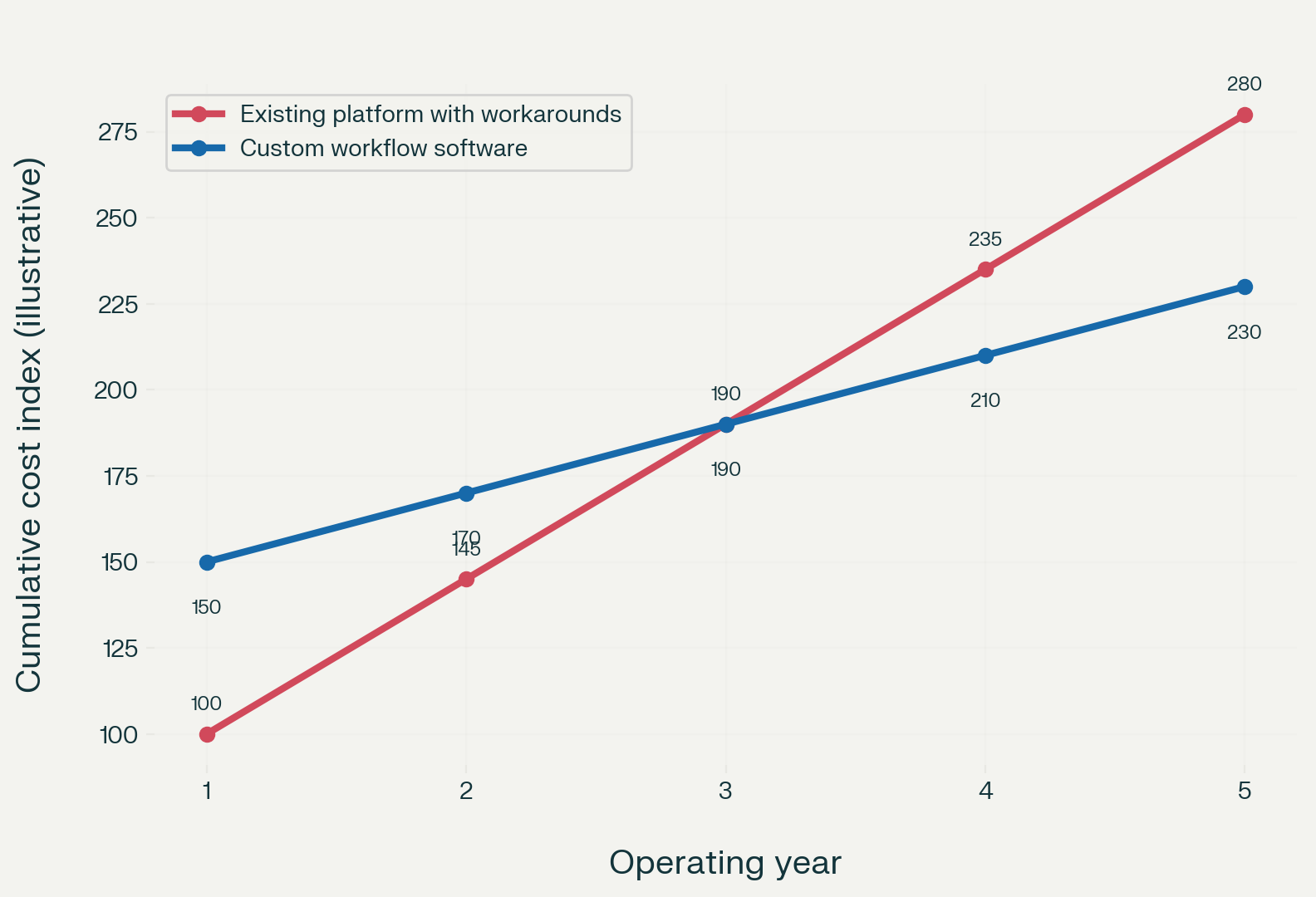
The factors that actually drive cost:
Integration count and complexity: Each connected system adds development, testing, error handling, and long-term maintenance. A modern API-based ERP may cost a fraction of a legacy system with a bespoke connector.
Data migration: Catalog volume, data quality, historical order records, and customer account structures determine whether migration takes weeks or quarters. Poor source data is the most consistently underestimated line in ecommerce projects.
Business rule complexity: Pricing logic, tax handling across jurisdictions, promotion stacking, and configurable products all expand scope significantly.
Workflow depth: Approval chains, quoting, credit management, and fulfillment routing each require design before development.
Experience requirements: A standard responsive storefront costs far less than a bespoke interface with custom configurators or interactive product tools.
Compliance and security scope: PCI scope, regulated industry requirements, and accessibility obligations affect architecture decisions and testing effort.
Infrastructure and operations: Hosting, monitoring, disaster recovery, and the support model carry ongoing costs that belong in the business case from the start.
The cheapest system to build is frequently not the cheapest system to operate for the next five years. That is the calculation that belongs in front of a CFO, and it is the one that makes custom development defensible when it genuinely is.
Build Custom Ecommerce Software Around Your Business
Custom software should fit the way your business works, not the other way around. The right custom ecommerce software development connects the systems, workflows, data, and customer journeys that keep the business moving.
More features do not automatically make better software. Value comes from closing the gaps that cost time, money, and opportunities. From real-time inventory and B2B workflows to pricing, personalization, security, and business intelligence, every feature should have a clear business reason.
The same principle applies to custom retail software development. Start with how the business operates and what customers need. Unique Software Development can then build around those requirements instead of forcing the business into a fixed system.