

Your patient record system was supposed to make care delivery simpler. For a lot of hospitals, it’s done the opposite.
Nurses re-enter the same data into three different screens. Physicians spend more time clicking through templates than talking to patients, averaging upwards of 16 minutes per patient encounter on documentation alone. Reports that should take ten minutes take a week, because nobody can get a straight answer out of the system. And every year, the renewal invoice gets a little bigger while the system itself stays exactly the same.
At some point, hospital leadership stops asking “how do we work around this?” and starts asking a harder question: should we replace it?
What an EHR replacement really costs, the risks nobody mentions in the sales pitch, and a practical framework for custom healthcare software migration that doesn’t put patient care at risk. Hospital leadership can use this guide as a foundational EHR replacement checklist to evaluate their options.
Why More Hospitals Are Reconsidering Their Patient Record System
The reasons are:
Hospitals Chose Stability Over Fit
Most hospitals didn’t choose their current EHR because it was the best fit. They chose it because it was the safe choice, the one every other hospital was buying, the one that wouldn’t get anyone fired if something went wrong.
Years later, the cracks show up in predictable places. Clinical teams encounter deep healthcare workflow inefficiency where software functions as an operational bottleneck, forcing staff to rely on sticky notes, shadow spreadsheets, and side channels just to deliver care.
When Workflow Friction Starts Affecting Patient Care
This UI friction triggers profound clinician burnout as physicians spend significant chunks of each shift on documentation rather than diagnosing patients. Because the legacy platform relies on rigid, canned data formats designed for a generic hospital model, leadership struggles to pull timely reports on throughput, readmissions, or staffing.
Research published by the Agency for Healthcare Research and Quality (AHRQ) confirms that fully mature, rigid EHR systems are heavily correlated with heightened physician stress and increased intent to leave practice entirely.
Rising Costs and Growing Vendor Dependency
Financially, compounding licensing costs escalate with every renewal cycle for a system that remains static. This deepens vendor dependency, putting your internal optimization roadmap at the mercy of their release schedule.
At the same time, fragmentation across billing, scheduling, and clinical tools turns your staff into a manual data integration layer, compounding IT bottlenecks.
Small Problems Eventually Become System-Wide Constraints
None of these problems shows up overnight. They build slowly, until one day the system that was supposed to support your hospital is actively working against it.
Recognizing these patterns early is the first step on any clinical EHR replacement checklist.
What Is Custom Healthcare Software?
Custom healthcare software is a platform built around your hospital’s actual workflows, departments, and patient population, instead of a generic system you have to bend your operations to fit.
That doesn’t mean building everything from scratch. Most custom healthcare software development uses a modular approach: a core architecture designed for your hospital, with components for scheduling, billing, clinical documentation, and reporting built or integrated specifically for how your teams work.
These modular healthcare platforms can deploy on-premise, in the cloud, or as a hybrid, depending on your infrastructure and compliance needs.
By restructuring your platform from the database level up, you establish a unified data architecture. Deploying modern centralized patient record tracking systems ensures your organization eliminates information gaps and streamlines how data streams cross department lines cleanly.
The difference between custom EHR software and an existing record system shows up clearly when you put the two side by side:
| Feature | Traditional Off-the-Shelf EHR | Custom Healthcare Software |
|---|---|---|
| Workflow Flexibility | Limited to rigid vendor templates. | Built entirely around your actual workflows. |
| Integration | Often requires costly workarounds and manual exports. | Designed for your existing tech stack from day one (interoperable healthcare platforms). |
| Reporting | Standard, generic templates that lack depth. | Dashboards built around your hospital’s real-time metrics. |
| Ownership | System changes run on the vendor’s roadmap. | Runs entirely on your roadmap; you own the platform. |
| Long-Term Cost | Recurring licensing fees that compound every year. | Upfront investment with drastically lower long-term overhead. |
The tradeoff is real: custom healthcare software development costs more upfront and takes longer to build than signing a license agreement.
But for hospitals that have outgrown off-the-shelf systems, that tradeoff often pays for itself within a few years; fewer workarounds, less wasted clinician time, and a system that bends to your hospital instead of the other way around.
Addressing these ownership and cost differences is a critical item on an executive EHR replacement checklist.
Cost Analysis: Is Replacing a Patient Record System Financially Worth It?
This is the question every hospital executive eventually has to answer with real numbers, not vague promises. Healthcare software development cost and EHR migration cost break down into the following categories:
The honest answer about custom healthcare software pricing is that it’s a bigger upfront investment than renewing an existing license.
The real question isn’t “what does this cost today?” It’s “What does the cost to replace our patient record system look like next to the cost of staying on it for five more years?” For hospitals already absorbing rising fees, integration debt, and staff turnover tied to documentation burden, that second number is usually larger than leadership expects.
Hidden Risks Hospitals Often Miss Before Replacing Their Record System
A responsible partner will evaluate the technical and operational vulnerabilities before asking you to sign a contract.
Data Migration Is Usually the Highest-Risk Phase
Managing healthcare data migration challenges stands as the highest risk category; migrating thousands of historical records out of older, proprietary vendor schemas requires absolute data validation to prevent loss.
To avoid gaps or broken records during complex database migrations, a strict testing regimen must be enforced. Learning why scripted QA is essential for scaling software highlights why automated code and data validation are mandatory for safeguarding clinical systems during high-stakes transfers.
Downtime Can Disrupt Critical Operations
Downtime in healthcare systems is another critical factor. Because hospitals run continuously, deployment strategies must rely on parallel database staging environments and phased rollouts to secure zero-outage launches.
Adoption Challenges Start Before Go-Live
Organizations also face change management and staff training gaps if clinical teams are not brought into the prototyping phase early.
Without clear governance mapping regarding data models and protocol updates before development kicks off, the new platform runs the risk of hitting interoperability roadblocks with legacy ancillary applications.
The Bottom Line: Replacement makes sense when your current system is actively limiting care quality, scalability, or compliance. If you are reviewing your infrastructure, cross-referencing these hidden migration risks against your EHR replacement checklist will help you determine if you are truly ready for a platform transition.
Step-by-Step Framework for Migrating to Custom Healthcare Software
A successful healthcare software migration process depends on the plan behind it, not the software itself.
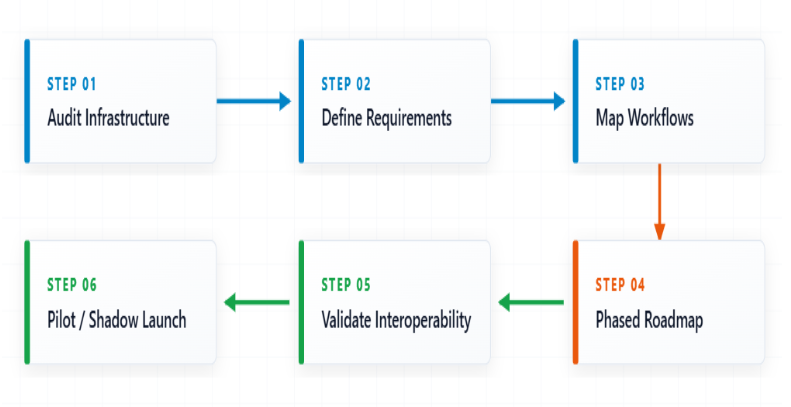
Step 1: Audit your current infrastructure: Document every system, integration, and workaround currently in use. You can’t replace what you haven’t mapped.
Step 2: Define operational requirements: Get direct input from clinical staff, billing, IT, and leadership to isolate systemic bottlenecks.
Step 3: Map clinical workflows: Document how care actually happens at your hospital, department by department, before writing code.
Step 4: Build the migration roadmap: Sequence the rollout by department or location to limit risk, rather than flipping a switch hospital-wide on day one.
Step 5: Validate interoperability: Test every connection to labs, pharmacies, billing systems, and external providers in a sandbox environment before go-live.
Step 6: Pilot before full deployment: Run the new system alongside the old one in a single department first. Track adoption, documentation time, and clinician feedback (healthcare system modernization roadmap).
Build vs Upgrade vs Replace: Which Option Makes Sense?
The optimal path forward depends entirely on where your current system infrastructure is failing. A keep-and-optimize strategy works best if clinical friction is minor and can be resolved through updated internal workflows and targeted staff re-training.
An upgrade framework fits growing networks experiencing localized integration gaps that can be solved via clean API configurations or manufacturer updates. A clean product replacement becomes necessary if your existing vendor announces platform sunsetting or cannot legally keep pace with shifting security compliance rules.
However, engineering a dedicated custom platform represents the ideal choice for multi-site hospital systems, specialized clinical environments, and groups looking to eliminate recurring seat licensing while capturing full ownership over their code and data metrics (custom healthcare software for hospitals).
Partnering with specialized web app development companies in 2026 ensures your new software relies on high-performance frameworks engineered to modern design, security, and scalability benchmarks.
Real Hospital Scenarios Where Custom Healthcare Software Makes Sense
Custom development delivers its highest return on investment in specific, highly complex environments.
Multi-location hospital networks require absolute synchronization across distinct geographical regions to maintain real-time patient charts without latency. Specialty healthcare organizations, such as oncology or behavioral health networks, run on specialized tracking and clinical documentation workflows that general off-the-shelf software cannot handle smoothly.
Rapidly expanding health systems navigating mergers and acquisitions rely on custom architectures to serve as a unified software layer over fragmented legacy assets. Furthermore, intense reporting environments dealing with extensive clinical research data or value-based care metrics use custom development to access deep, flexible analytics dashboards (enterprise healthcare IT solutions).
Signs You Need to Replace Your EHR System
Not every hospital needs a full EHR replacement. Some just need a better-configured version of what they already have. Here’s an EHR replacement checklist to tell the difference.
- Documentation time keeps climbing: If your clinicians are spending more time on charting this year than last year, and nothing in your patient volume explains it, the software is the problem.
- Data lives in silos: Ask a simple question, “How many readmissions did we have last quarter, broken down by department and discharge reason?”, and watch how many people and systems it takes to answer it. If the answer takes days, your data isn’t unified.
- Integration has hit a wall: Every new tool, device, or partner system requires a custom workaround, a manual export, or an expensive third-party connector. This is what healthcare system fragmentation looks like from the inside.
- You’re trying to scale across locations: A single clinic can live with an imperfect system. A multi-site hospital network can’t; inconsistent records across locations create real clinical risk, not just inconvenience.
- Security and compliance reviews keep flagging the same issues: If your audits consistently point back to the same gaps in access control, logging, or data governance, the system itself may not be built to close them.
Quick Self-Check: If three or more of these sound familiar, it’s worth a serious infrastructure review before your next renewal cycle locks you in for another few years. That’s usually the real answer to “is it time to replace hospital EHR”, not a single dramatic failure, but a pattern that’s been building for a while.
Conclusion
Replacing a patient record system isn’t really a software decision. It’s an operations decision that happens to involve software.
For hospitals dealing with workflow friction, clinician burnout, fragmented data, and rising costs that don’t match rising value, custom healthcare software is worth serious consideration as part of any real healthcare digital transformation strategy. Done right, it’s not an expense; it’s an investment in how your hospital runs for the next decade, not just the next renewal cycle.
At Unique Software Development, we build secure, compliant custom infrastructure tailored to your exact clinical workflows.