

Most enterprise CMS decisions come down to a gut feeling, and that gut feeling costs companies hundreds of thousands of dollars. Sitecore and Umbraco both run on the .NET framework, both serve enterprise-grade websites, and both have loyal developer communities.
But they solve completely different problems. One is a fully bundled digital experience platform built for global marketing machines. The other is a lean, open-source CMS that lets your team build exactly what the project needs.
This Sitecore vs Umbraco breakdown cuts through the noise and gives enterprise teams a clear picture of which platform actually fits their roadmap in 2026.
Quick Comparison: Sitecore vs Umbraco at a Glance
The difference between Sitecore vs Umbraco is not just about features. It also comes down to cost, coding architecture, scalability, and long-term flexibility. Below, we compare both platforms across the key areas that matter most, so you can better understand which CMS is the right fit for your business.
| Criteria | Sitecore | Umbraco |
|---|---|---|
| Best for | Global enterprises with complex DXP needs | Mid-market to enterprise teams needing flexibility |
| Licensing | Proprietary, high-cost annual licensing | Open-source; paid cloud tiers available |
| Ease of development | Complex, requires Sitecore-specialist developers | Standard .NET developers handle it well |
| Scalability | Highly scalable, built for global traffic | Scales well with proper architecture |
| Customization | Deep but locked within the Sitecore ecosystem | Fully open; customize anything |
| Marketing tools | Built-in personalization, CDP, analytics | Modular via Umbraco Engage and third-party tools |
| Headless support | Yes, via XM Cloud and GraphQL | Yes, fully API-first and headless-ready |
| Learning curve | Steep — editors and developers need platform training | Moderate — editors onboard fast |
| Time to launch | 12–18 months typical | ~4 months typical |
| Enterprise readiness | Full enterprise DXP suite | Enterprise-ready CMS without suite overhead |
| Hosting flexibility | Sitecore Cloud or managed environments | Umbraco Cloud, Azure, AWS, any host |
| AI readiness | AI tied to Sitecore’s roadmap and licensing | Open AI integrations; fully composable |
| Support ecosystem | Sitecore-certified partner network | Large open-source community + commercial support |
If this choice feels confusing, we can help determine your true technical objectives. Our experts analyze your roadmap to deploy whichever platform cuts your costs and scales your business.
Sitecore vs Umbraco: Core Differences
Before going feature by feature, the most important thing to understand is that these two platforms come from completely different philosophies, and that philosophy shapes every decision downstream.
- Architecture philosophy: Sitecore ships as a tightly coupled, all-in-one DXP. Everything, content, data, personalization, analytics, lives inside Sitecore’s ecosystem. Umbraco ships as an open content foundation. You bring the tools you need, connect them via API, and keep full architectural control.
- Licensing model: Sitecore uses proprietary, enterprise-grade licensing that typically costs $40,000–$100,000+ per year before implementation. Umbraco is open-source with optional paid tiers. The core platform is free.
- Developer ecosystem: Sitecore requires platform-certified specialists. Umbraco runs on mainstream .NET, which means the developer talent pool is larger, hiring costs are lower, and onboarding new team members takes weeks, not months.
- Implementation style: Sitecore implementations follow a structured, often consultant-heavy approach. Umbraco projects move faster, with smaller teams, shorter sprints, and less ceremony around deployments.
- Enterprise positioning: Sitecore targets the Fortune 500 bracket, organizations with dedicated martech teams, organizations with complex governance needs, and organizations with large IT budgets. Umbraco serves mid-market to enterprise organizations that need serious CMS power without the full DXP overhead.
What Is Umbraco?
Umbraco is an open-source CMS built on Microsoft .NET, first released in 2004 and now used by over 700,000 websites worldwide. It offers a flexible content modeling system, a clean editor interface, and strong API-first capabilities that make it equally effective as a traditional CMS or a headless content hub.
The platform’s real strength is its composability. Developers extend it through packages, custom integrations, and open APIs, so organizations can build exactly the stack they need rather than adopting an entire suite they did not ask for.
Umbraco Pros
- Open-source with zero licensing cost on the core
- Clean, intuitive editing UI, editors learn it in days
- Standard .NET architecture, hire any .NET developer
- API-first and headless-ready out of the box
- Umbraco Cloud automates hosting, upgrades, and deployments
- 60–70% lower TCO than Sitecore in most implementations
Umbraco Cons
- Built-in personalization requires Umbraco Engage (additional cost)
- Fewer native marketing automation features compared to Sitecore
- Large-scale multisite governance needs careful custom architecture
- Community packages vary in quality.
What Is Sitecore?
Sitecore is a proprietary Digital Experience Platform built on .NET, positioned for large enterprises that need unified content, personalization, analytics, and marketing automation inside a single platform. With XM Cloud, Sitecore moved toward a fully SaaS-based, composable DXP model in recent years.
The platform excels at delivering personalized experiences across channels at scale, but that capability comes with significant investment in licensing, specialized talent, and implementation time.
Sitecore Pros
- Industry-leading built-in personalization and CDP
- Native marketing automation, analytics, and multisite management
- Strong enterprise governance and workflow controls
- XM Cloud supports modern headless architecture
- Deep integration with Salesforce, SAP, and major enterprise tools
- Proven at a global scale with multinational organizations
Sitecore Cons
- Licensing starts at $40,000/year and scales significantly
- Implementations routinely take 12–18 months
- Specialist developers are expensive and harder to find
- Upgrades require significant technical involvement
- Editor onboarding takes longer than most CMS platforms
- Total cost of ownership is among the highest in the market
Sitecore vs Umbraco: Feature-by-Feature Comparison
Here is a breakdown of the key features in Sitecore vs Umbraco, so you can better understand how each platform compares in terms of scalability, flexibility, development experience, and enterprise capabilities.
Ease of Development
Umbraco uses standard .NET patterns that any .NET developer knows immediately. Sitecore requires platform-specific knowledge, significantly increasing ramp time and developer costs.
Content Editing Experience
Umbraco’s editing UI scores 8.7/10 on G2 for ease of use. Sitecore scores 7.0/10; editors consistently report needing more training to stay productive.
Personalization and Marketing Automation
Sitecore leads here with native CDP, AI personalization, and omnichannel automation built in. Umbraco achieves personalization through Umbraco Engage or third-party martech integrations.
Headless CMS Capabilities
Both platforms support headless delivery via REST and GraphQL APIs. Umbraco offers a full decoupled architecture without additional licensing. Sitecore’s headless features run on XM Cloud.
Security and Compliance
Both platforms meet enterprise security standards. Sitecore provides built-in security governance tools and compliance reporting. Umbraco relies on .NET security best practices with configurable permissions.
Scalability for Enterprise Teams
Sitecore handles global-scale traffic natively within its managed infrastructure. Umbraco scales well when architected correctly. It has powered high-traffic enterprise properties without issues.
Third-Party Integrations
Umbraco integrates with any tool via open APIs without ecosystem lock-in. Sitecore integrates deeply with enterprise systems, though some integrations require paid Sitecore products.
Cloud Hosting Flexibility
Umbraco runs on any cloud provider, Azure, AWS, Google Cloud, or Umbraco Cloud. Sitecore primarily targets its own managed cloud environment, reducing hosting flexibility.
AI and Automation Readiness
Umbraco accepts any AI integration through open APIs, making it composable for custom AI workflows. Sitecore’s AI features follow its platform roadmap and licensing model.
Multisite and Multilingual Support
Both platforms support multisite and multilingual publishing. Sitecore handles global governance natively. Umbraco manages this through its multisite architecture with proper configuration.
Performance and Page Speed
Both platforms deliver strong Core Web Vitals when properly configured. Umbraco’s lighter footprint often produces faster cold-start performance in lean implementations.
Workflow and Governance
Sitecore provides enterprise-grade publishing workflows, approval chains, and audit trails out of the box. Umbraco supports workflow through configuration and available packages.
Developer Availability
.NET developers move into Umbraco projects quickly. Sitecore-certified developers represent a smaller talent pool, which directly affects hiring timelines and rates.
Cost of Sitecore Website Development vs Umbraco
This section is the real decision-maker for most enterprise teams. The feature gap between these two platforms is real but often overstated. The cost gap is enormous.
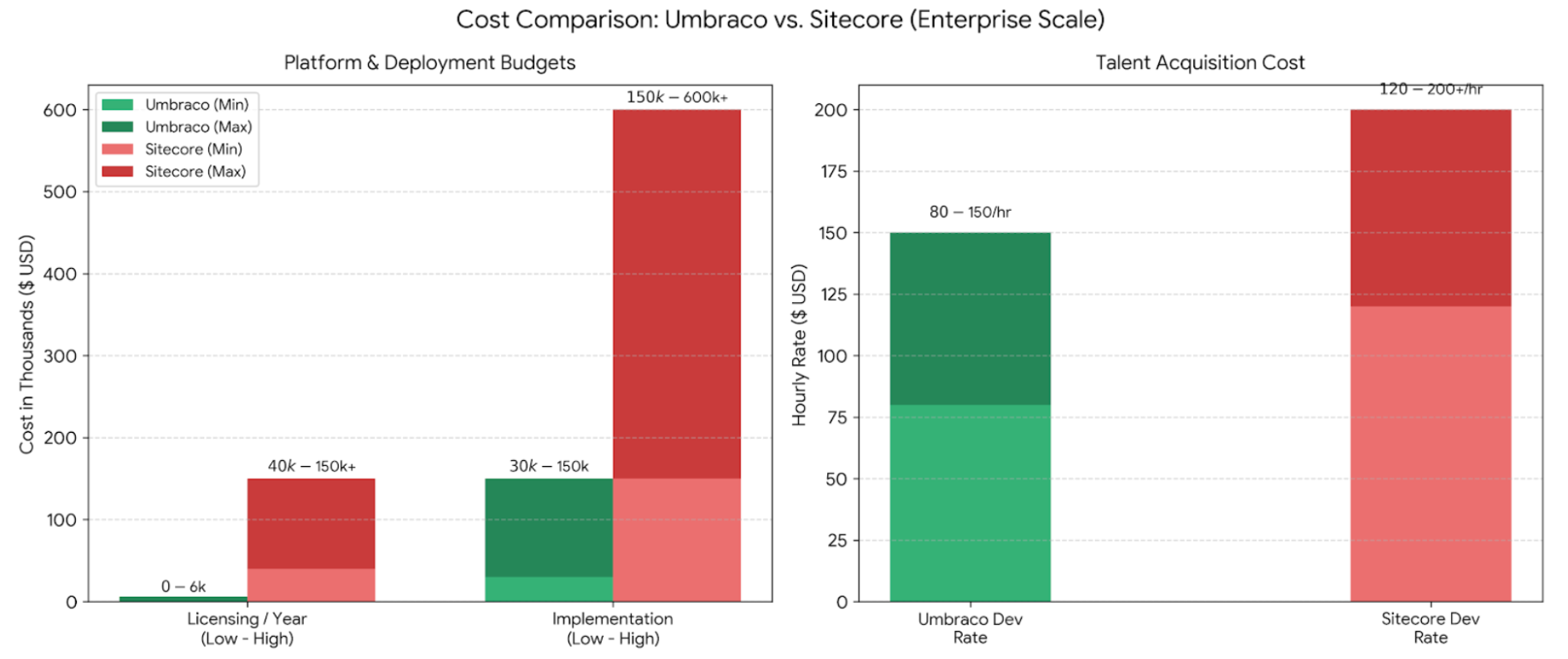
5-Year Total Cost of Ownership Comparison:
| Cost Category | Umbraco (5 Years) | Sitecore (5 Years) |
|---|---|---|
| Licensing | $0–$30,000 | $200,000–$750,000 |
| Implementation | $50,000–$150,000 | $250,000–$1,000,000+ |
| Developer maintenance | $40,000–$100,000 | $150,000–$400,000 |
| Hosting | $30,000–$60,000 | $100,000–$300,000 |
| Upgrades | $10,000–$30,000 | $50,000–$200,000 |
| Total estimate | $130,000–$370,000 | $750,000–$2,650,000+ |
The numbers reflect a consistent pattern across the industry: organizations that migrate from Sitecore to Umbraco report 60–70% reductions in total cost of ownership.
Expert Perspective
CTO Insight: “The biggest mistake enterprise teams make is treating Sitecore’s licensing as the only cost. The real cost is ongoing developer dependency. Every change, every upgrade, every integration typically requires a Sitecore-certified resource. With Umbraco, a standard .NET team can usually handle day-to-day platform work.”
Which CMS Is Easier to Develop and Maintain?
Umbraco wins this category on nearly every practical metric.
- Deployment pipelines: Umbraco Cloud provides built-in CI/CD pipelines with environment management (development, staging, production). Sitecore implementations typically require custom DevOps configuration and platform-specific tooling.
- Debugging: Both platforms sit on .NET, but Sitecore’s added abstraction layers, templates, rendering engines, and platform-specific patterns introduce more surface area for issues. Sitecore project errors often require specialist diagnostics.
- Testing workflows: Umbraco supports standard .NET testing frameworks without platform-specific workarounds. Scripted QA runs cleanly in Umbraco environments. Sitecore QA requires testers familiar with the platform’s content tree structure and rendering pipeline.
- Release management: Umbraco Cloud automates major version upgrades for cloud-hosted projects. Sitecore upgrades, particularly across major versions (XP to XM Cloud migrations), routinely take months and require dedicated solution engineering resources.
- Upgrade cycles: Umbraco releases follow a predictable schedule with clear migration paths. Sitecore’s shift from XP to XM Cloud created significant upgrade complexity for existing customers; many organizations still operate on unsupported legacy versions because the migration cost is prohibitive.
The bottom line for development teams: Umbraco substantially reduces operational overhead. That reduction shows up in faster deployments, lower developer burn, and far fewer emergency escalations.
Developer Perspective
Sitecore has incredible capabilities, but you spend a lot of time fighting the platform instead of building the product. With Umbraco, you spend that time on actual web app development, the features your client actually asked for.
Sitecore vs Umbraco for Modern AI-Driven Digital Experiences
This is the section most competitor articles skip entirely, and it is the most important strategic consideration for 2026 and beyond.
- AI personalization: Sitecore includes native AI personalization through its XM Cloud and Personalize products. The system uses behavioral data to deliver individualized content experiences across channels. The limitation is that this AI operates within Sitecore’s data model and cannot easily integrate with external AI systems.
- Umbraco takes a composable approach. Organizations connect OpenAI, Azure AI, or any AI service via standard APIs. This flexibility lets teams build autonomous AI workflows, integrate custom machine learning models, and adopt new AI tools as the technology evolves, without waiting for a platform vendor to release support.
- AI-assisted content operations: Both platforms support AI-assisted writing tools. Umbraco’s open architecture lets teams embed tools like Claude, GPT-4, or custom models directly into the editorial workflow. Sitecore’s AI features follow its product roadmap and require platform-level updates to add new capabilities.
- Semantic search: Umbraco supports vector search and semantic retrieval through external integrations. Teams building intelligent content discovery experiences have more architectural freedom with Umbraco’s open API surface.
- Autonomous workflows: The shift toward agentic A!, systems that take action, not just generate text, favors open, API-first architectures. Umbraco’s composable foundation accommodates autonomous AI systems more naturally than Sitecore’s bundled ecosystem.
- Composable DXP future: Gartner has consistently tracked the shift from monolithic DXPs toward composable architectures. Umbraco was built composable from the ground up. Sitecore responded to this shift with XM Cloud, but the transition from legacy Sitecore to a composable model remains complex.
- API-first ecosystems: Umbraco’s content delivery API works with any frontend framework, React, Next.js, Vue, or a native mobile app. AI development services that build on top of CMS content benefit significantly from this openness.
Which Platform Is Better for Ecommerce?
| Ecommerce Factor | Umbraco | Sitecore |
|---|---|---|
| Native commerce | Via the Umbraco Commerce add-on | Via Sitecore OrderCloud |
| Shopify integration | Clean API-based integration | Supported via connectors |
| BigCommerce integration | Headless storefront composability | Supported with configuration |
| Custom commerce builds | Fully custom via open architecture | Possible, but within the Sitecore ecosystem |
| B2B commerce | Strong with custom development | Sitecore OrderCloud handles complex B2B |
| Composable commerce | Native composability | Composable with XM Cloud stack |
| Implementation cost | Lower | Significantly higher |
For pure ecommerce brands, particularly those using Shopify or BigCommerce as their commerce engine, Umbraco works exceptionally well as a headless content frontend.
The platform connects cleanly to any commerce backend. Sitecore’s OrderCloud handles complex B2B commerce scenarios where personalization, pricing rules, and customer segmentation intersect with content, but the cost and complexity are substantial.
When Sitecore Is the Better Choice
Sitecore makes the most sense in specific enterprise scenarios:
- Global corporations with dedicated martech teams running personalization at scale
- Organizations already deep in the Sitecore ecosystem with existing infrastructure
- Enterprises that need native CDP, marketing automation, and content management in one licensed product
- Companies with $500,000+ annual digital platform budgets
- Industries like financial services and healthcare, where compliance and built-in governance are non-negotiable
- Organizations running complex multiregion campaigns with advanced segmentation requirements
- Teams that want a single vendor for their entire digital experience stack
When Umbraco Is the Better Choice
Umbraco fits a broader range of enterprise scenarios:
- Organizations that want enterprise capability without an enterprise-level platform bill
- Teams that need to launch faster, Umbraco projects go live in roughly 4 months versus 12–18 months for Sitecore
- Companies that prefer to choose best-of-breed tools for marketing, analytics, and personalization separately
- Organizations with strong .NET development teams that want architectural freedom
- Businesses are moving from legacy Sitecore versions, where upgrade costs have become unsustainable
- Mid-market companies growing toward enterprise scale
- Any organization that wants full source code access and no vendor lock-in
- Teams building custom digital experiences where the CMS is a content API, not a user interface
Sitecore vs Umbraco: Which CMS Fits Your Business Type?
| Business Type | Better Choice | Why |
|---|---|---|
| Startup | Umbraco | Low cost, fast launch, no licensing barrier |
| Mid-market | Umbraco | Enterprise features at a fraction of the cost |
| Large enterprise | Depends on needs | Sitecore if DXP features are core; Umbraco if content flexibility matters more |
| Ecommerce brand | Umbraco | Composable commerce with any backend |
| SaaS company | Umbraco | API-first content delivery for product marketing sites |
| Healthcare | Sitecore or Umbraco | Both handle compliance; Sitecore adds native governance |
| Education | Umbraco | Cost-effective, editor-friendly, multisite capable |
| Multi-location businesses | Umbraco | Flexible multisite at lower TCO |
Common Mistakes Businesses Make When Choosing a CMS
Most enterprises get this wrong for predictable reasons:
- Choosing enterprise software too early: Teams buy Sitecore when they need Umbraco, the features they are paying for will not get used for two years, but the license costs start on day one.
- Underestimating maintenance: A CMS is not a one-time build. Sitecore’s ongoing maintenance requirements catch organizations off guard 18 months into a deployment.
- Ignoring developer availability: Choosing Sitecore in a market where Sitecore-certified developers are scarce creates permanent delivery bottlenecks. The choice of technology should match the talent supply.
- Focusing only on features: The features comparison is 10% of the decision. The 90% is the total cost, team capability, and long-term architectural flexibility.
- Not planning for scalability: Both platforms scale, but Umbraco’s scaling costs far less. Teams that plan for growth on Sitecore are often locked into infrastructure costs that grow faster than their business.
- Treating upgrades as optional: Sitecore versions go end-of-life. The cost of staying current is a line item that most initial project budgets do not include.
Final Verdict: Sitecore vs Umbraco
The trend in the enterprise CMS market is clear. G2 data shows Umbraco consistently outpacing Sitecore on key usability indexes, earning top marks for meeting user requirements from a massive community of verified reviewers. More enterprise organizations choose Umbraco each year precisely because the platform delivers serious capability without locking them into a $2 million, five-year commitment.
However, the choice between Sitecore vs Umbraco isn’t about which platform wins on paper. It’s about which one fits your actual operational model. If you are a global marketing machine that demands pre-bundled, AI-driven personalization engines out of the box, Sitecore remains a heavyweight contender. If you prioritize development speed, architectural freedom, and a highly reduced total cost of ownership, Umbraco is the modern enterprise standard.
If this choice feels confusing, we can help determine your true technical objectives. Our .NET experts analyze your roadmap to deploy whichever platform cuts your costs and scales your business.