


The total cost of Sitecore website development generally spans from $120,000 to over $1,000,000 across its deployment lifecycle. On paper, most executive teams assume the expense ties cleanly to the initial software license and primary implementation. In reality, that upfront sticker price represents only a small fraction of your total operational investment.
What usually gets overlooked is everything that happens after the initial build. Custom integrations with CRM and marketing tools, content migration from legacy systems, infrastructure scaling, and the ongoing need for specialized Sitecore developers to maintain and evolve the platform.
This guide breaks down those hidden cost drivers in detail so you can understand what actually drives Sitecore investment, and whether the platform fits your long-term digital strategy.
Quick Overview: Hidden Cost of Sitecore Website Development
Sitecore costs extend far beyond the platform license. Here is what businesses actually pay for across the full project lifecycle:
- Licensing tiers and annual renewals: $150,000 to $350,000, depending on edition
- Cloud infrastructure and hosting: $2,000 to $15,000+ monthly
- Custom development: $150 to $250 per hour for experienced Sitecore developers
- Third-party integrations: $10,000 to $80,000 per integration
- Content migration: $15,000 to $100,000 depending on volume
- DevOps and deployment management: $3,000 to $12,000 monthly
- Performance optimization: $20,000 to $60,000 for complex environments
- Version upgrades: $30,000 to $150,000 every major release cycle
- Staff training: $5,000 to $25,000 per team onboarding cycle
- Technical debt remediation: $50,000 to $200,000+ for over-customized builds
According to historical data across the enterprise segment, these figures reflect the compounding expenses companies face when they implement a rigid platform without a highly strategic architectural roadmap.
Sitecore estimates often look complete until implementation begins. Licensing, development, hosting, integrations, migration, DevOps, and support all sit in different budget lines. If you want a clearer view of your actual Sitecore investment, Unique Software Development can review your requirements and identify the cost areas most likely to expand after launch.
Why Sitecore Costs Are Routinely Underestimated
Businesses walk into Sitecore expecting a CMS. What they get is an enterprise platform ecosystem that requires specialized architecture, dedicated infrastructure, and developer expertise that most internal teams simply do not have on staff.
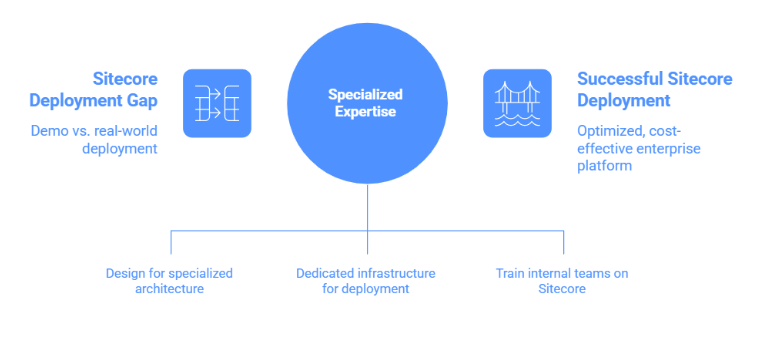
The demo environment Sitecore shows you runs on optimized, pre-configured infrastructure. Your real-world deployment runs on your business logic, your legacy data, your compliance requirements, and your team’s bandwidth.
That gap between demo and deployment is where budgets fracture. Enterprise CMS projects become operationally expensive because every customization adds a maintenance obligation, every integration adds a failure point, and every version upgrade touches everything your developers built before.
What Drives Up Sitecore Engineering Costs?
The total investment in Sitecore is not one cost. It is six to eight cost categories that compound over time, and most vendors only quote you the first one.
Licensing and Platform Tiers
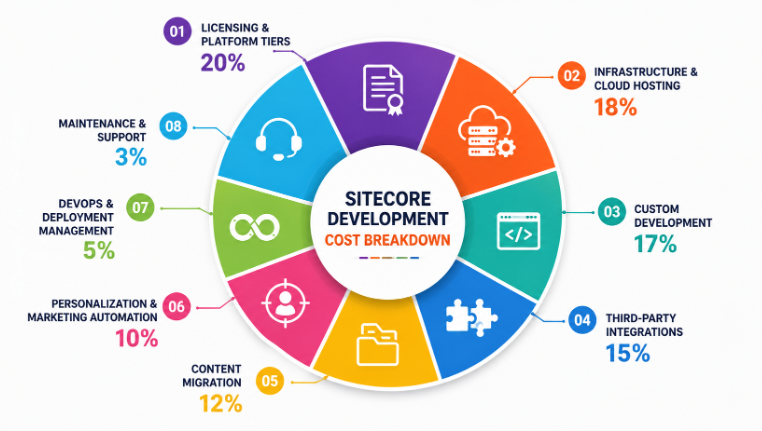
Sitecore moved to a composable SaaS model with XM Cloud, but licensing still runs between $150,000 to $350,000+ annually depending on traffic volume, modules selected, and contract terms.
Organizations that need CDP, Personalize, or Send stack additional subscription fees on top of core CMS access.
Infrastructure and Cloud Hosting
Sitecore requires serious cloud infrastructure. Azure or AWS environments for production, staging, and development environments combined typically cost $2,000 to $8,000 per month.
Content delivery networks, search infrastructure like Solr or Azure Search, and load balancing add further to that base.
Custom Development Requirements
Out-of-the-box Sitecore rarely fits enterprise business requirements. Custom renderings, workflow configurations, headless architecture builds, and unique business logic push development budgets into the $150 to $250 per hour range before you launch a single page.
Third-Party Integrations
Sitecore connects to CRMs, marketing automation platforms, ERP systems, and analytics tools. But those connections require custom middleware or certified connectors. Each integration costs development time plus ongoing maintenance when APIs change on either end.
Content Migration Complexity
Moving thousands of pages from a legacy CMS into Sitecore’s item tree, mapping fields, preserving SEO metadata, and validating rendering output takes longer than any project plan predicts. We have seen content migrations alone consume 30% of a total project budget.
Personalization and Marketing Automation
Sitecore’s personalization engine is genuinely powerful. It is also complex to configure correctly. Rules-based personalization, xConnect data integration, and campaign tracking require dedicated configuration work that many teams skip in launch, then struggle to activate later.
Ongoing DevOps and Deployment Management
Sitecore does not deploy itself. CI/CD pipelines, environment management, deployment scripting, and release coordination require dedicated DevOps capacity. Organizations without a mature DevOps practice spend significantly more managing Sitecore environments than they planned.
The Hidden Costs Most Businesses Discover Too Late
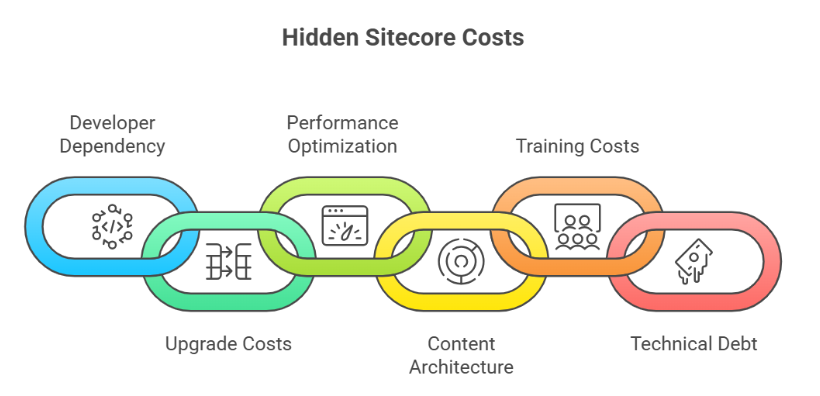
These are the costs that kill Sitecore project confidence. Because they appear six, twelve, or eighteen months after go-live.
Developer Dependency and Specialized Talent
Sitecore developers cost $120 to $200 per hour on the open market. Hiring full-time Sitecore engineers takes months. When companies look to hire specialized application developers to offset internal gaps, they often face high market rates.
Upgrade and Version Migration Costs
Sitecore releases major version updates regularly. Moving from Sitecore 9 to 10 or from XP to XM Cloud is not a patch update. For complex enterprise web applications, it requires full environment rebuilds. This costs around $50,000 to $150,000 per migration cycle.
Performance Optimization Overhead
Sitecore performance requires active management. Implementing proper Site Reliability Engineering (SRE) principles ensures caching rules, Lucene or Solr indexing, rendering performance, and CDN configuration must be tuned continuously. Neglect any one layer and page load times degrade quickly, hurting both UX and SEO rankings.
Content Architecture Mistakes
A poorly designed content tree in Sitecore creates years of technical debt. When information architecture decisions made at launch do not scale, fixing them means rebuilding template hierarchies, re-mapping data, and rewriting rendering logic across the entire site.
Training Non-Technical Teams
Marketing teams need to manage content without breaking layouts. Training content editors on Sitecore’s Experience Editor, workflow tools, and publishing pipeline takes meaningful time and budget. A cost of Sitecore website development that most implementation contracts leave completely out of scope.
Technical Debt from Over-Customization
Sitecore allows deep customization. That flexibility becomes a liability when teams build workarounds instead of using platform features correctly. Over-customized Sitecore instances become brittle, expensive to maintain, and nearly impossible to upgrade without major rework.
Sitecore Implementation Cost by Business Type
Every organization comes to Sitecore with different requirements, traffic patterns, and integration needs. Here is a realistic breakdown of cost of Sitecore website development by implementation type:
| Business Type | Estimated Total Year-One Cost | Key Cost Drivers |
|---|---|---|
| Mid-Sized Business Website | $120,000 – $250,000 | Licensing, custom dev, basic integrations |
| Enterprise Multi-Site Ecosystem | $400,000 – $900,000+ | Multi-environment infrastructure, complex architecture, governance |
| Ecommerce Implementation | $250,000 – $600,000 | Commerce module, order management integration, performance at scale |
| Multi-Region or Multilingual Platform | $300,000 – $700,000+ | Language management, regional infrastructure, localization workflows |
These ranges include licensing, development, infrastructure, and first-year maintenance. They do not include ongoing content production, campaign management, or future version upgrades.
The 5-Year Total Cost of Ownership: What Sitecore Really Costs
Most budget conversations stop at year one. That is the wrong frame. The real financial decision is what Sitecore costs across five years, because that is the window where the platform either justifies itself or becomes an expensive mistake.
Here is what a realistic 5-year TCO looks like across the two most common deployment profiles:
| Year | Business Stage | What Teams Usually Expect | What Actually Becomes Expensive | Estimated Cost Range |
|---|---|---|---|---|
| Year 1 | Foundation & Launch | Licensing, design refresh, website migration | XM Cloud architecture decisions, CRM integrations, DevOps setup, rebuilding reusable components | Mid: $150k+ Enterprise: $450k+ |
| Year 2 | Adoption & Workflow Expansion | Minor optimization and staff onboarding | Governance friction, localization workflows, personalization setup, internal training | Mid: $30k+ Enterprise: $90k+ |
| Year 3 | Personalization & Scaling | Adding marketing features and microsites | CDP integrations, testing infrastructure, data complexity, performance tuning | Mid: $35k+ Enterprise: $100k+ |
| Year 4 | Operational Maintenance | Routine support and small fixes | Technical debt cleanup, API optimization, security hardening, dependency updates | Mid: $20k+ Enterprise: $75k+ |
| Year 5 | Platform Evolution | UI modernization and feature expansion | Omnichannel delivery, headless architecture upgrades, legacy compatibility work | Mid: $40k+ Enterprise: $120k+ |
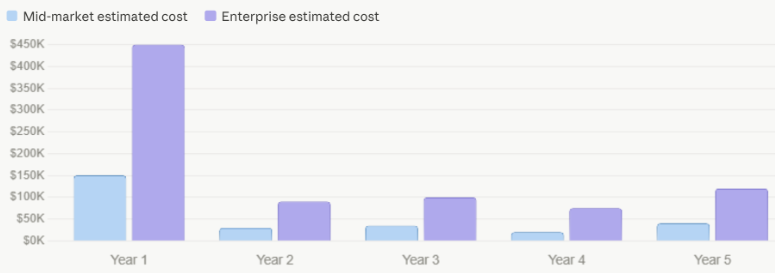
The 5-year TCO chart breaks down the persistent operational costs that surface long after the initial implementation phase.
- The Year 1 Capital Spike: The graph clearly shows that Year 1 demands the heaviest capital investment, with mid-market implementations starting around $150,000 and enterprise instances soaring past $450,000. This is driven by deep infrastructure setups, legacy migrations, and system integrations.
- The Year 2–5 Operational Tail: While costs drop sharply in Year 2, they do not flatline. Instead, the graph reveals a cyclical undulating pattern.
As platforms scale through data complexity in Year 3 or undergo inevitable headless modernization in Year 5, mid-market businesses routinely face $20,000 to $40,000 in annual maintenance, while enterprise environments scale between $75,000 and $120,000 annually just to stay optimized.
The predictable spike and ongoing tail in this graph highlight a common architectural trap: platforms built with rigid frameworks inherently accumulate expensive maintenance cycles. By engineering modern, decoupled front-ends and lightweight backend API integrations, you can decouple your growth from exponential vendor maintenance fees.
When Sitecore Is Worth the Investment?
Sitecore earns its price tag when your organization runs multiple brands, serves millions of sessions monthly, requires deep personalization, and has dedicated technical resources to manage a complex platform.
For global enterprises with complex content operations, Sitecore delivers genuine competitive advantage. For mid-sized businesses publishing standard marketing content with moderate traffic, the cost of Sitecore website development is almost always overkill. Simpler platforms, including WordPress VIP, Contentful, or Optimizely, deliver faster time to value at significantly lower total cost.
The businesses that benefit most from Sitecore are those with active personalization programs, multi-site governance needs, and development teams experienced enough to maintain custom implementations over time. If that does not describe your organization today, choosing the best eCommerce platform or CMS for your actual requirements, not your aspirational ones, will produce better outcomes.
How Sitecore Compares to Other Enterprise CMS Platforms
Sitecore competes in a crowded enterprise CMS market, and price alone does not tell the full story. Here is how the platforms compare across the dimensions that matter most:
| Platform | Licensing Cost | Maintenance Complexity | Flexibility | Developer Requirement | Scaling |
|---|---|---|---|---|---|
| Sitecore XM Cloud | $40K–$100K+/yr | High | Very High | Specialized (.NET + Sitecore certified) | Enterprise-grade |
| Adobe Experience Manager | $250K–$500K+/yr | Very High | High | AEM certified (Java/OSGi) | Enterprise-grade |
| WordPress VIP | $15K–$40K+/yr | Medium | High | General WordPress/PHP | Mid to large scale |
| Optimizely (Episerver) | $30K–$80K+/yr | High | High | .NET specialized | Enterprise-grade |
| Contentful | $10K–$50K+/yr | Low | High (headless) | Any modern stack | Very scalable |
| Drupal | Open source + hosting | Medium-High | Very High | PHP specialized | Enterprise capable |
The cost of Sitecore website development is cheaper than Adobe Experience Manager and more flexible than Contentful for multi-site scenarios. But it requires more specialized developer talent than WordPress VIP and carries higher maintenance complexity than Optimizely for comparable feature sets.
How to Reduce Sitecore Costs Without Hurting Performance
Strategic decisions made before development begins save more money than optimizations made after launch. We have worked with organizations that cut their Sitecore total cost by 30 to 40 percent simply by making smarter architecture choices early.
- Choose the right implementation scope. Build only what your business requires in year one. Sitecore’s modular architecture lets you add capabilities over time.
- Avoid unnecessary customization. Use Sitecore’s built-in features before building custom solutions. Every custom component adds a maintenance burden. We help teams identify where platform features solve the problem and where custom development genuinely adds value.
- Start with scalable architecture. Headless Sitecore with a decoupled front end scales better, deploys faster, and costs less to maintain than traditional MVC implementations.
- Use experienced Sitecore consultants early. Fixing Sitecore project errors after launch costs three to five times more than preventing them during architecture review.
- Plan governance before development begins. Content workflows, publishing permissions, environment management policies, and deployment processes need documentation before the first sprint. Organizations that skip governance planning spend disproportionate time managing chaos after launch.
Signs You Are Overpaying for Sitecore
Most Sitecore overspending does not happen because someone made a single bad decision. It accumulates through a series of smaller missteps, each of which seems reasonable at the time. Here are the warning signs that your Sitecore investment is bleeding budget unnecessarily.
- Your Sitecore bill grows every year but your site capabilities do not
Licensing costs scale with traffic and module usage. If your annual Sitecore spend increases year over year but you are likely paying for capacity you are not using.
- Your development team spends more time maintaining custom code than building new features
Every unnecessary customization creates a maintenance obligation. If your developers spend more than 40% of their sprint capacity maintaining existing Sitecore customizations rather than delivering new functionality, your technical debt has crossed from manageable to structural.
- You skipped a major version upgrade because it felt too expensive
Organizations running on outdated Sitecore versions face compounding technical debt, security vulnerability exposure, and increasingly expensive future migration costs. If you have skipped a major version because the upgrade quote was too high, that number will only grow.
- Your Sitecore partner cannot explain what you are paying for each month
Vague retainer invoices with line items like “general maintenance” or “support hours” without specifics are a red flag. Legitimate Sitecore partners itemize work against specific tickets or deliverables.
- You have personalization features turned on but nobody configured them
Sitecore’s personalization and CDP tools carry real subscription costs. If those modules are active on your license but your marketing team is not running active personalization programs, you are paying for enterprise capabilities that are delivering zero ROI.
- Your content editors need developer support to publish pages
If your editorial team requires a developer to publish content, update templates, or make layout changes, your implementation was not built for content editor efficiency. This creates a hidden labor cost
- You have never had an architecture review by someone outside your original implementation partner
Implementation partners have an inherent conflict of interest when auditing their own work. If the same team that built your Sitecore instance is also the team telling you everything is optimized, you have a blind spot.
Why Expert Sitecore Consulting Matters
Sitecore’s flexibility is its greatest strength and its greatest risk. The platform can do almost anything. Which means implementation teams face hundreds of architectural decisions before writing a single line of production code.
The wrong decisions at that stage do not just slow projects down. They create technical debt that compounds over years, making future development slower, more expensive, and increasingly fragile.
Expert Sitecore consulting is not about having someone write code faster. It is about having people in the room who have seen what breaks, what scales, and what turns into a maintenance disaster eighteen months after launch.
We have guided organizations through implementations where early architecture review prevented six-figure rework costs. We have also stepped into projects mid-stream, identified over-customization patterns and scripted QA gaps, and restructured delivery plans that recovered both timelines and budgets.
Final Thoughts: The Real Cost of Sitecore Website Development Is Operational Complexity
The biggest expense in any Sitecore project is rarely the license itself. It is the long-term cost of managing complexity poorly.
Organizations that treat Sitecore as a software purchase rather than a platform commitment consistently overspend, underperform, and find themselves locked into unmaintainable custom implementations built by developers who are no longer on staff.
Understanding the full cost of Sitecore website development before you commit is not pessimism. It is the only way to make a decision that holds up three years from now.