

A 250-truck transportation company can lose six figures a year without losing a single customer. Small inefficiencies in dispatch, fuel, mileage, billing, maintenance, and daily operations can quietly add up to a major cost.
Better monitoring helps companies spot these problems earlier, make faster decisions, and reduce unnecessary costs. That is why logistics software has become an important part of fleet operations.
But standard software does not always fit the way every transportation company works. A fleet may pay for features it does not need while still lacking the tools required for its specific workflows. This can leave teams relying on manual workarounds or separate systems to fill the gaps.
Custom logistics software development allows transportation companies to build the workflows and tools they actually need into one system.
Where Transportation Operations Lose Money Before Management Sees It
Transportation companies rarely lose money through one obvious failure. More often, costs accumulate quietly across disconnected systems, manual handoffs, inefficient routes, delayed decisions, billing gaps, and preventable downtime. By the time management sees the numbers, the underlying inefficiencies may have already repeated thousands of times across the fleet.
Fragmented Data Creates Expensive Blind Spots
A shipment can pass through six or more operational stages before revenue reaches the books:
Order → Load assignment → Dispatch → Transit → Proof of delivery → Billing
If each stage depends on a different system or manual handoff, information can arrive late, appear in duplicate, or require human verification.
The result is more than administrative inconvenience.
A dispatcher may not see a delivery exception until a customer calls. Accounting software for trucking companies may wait for proof of delivery before issuing an invoice. A manager may receive a fleet report after the opportunity to correct a route has already passed.
The critical metric is not the number of software products in use. It is the number of manual touches required to move one shipment from order to cash.
For a company with 10,000 monthly shipments, cutting only 2 minutes of manual work from each shipment removes more than 333 labor hours per month, or roughly 4,000 hours per year.
That is operational capacity that can return to higher-value work.
Tracking a Truck Is Not the Same as Controlling a Fleet
Better routing and fleet monitoring can measurably reduce transportation costs. In an EPA SmartWay case study, one frozen-food operator that implemented route optimization software reported a $400,000 reduction in monthly transportation costs, a 12% improvement in on-time delivery, 90% fewer brokered loads, and a 10% smaller fleet. The result came from optimizing routes against factors such as orders, delivery windows, vehicle characteristics, route restrictions, and driver hours.
Remember, GPS can answer one basic question:
Where is the truck?
But transportation managers need to answer several more:
- Is the truck on schedule?
- What is the predicted arrival time?
- Has the vehicle deviated from its planned route?
- Does the driver have enough available hours?
- Has the shipment reached the required milestone?
- Is the vehicle carrying a time-sensitive load?
- Does the dispatcher need to intervene now?
GPS alone does not answer these questions. Location data becomes much more valuable when it is connected with routing, driver hours, shipment status, vehicle information, and dispatch workflows.
This is where dispatch software with GPS and telematics can provide greater operational control. Instead of giving dispatchers another map to monitor, a connected system can combine GPS and telematics data with shipment and driver information to identify exceptions, update ETAs, support route decisions, and give dispatchers the information they need to act.
The goal is therefore not simply to track vehicles.
It is to connect monitoring → intelligence → dispatch action so transportation teams can respond to problems before they become missed deliveries, unnecessary miles, or avoidable operating costs.
Small Inefficiencies Become Large Fleet Costs
A 1% improvement can sound insignificant until fleet scale enters the equation.
These are illustrative calculations, not industry-wide savings claims. Actual economics depend on route structure, fuel, labor, vehicle type, geography, and utilization.
The important point is scale.
Turn Fleet Inefficiencies Into a Competitive Advantage
The right technology can help transportation companies reduce operational leakage, improve fleet utilization, and make faster decisions. Unique Software Development builds custom logistics and transportation software that connects dispatch, fleet, drivers, shipments, and business systems around your specific operating model.
What Can Custom Logistics Software Include?
The value of custom logistics software development is not simply creating another transportation dashboard. The platform should be designed around the workflows, systems, and operational rules that make each transportation company different.
Depending on fleet size, shipment volume, business model, and integration requirements, a custom logistics platform can combine dispatch, fleet management, driver operations, customer visibility, billing, maintenance, analytics, and compliance into one connected ecosystem.
The exact scope should be determined during discovery rather than treated as a fixed feature checklist. However, most transportation companies evaluating custom development will consider the following core capabilities.
Dispatch Management
A custom dispatch module can give dispatchers a centralized workspace for assigning loads, managing drivers, monitoring shipment status, handling exceptions, and adjusting schedules.
Instead of moving between separate systems, dispatchers can see available vehicles, driver status, shipment requirements, delivery windows, and operational constraints in one workflow. Business-specific dispatch rules can also be built into the system, helping automate repetitive assignments and escalation processes.
Fleet and Load Management
Fleet management capabilities can connect vehicle availability with active loads, scheduled maintenance, driver assignments, utilization, and operational status.
Load management can cover the complete shipment lifecycle:
Order → Load creation → Assignment → Dispatch → Transit → Delivery → POD → Billing
This creates a single operational record for each shipment while giving managers visibility into fleet utilization, load status, capacity, and exceptions.
Route Optimization and Real-Time Tracking
Custom software can integrate GPS, telematics, traffic information, delivery windows, vehicle constraints, and driver availability to support dynamic route planning.
Rather than simply displaying a truck’s location, the system can identify route deviations, calculate updated ETAs, flag potential delays, and recommend operational interventions. For transportation companies with complex routes or frequent schedule changes, this can turn location data into actionable fleet intelligence.
Driver Mobile Application
A dedicated driver application can connect field operations directly to the transportation platform.
Depending on the workflow, the app can support:
- Job acceptance and assignment
- Navigation
- Driver status updates
- Pickup and delivery confirmations
- Electronic proof of delivery
- Photo and document capture
- Digital signatures
- Messaging with dispatch
- Exception reporting
- Mileage and trip information
The objective is to reduce phone calls, paperwork, and duplicate data entry while giving dispatchers accurate information from the field.
Customer Portal and Shipment Visibility
A customer-facing portal can provide shipment status, ETA information, delivery milestones, alerts, documentation, and proof of delivery without requiring customers to contact dispatch for every update.
Custom visibility workflows can also reflect the company’s service model. For example, customers may receive automated notifications when a shipment is dispatched, approaching its destination, delayed, delivered, or ready for billing documentation.
ELD and Telematics Integration
Custom logistics software does not necessarily need to replace existing ELD or telematics platforms. In many cases, the better approach is to integrate them into the company’s operational ecosystem.
APIs can bring relevant vehicle, driver, location, and hours-of-service data into the platform, allowing transportation teams to use existing technology while reducing the need to switch between systems.
Proof of Delivery and Document Management
Digital document workflows can connect delivery confirmation directly to the shipment and billing process.
The platform can capture and organize:
- Bills of lading
- Proof of delivery
- Digital signatures
- Delivery photographs
- Driver documents
- Inspection records
- Invoices
- Supporting shipment documentation
Once documents are associated with the correct shipment automatically, finance and operations teams spend less time searching for missing information or reconciling records manually.
Automated Billing and Order-to-Cash Workflows
A custom platform can connect completed delivery milestones with billing processes. Once required conditions are satisfied, the system can trigger invoice preparation, validate shipment information, identify missing documentation, and send relevant data to accounting or ERP systems.
This can help reduce billing delays, duplicate entries, incorrect charges, and unbilled shipments.
Maintenance and Vehicle Workflows
Fleet maintenance can also become part of the same operational environment.
The software can track service schedules, inspections, repair requests, maintenance history, vehicle availability, and downtime. Telematics data can provide additional signals that help identify vehicles requiring attention before a maintenance issue becomes a larger operational disruption.
Analytics and Management Dashboards
Custom analytics can turn operational data into management decisions.
Dashboards can track metrics such as:
- Cost per mile
- Empty-mile percentage
- Fleet utilization
- Revenue per truck
- On-time delivery rate
- Fuel cost per load
- Driver productivity
- Dispatch response time
- Billing cycle time
- Vehicle downtime
- Shipment exceptions
Because the analytics layer is connected to operational workflows, management can move from identifying a problem to investigating its underlying cause without relying on multiple disconnected reports.
Role-Based Permissions and Workflow Controls
Different users need different levels of access. A dispatcher may need access to assignments and shipment status, while an accounting user needs billing and invoice information. Fleet managers may require maintenance and vehicle data, and customers should only see information associated with their shipments.
Role-based permissions can control what each user can view, edit, approve, or export. Audit trails can also record important actions, helping organizations maintain accountability and operational control.
API Integrations
The custom platform can act as a connective layer between existing business systems rather than forcing the company to replace everything it already uses.
Common integrations include:
- TMS platforms
- ERP systems
- WMS platforms
- Accounting software
- ELD providers
- Telematics platforms
- GPS services
- Mapping and traffic APIs
- Payment systems
- Customer portals
- Communication services
The result is an integrated technology environment in which information moves between systems with fewer manual handoffs.
The Final Product Should Reflect the Company’s Operating Model
Not every transportation company needs every module. A regional carrier may prioritize dispatch, driver mobility, tracking, and POD management, while a large enterprise fleet may require sophisticated integrations, automated billing, maintenance workflows, advanced analytics, and complex permissions.
That is the fundamental difference between buying generic software and investing in custom logistics software development.
The product should be built around the company’s existing workflows, operational constraints, systems, and growth plans. The technology becomes valuable when these capabilities work together as one operational process rather than as a collection of disconnected features.
What Should Modern Logistics Management Software Actually Solve?
Once the financial problem is clear, the logistics management software technology requirements become easier to define. A serious transportation platform should reduce the distance between data, decision, and action.
One Operational View Across Fleet, Drivers, and Shipments
A dispatcher cannot control what they cannot see. A unified operational view brings vehicle location, driver status, shipment milestones, ETA, route deviations, delivery windows, and exceptions into one workflow. For a fleet managing 10,000 monthly shipments, reducing just 1 minute of status-checking per shipment saves about 167 staff hours each month.
With cleaner real-time data, teams can also target 90–95% ETA prediction accuracy, helping identify delays earlier and reduce unnecessary customer calls. The goal is not more screens; it is fewer manual checks, faster intervention, and more reliable decisions across the operation.
Dynamic Route Intelligence Instead of Static Directions
A route can become inefficient within hours as traffic, new orders, delivery windows, driver hours, and vehicle constraints change. Dynamic route intelligence continuously evaluates these variables instead of relying on a fixed plan. For a fleet traveling 25 million miles annually, even a 1% reduction in avoidable mileage represents 250,000 miles.
At an illustrative $2 per mile operating cost, that equals approximately $500,000 in annual cost exposure. Optimization models can evaluate thousands of route combinations in seconds, while ETA prediction can target 90–95% accuracy when supported by reliable dispatch software with GPS and telematics, traffic, and historical data.
The commercial KPIs remain clear: miles per load, empty-mile percentage, fuel cost, stops per route, dispatcher response time, and on-time delivery rate.
Automated Order-to-Cash Workflows
A delivered shipment only becomes revenue when the commercial workflow is completed accurately. Order creation, load assignment, dispatch, delivery confirmation, POD capture, invoicing, and payment should move through one connected process.
For a carrier handling 10,000 shipments per month, even a few minutes of manual reconciliation per shipment can add up to hundreds of hours of administrative work. Automation can reduce missing PODs, duplicate records, incorrect charges, and delayed invoices while giving finance teams clearer visibility into unbilled shipments.
The most useful KPIs are invoice cycle time, billing error rate, unbilled shipment value, and days from delivery to invoice.
TMS, ERP, WMS, Accounting, and Telematics Integration
Transportation companies often rely on multiple systems, from transportation management system (TMS) and ERP platforms to WMS, accounting, telematics, ELDs, and customer portals. The goal of logistics management software is not to replace them all, but to connect them reliably so data moves between systems without repeated entry, delays, or reconciliation.
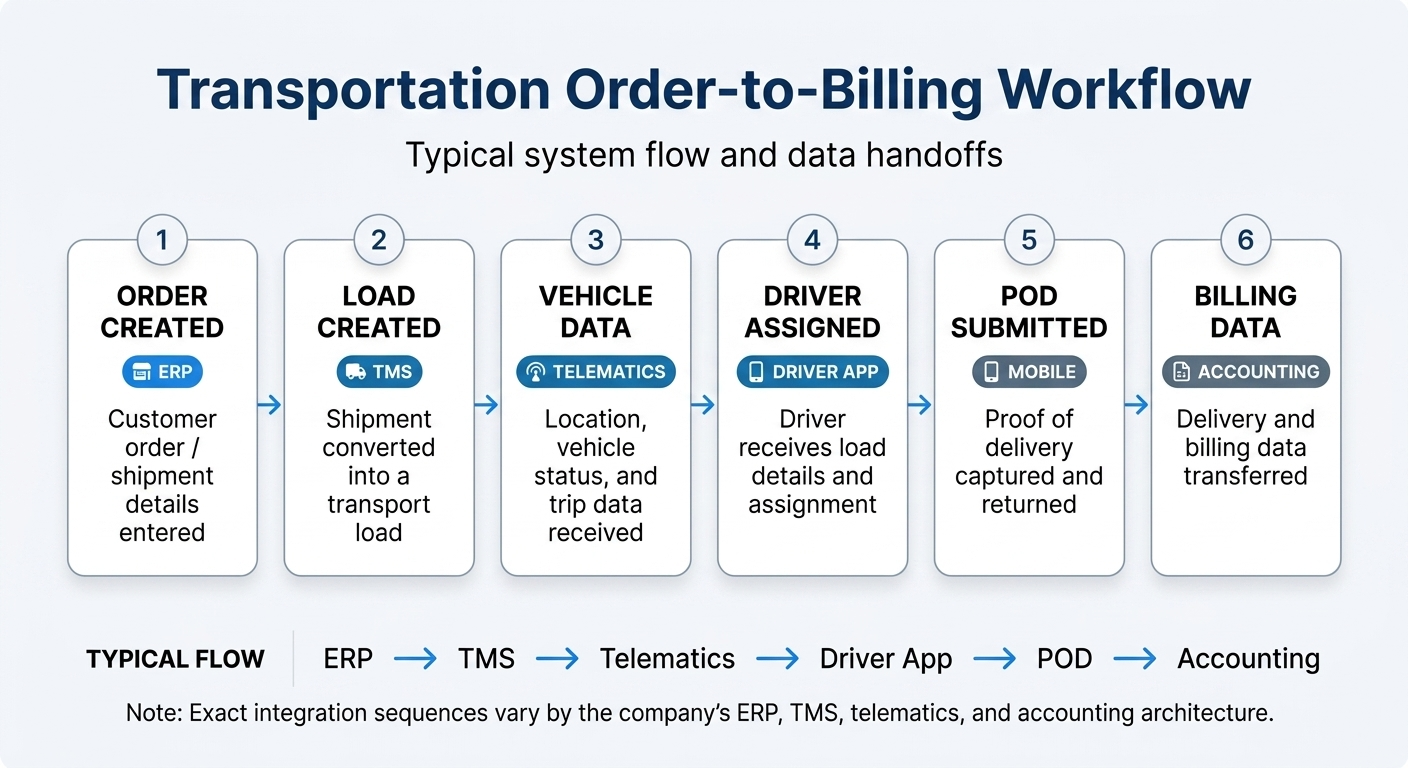
That chain can eliminate repeated data entry and reduce reconciliation work. Now the question for management should be:
How many times does an employee have to enter, verify, or correct the same shipment information?
That number is a technology KPI.
Driver and Customer Visibility Without More Dispatcher Work
A driver application should simplify delivery operations, not create another administrative burden. By bringing essential workflows such as job acceptance, navigation, driver status updates, electronic proof of delivery, document capture, messaging, and exception reporting into a single platform, the app can reduce manual communication and improve operational efficiency.
On the customer side, real-time shipment status, ETA updates, delivery milestones, automated alerts, and digital POD access provide greater visibility throughout the delivery journey. The resulting business value comes from fewer status calls, faster document processing, improved shipment visibility, and quicker billing cycles.
Featured article: Transportation Software ROI: Metrics Decision-Makers Should Track
What Separates High-Performance Logistics Software From Basic Fleet Tools?
High-performance logistics software goes beyond tracking vehicles and managing basic fleet activities. It connects drivers, dispatchers, customers, documents, shipments, and financial workflows in one system, turning operational data into actionable insights. The difference lies in automation, real-time visibility, seamless communication, exception management, and measurable business outcomes.
Real-Time Data Must Lead to Action
Real-time information has little value if it only produces another screen.
A stronger architecture moves through three stages:
- Visibility → Prediction → Intervention
- Visibility tells management what happened.
- Prediction identifies what is likely to happen.
Intervention gives the appropriate person enough information to act.
That model can apply to delayed shipments, route deviations, maintenance risk, fuel anomalies, capacity shortages, and suspicious transactions.
AI Should Improve Decisions, Not Decorate the Product
AI has value when it produces a measurable operational result.
| AI Capability | Business Decision / Impact |
|---|---|
| ETA Prediction | Alert customers before a delay occurs |
| Route Optimization | Reduce unnecessary miles and travel time |
| Demand Forecasting | Position fleet capacity where it is needed |
| Anomaly Detection | Flag unusual vehicle or shipment activity |
| Predictive Maintenance | Reduce unplanned downtime and maintenance costs |
| Fraud Detection | Identify suspicious transactions and activity |
This approach keeps AI tied to SOPs.
A transportation company should first establish the required workflow and decision rules. AI can then automate repeatable decisions, identify patterns, and escalate exceptions to staff.
The target is not “more AI.” The target is faster and more accurate decisions at scale.
Security Protects More Than Data
Transportation platforms can contain customer records, shipment details, driver information, financial records, vehicle locations, commercial contracts, and operational intelligence.
A breach can therefore affect more than an IT budget.
It can create:
system downtime + investigation costs + customer disruption + contractual exposure + reputational damage.
Security architecture should account for:
- Encryption
- Role-based access
- Audit trails
- Secure APIs
- Backup controls
- Disaster recovery
- Data segregation
- Authentication
- Access monitoring
ELD data also carries retention and privacy requirements. FMCSA states that carriers must retain ELD record-of-duty-status data and backup data for six months, with privacy protections for driver information.
For a large transportation operation, security is therefore an investment consideration, not a final-stage checkbox.
SOPs Should Define the System
Technology should follow the operation. A transportation platform should reflect established rules for:
- Dispatch
- Escalation
- Driver assignment
- Delivery exceptions
- Document approval
- Billing
- Compliance
- Maintenance
- Customer communication
This creates a clear technology hierarchy:
SOP → data → automation → AI → human decision
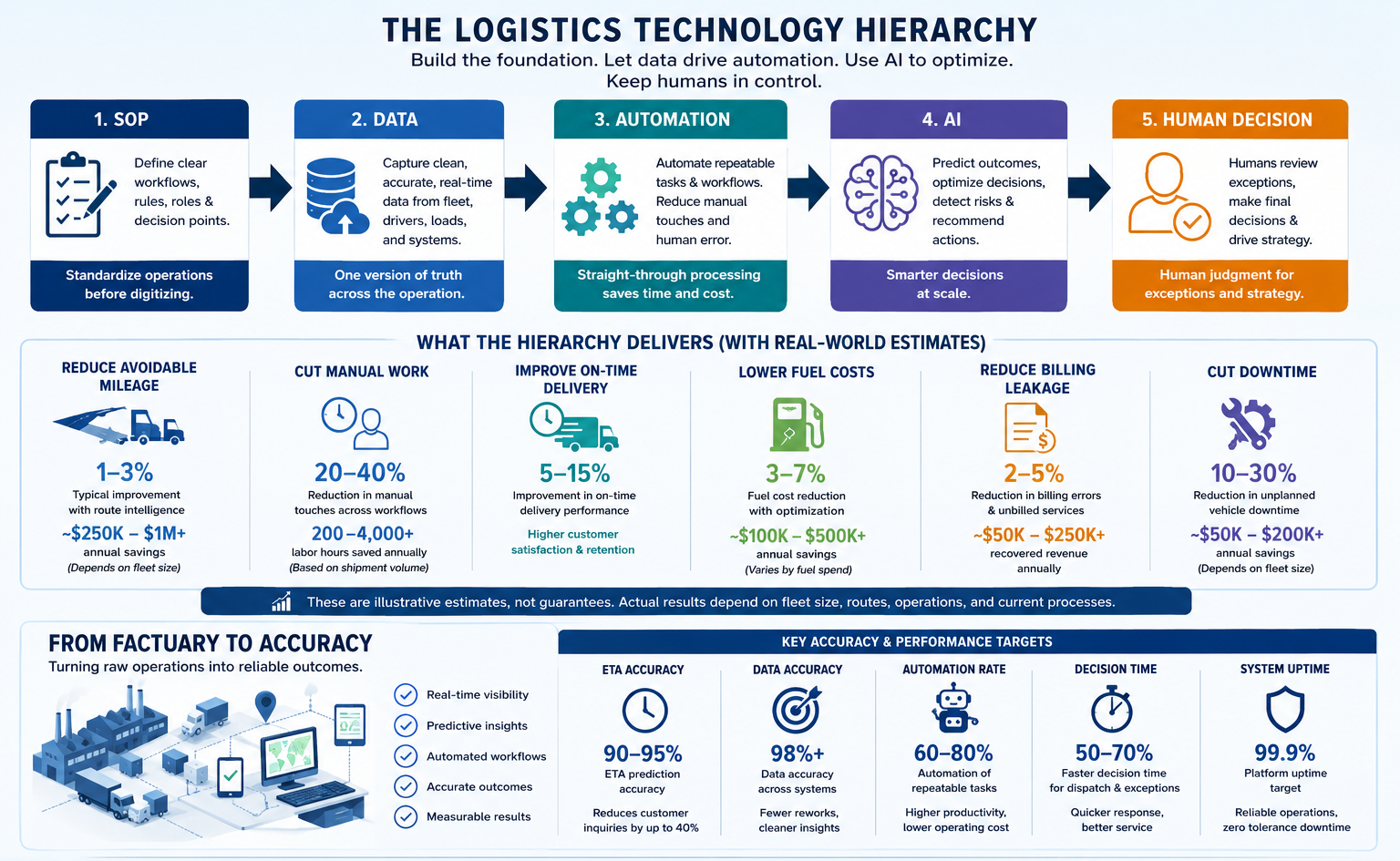
That model for custom logistics mobile app development is more sustainable than an AI-first approach with no defined operating logic.
Build Logistics Software That Fits Your Fleet, Not the Other Way Around
Off-the-shelf tools force you to change your workflows. We do the opposite. At Unique Software Dev, we design custom logistics software development around your dispatch rules, routes, billing, and integrations so your team spends less time on manual work and more time moving freight.
How Should Transportation Companies Measure the Business Case?
Transportation companies should measure the business case against clear operational and financial KPIs, including cost per shipment, miles per delivery, driver productivity, on-time delivery, administrative hours, billing cycle time, and customer service volume. A strong business case should quantify improvements against a baseline and calculate ROI, payback period, and total cost of ownership (TCO) before and after implementation.
Eight KPIs Reveal the Real Cost of Inefficiency
Management should establish a baseline before approving a major technology investment. The most useful measures include:
- Cost per mile
- Empty-mile percentage
- Fleet utilization
- Revenue per truck
- On-time delivery rate
- Average dispatch time
- Billing error rate
- Fuel cost per load
These numbers create a financial baseline.
For example, if a fleet spends $12 million a year on fuel, even a small percentage improvement has a material dollar value. If 15 dispatchers spend 2 hours each day on manual status checks, that time has an annual labor cost. If invoices take 5 days longer to process than necessary, the business carries a working-capital consequence.
The investment discussion should start with those numbers. A well-designed logistics management software platform should ultimately be evaluated against measurable improvements in cost, utilization, delivery performance, and administrative efficiency.
Calculate Annual Leakage Before Calculating Software ROI
A practical model is:
Annual operational leakage = fuel inefficiency + empty-mile cost + manual labor + billing leakage + avoidable downtime + preventable service failures
Suppose an operation identifies:
- $300,000 in avoidable mileage cost
- $150,000 in manual administrative labor
- $100,000 in billing leakage
- $100,000 in preventable downtime
That creates a theoretical annual exposure of $650,000. The next question is not “Can software save $650,000?”
It is:
Which portions of that $650,000 can technology realistically address, and how will the company measure the result?
That distinction keeps ROI analysis credible.
When Does Custom Logistics Software Development Become the Rational Investment?
Custom logistics software development becomes rational when off-the-shelf tools cannot support critical workflows, integrations, scalability, or operational requirements without costly workarounds. For companies with complex processes, high transaction volumes, or differentiated service models, Unique Software Development can provide greater control, adaptability, and long-term value than continually modifying generic fleet platforms.
Complexity Creates the Investment Case
Custom development becomes more compelling when the operation has enough complexity that standard workflows no longer reflect the business. Typical signals include:
- Large fleet volume
- High shipment volume
- Multiple operational systems
- Complex dispatch rules
- Specialized compliance requirements
- Proprietary workflows
- Significant manual reconciliation
- High integration requirements
- Strict data-security requirements
- Rapid expansion
A company with $500,000 of measurable annual inefficiency may view a $150,000 technology investment very differently from a company with $40,000 of annual inefficiency.
The investment must match the scale of the problem.
What Does Custom Logistics Software Development Cost?
Custom logistics software development costs vary significantly based on system complexity, integrations, automation, scalability, security, and ongoing support requirements. Rather than competing on lowest price, companies should evaluate total cost of ownership, implementation quality, scalability, and long-term business value.
For complex logistics operations, a premium investment can be justified when the software delivers measurable operational and financial gains.
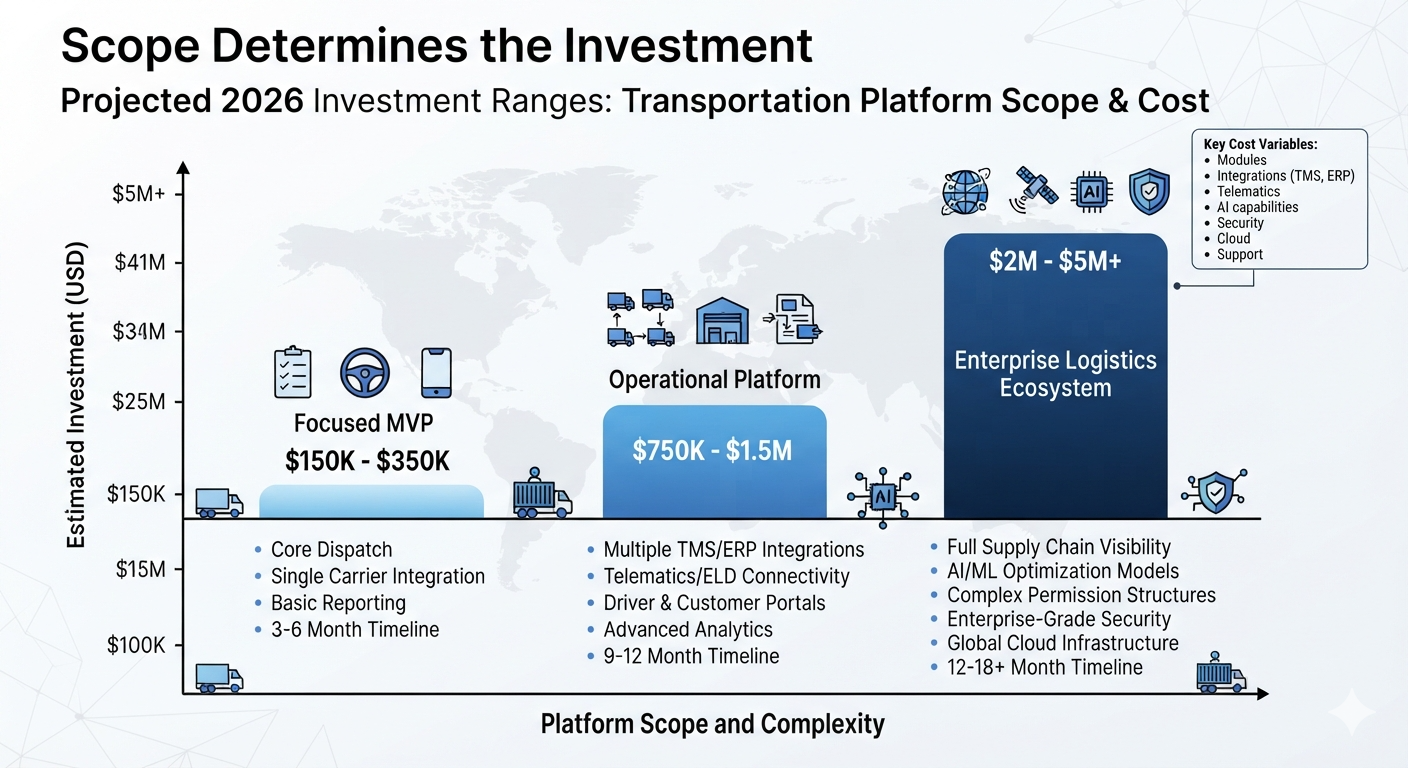
Scope Determines the Investment
There is no single responsible price for an enterprise transportation platform. The major cost variables include:
- Number of operational modules
- TMS and ERP integrations
- Telematics and ELD connectivity
- Driver applications
- Customer portals
- AI capabilities
- Data migration
- Security architecture
- Cloud infrastructure
- Testing
- Post-launch support
A relatively focused MVP can require a substantially lower investment than a full transportation ecosystem with multiple applications, integrations, AI models, complex permissions, and enterprise security controls.
For a premium transportation operation, the cheapest quote should not automatically win.
Architecture quality, security, integration reliability, scalability, and long-term support can have a larger financial impact than the initial development invoice.
The Payback Period Matters More Than the Sticker Price
A simple payback model can keep the decision objective:
Payback period = technology investment ÷ annual measurable savings
For example, a $200,000 project against $400,000 in defensible annual savings has a theoretical simple payback of 0.5 years, or 6 months.
That does not prove the project will achieve those savings. It shows how management can evaluate the investment.
The baseline, expected improvement, implementation cost, and measurement method should all be documented before development starts.
The Partner Behind High-Performance Logistics Software
The right logistics software development partner should offer more than technical expertise or competitive rates. Assess their experience with complex logistics workflows, system integrations, data security, scalability, product architecture, and long-term support. A strong partner understands the operational challenges behind the software and builds a solution that supports measurable business performance and long-term growth.
Look for Transportation Domain Expertise
A capable Logistics software development company should understand more than application development. The evaluation should cover experience with:
- Fleet management
- Dispatch
- TMS
- Telematics
- Driver applications
- WMS
- ERP integrations
- Compliance workflows
- Data security
- Analytics
The strongest portfolio evidence is not a list of technologies. It is proof of measurable operational outcomes.
Evaluate the Entire Technology Lifecycle
A serious transportation platform requires more than code.
Assess the partner’s ability to handle:
Discovery → architecture → UX → development → integration → security testing → deployment → monitoring → maintenance
That matters because transportation operations cannot afford a platform that works during a demonstration but fails under peak shipment volume or a critical integration outage.
A specialized Logistics software development company should also explain how it will establish KPIs, protect operational data, support users, and evolve the platform after launch.
You Just Have to Treat Logistics Technology as an Operating Investment!
Transportation companies rarely lose substantial money from one dramatic software failure. More often, margin disappears through hundreds of small operational leaks that repeat every day.
The right custom logistics software development strategy starts by quantifying those losses, identifying the workflows that create them, and then building technology around the highest-value problems.
The objective is not more software.
It is faster decisions, tighter control, lower operating leakage, stronger security, and measurable improvement in fleet economics. For transportation companies ready to evaluate that business case, Unique Software Development provides custom technology development for complex operational environments across North America and MENA.