

A custom Transportation Manaement System development can cost $30,000–$70,000 for a basic MVP, $100,000–$200,000 for an operational system, and $250,000–$500,000+ for an enterprise platform. These are planning ranges, not fixed market prices.
A basic MVP covers the core work needed to run transportation operations. That can include load creation, dispatch, shipment tracking, and basic reporting. An operational TMS goes further with features such as carrier management, billing, automation, and business system integrations.
That is why two vendors can quote $100,000 and $400,000 for what appears to be the same Transportation Manaement System development. One proposal may cover basic load management, dispatch, and tracking. Another may include ERP and WMS integrations, EDI, data migration, complex freight rating, automated billing, mobile apps, security controls, and multi-location workflows.
The difference is rarely just the developer’s hourly rate. The real cost sits in the complexity behind the screens. Every integration, workflow variation, financial rule, data source, and automation adds development and testing work. Some also create ongoing costs after launch.
This guide breaks down what drives TMS development cost, which expenses can appear after development starts, how custom development compares with buying a TMS, and what to include in a vendor quote before approving the budget.
How Much Does It Cost to Develop a TMS?
A Transportation Management System can start with a small set of core transportation functions or grow into a system that manages multiple locations, business units, integrations, and financial workflows. The more work the system has to coordinate, the more it costs to build.
| Development Scope | Estimated Timeline | Main Deliverables | Factors That Can Extend the Timeline |
|---|---|---|---|
| MVP | 3–5 months | Vehicle records, GPS tracking, one telematics integration, basic dispatch, driver app, and essential reports | Hardware compatibility issues, unclear requirements, and delayed feedback |
| Production platform | 6–10 months | Multiple telematics integrations, ELD data, maintenance workflows, mobile apps, fuel tracking, and accounting or TMS connections | Third-party API limitations, complex workflows, and data migration |
| Enterprise platform | 10–18 months or longer | Multi-location operations, mixed hardware, ERP integrations, advanced analytics, high availability, and phased rollout | Legacy system dependencies, inconsistent historical data, extensive testing, and complex security requirements |
The major cost drivers are the tasks and processes the software must coordinate, including workflows, integrations, automation, and financial rules. Add a few basic dispatch features, and you are looking at one level of cost. Add complex logistics workflows, integrations, automation, or enterprise features, and the number can look completely different.
So, if you need an exact number to share with management or use for your budget, don’t rely on a rough range. Talk to an experienced transportation software development team. They can understand the scope, review the requirements, and give you a number based on the actual project instead of assumptions.
Transportation Management System Development Cost by Size of Operation
As we stated above, TMS prices vary based on the functions and features your business needs. But a smaller operation does not always mean a cheaper TMS. A limited TMS may only need to handle basic fleet and dispatch operations. A more complex system may need to coordinate multiple locations, carriers, workflows, integrations, billing rules, and automation.
That’s why we size transportation management system development cost by operational complexity, not headcount.
Focused transportation operation
This TMS covers one operating model with a small team of planners and dispatchers. It handles load creation and assignment, core dispatch, shipment tracking, and basic reporting. A focused operation may also need dispatch software with GPS tracking when real-time vehicle visibility is part of the workflow. It costs around $30K–$70K and takes about 3 to 5 months to build. During this period, the TMS can handle load management, including shipment creation and assignment, core dispatch, shipment tracking for visibility, and basic operational reporting.
Growing 3PL or multi-location operation
This tier covers transportation software that typically costs around $100K–$200K and takes about 6 to 10 months to build. Instead of handling just one designated task, the system starts managing a much wider part of the transportation operation.
It can handle carrier and rate management, customer portals, load tendering, and automated billing. For larger operations, it can also connect multiple locations, ERP and accounting systems, EDI or APIs, and exception workflows.
This is where automation starts taking more manual dispatch work off your team’s plate. Routine tasks that once needed a dispatcher can now run through the software, reducing the time and cost spent on manual work.
For a deeper comparison, read Dispatch Software vs. Manual Dispatching: The True Cost Comparison.
Enterprise transportation operation
At this level, transportation operations are no longer simple. You may have multiple locations, a large carrier network, different transportation modes, and more rules to manage.
The TMS has to keep these moving parts connected. Rate management may cover contract rates, spot rates, fuel surcharges, and accessorial charges. Carrier management may involve onboarding, compliance, performance, and availability.
The system also needs permissions, audit logs, security controls, and reliable uptime as more users, locations, and systems depend on it. The TMS may need to exchange data with ERP, WMS, accounting software, EDI partners, GPS, and telematics systems. Our WMS and ERP integration guide explains how to plan those connections.
That is why enterprise TMS development can cost $250K–$500K+ and take about 10 to 18 months to complete. At this level, you are not simply paying for more features. You are paying to make a much larger transportation operation work together.
What Actually Drives TMS Development Cost?
As we’ve seen, more features do not always mean a higher cost. You cannot calculate the cost of custom transportation software simply by counting the features or buttons you add.
What matters is what the software needs to do and what type of transportation operation it supports. A simple fleet workflow can cost very differently from software built for a complex FMCG operation with multiple systems and workflows.
To make this easier to understand, let’s break down the five main pillars that shape transportation management system development cost.
Workflow complexity
Every transportation workflow carries business rules, approval steps, and exception handling across the shipment lifecycle. A temperature-controlled load, a hazmat load, and a cross-border load each follow different rules. More workflow variations create more business rules, and more rules demand more development and far more testing. Automation then depends on those rules being right.
Integrations
Integrations can be one of the biggest drivers of Transportation Management System development cost, especially when multiple systems need to exchange data reliably. A typical TMS talks to ERP, WMS, accounting, EDI partners, carrier APIs, GPS and telematics devices, load boards, and mapping or routing APIs. The TMS feeds an integration layer; the layer talks to external systems, which return synchronized operational data. When one link breaks, dispatchers go back to rekeying.
Transportation modes
FTL, LTL, parcel, ocean, air, and multimodal transportation each bring their own planning logic, rating structure, carrier rules, and execution steps. An LTL rate engine alone handles freight class, density, minimum charges, and zone tables. Each mode you add increases transportation management system development costs because it adds a new set of rules to design and test.
Automation and optimization
Route optimization, load optimization, automated dispatch, carrier selection, rate shopping, ETA prediction, and exception alerts all combine algorithms, business rules, and real-time data. Optimization pays off at scale; MarketsandMarkets cites a US food retailer with 460+ stores that cut empty miles by 8% and total miles by 7.7% after consolidating onto one TMS. That return justifies the engineering, but the engineering still costs real money.
Financial complexity
Freight rating, accessorial charges, fuel surcharges, invoice generation, freight audit, carrier settlement, and reconciliation change the nature of the software. A dispatch board can afford a rounding error. A finance-grade TMS cannot, because every adjustment must stay explainable months later during an audit. For enterprise readers, this layer often decides whether the transportation management system development cost lands in the operational band or the enterprise band.
What Your TMS Development Budget Pays For
A proposal that shows one lump sum hides the decisions inside it. A clear transportation management system development cost estimate breaks the budget into separate workstreams. This shows where the money goes and which parts of the project will take the most investment.
| Cost Area | What It Covers |
|---|---|
| Discovery | Processes, requirements, transportation workflows, edge cases |
| Architecture | System design, data model, scalability, integration patterns |
| UX/UI | Interfaces for planners, dispatchers, carriers, and drivers |
| Core development | Orders, loads, dispatch, tracking, rating, documents |
| Integrations | ERP, WMS, EDI, carrier APIs, telematics |
| Mobile | Driver-facing app for status, GPS, and proof of delivery |
| QA | Functional, integration, and performance testing |
| Security | Access control, data protection, auditability |
| DevOps | Deployment pipelines, monitoring, cloud infrastructure |
| Data migration | Existing carriers, customers, rates, and shipment history |
| Launch | Training, phased rollout, and hypercare support |
Most of the cost is not in the screens themselves. The real work sits behind them. Your data has to move between systems, and every handoff needs to work properly. That is where custom logistics software development becomes important. The software needs to fit the way the operation runs, not force the operation to change around it.
The same applies to the driver side. Logistics mobile app development may need offline access, GPS tracking, quick status updates, and proof of delivery, especially when drivers work in areas with unreliable connectivity.
The Costs That Never Appear in the Quote
Every operations leader asks the same quiet question after the first proposal: what am I going to get hit with later? The honest answer is a list, and it starts before a single line of code.
- Pre-development costs. Discovery, business analysis, process mapping, architecture, and a data assessment. Skipping them does not save money; it moves the bill to rework.
- Integration costs. API development, EDI mapping, third-party service fees, legacy-system connections, and integration monitoring once the system goes live.
- Migration costs. Data cleanup, data mapping, validation, and migration testing for carriers, customers, rates, and shipment history.
- Deployment costs. Cloud infrastructure, DevOps, monitoring, and security hardening.
- Adoption costs. Employee training, documentation, change management, and a phased rollout that keeps freight moving during the switch.
- Post-launch costs. Maintenance, security updates, carrier API changes, bug fixes, performance tuning, new integrations, and ongoing feature development.
Budget for the Full Cost of a TMS
A McKinsey and University of Oxford study of more than 5,400 large IT projects found that they ran 45% over budget and 7% over schedule on average, while delivering 56% less value than predicted. The research also found that each additional year increased cost overruns by about 15%. These findings highlight why transportation businesses should budget for the full project lifecycle rather than the initial development quote alone.
Internal staff time adds another cost. ARC Advisory Group’s research on TMS implementations found that a complex project could require around 6,000 hours from three full-time client staff, plus approximately 4,000 hours from part-time subject matter experts. These hours represent an internal resource commitment, separate from the external implementation bill.
Other operating expenses can include cloud hosting, mapping and geocoding, telematics feeds, third-party API fees, integration monitoring, security updates, and ongoing maintenance. The exact cost depends on the systems involved, usage levels, and support requirements.
Example of a Three-Year Custom TMS Budget
The following example illustrates how the cost of a $150,000 operational TMS can grow over three years. The 20% launch reserve is a planning assumption, not a standard requirement. Annual upkeep is estimated at 20% of the original development cost.
| Cost Item | Calculation | Estimated Cost |
|---|---|---|
| Initial development | Base project cost | $150,000 |
| Launch reserve | 20% of initial development cost | $30,000 |
| Annual upkeep | 20% of initial development cost | $30,000 |
| Three-year upkeep | $30,000 × 3 years | $90,000 |
| Illustrative three-year total | Development + reserve + upkeep | $270,000 |
This estimate excludes internal staff time, cloud hosting, third-party service fees, and any additional integrations or upgrades not covered by the upkeep allowance. Actual costs will depend on the project scope and service agreements.
The $270,000 figure is therefore an illustrative planning estimate, not a guaranteed total cost of ownership. Before approving a budget, confirm which services are included in the development and maintenance agreements and account separately for any exclusions.
Compare Custom Development With Buying a TMS
A fair build-versus-buy comparison should use the same three-year period and include the costs relevant to each option.
For a custom TMS, account for development, implementation, migration, internal staff time, hosting, maintenance, integrations, and upgrades. For a purchased TMS, include subscription or licensing fees, implementation services, configuration, integrations, data migration, internal staff time, and any additional support or upgrade charges.
The lowest initial quote may not produce the lowest three-year cost. Comparing both options across the same period gives operations and finance teams a more reliable basis for choosing the right approach.
For a deeper look at the business return behind a TMS investment, see our Transportation Software ROI guide.
How Development Location Changes the Price
Where your team sits changes the hourly rate. It doesn’t change the scope, and scope drives most transportation management system development costs.
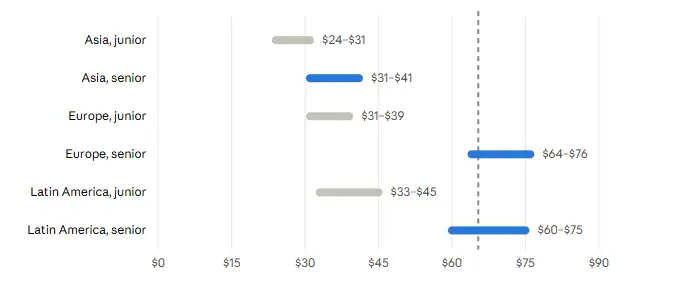
The numbers come from the Accelerance 2026 Global Software Development Rates & Trends Guide, based on a survey of 60 development partners. Rates fell across major regions last year, with Latin America down 7.1%. For comparison, the U.S. Bureau of Labor Statistics reports a median US software developer wage of $135,980 a year as of May 2025, or about $65 an hour before benefits and overhead.
- The takeaway is simple: Asia remains the lowest-cost region, while senior rates in Europe and Latin America can approach a US developer’s base wage.
- North American development: Higher rates come with the same time zone, easier in-person collaboration, and fewer handoff delays.
- Nearshore development: Latin American teams offer US time-zone overlap at a lower blended cost.
- Offshore development: Offshore teams offer the lowest rates, but savings depend on clear documentation, communication, and project management.
- Hourly rates: A $40-per-hour team that takes twice the hours can cost the same as an $80-per-hour team. Compare proposals by total hours, seniority, architecture, QA, documentation, and expected rework, not just the hourly rate.
Build vs. Buy: Compare the Total Cost Over Time
ARC Advisory Group interviewed the system integrators who install packaged TMS platforms. TMS vendors charge about $250 an hour for implementation, boutique consultancies charge in the mid-$100s, and global system integrators charge up to $300.
A complex implementation typically takes three full-time consultants about 5,000 to 6,000 hours. At $150 to $250 an hour, that is roughly $750,000 to $1.5 million in outside labor alone, before the subscription and before the 10,000 or so hours your own team puts in.
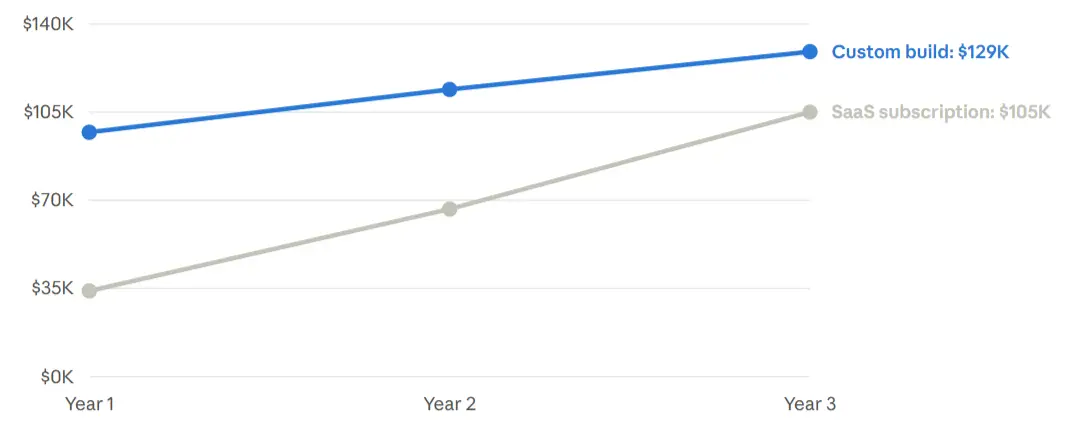
Now compare that with a custom TMS. A $250,000–$500,000 enterprise build costs more upfront than a basic SaaS subscription, but often less than a complex packaged implementation, and that investment creates software around the company’s actual workflows. The business can build its rate rules, dispatch process, ERP and WMS connections, financial controls, and reporting into one system instead of paying to configure and connect a product built for a broader market.
That does not make custom development cheaper in every case. It makes the economics more attractive when the operation is complex enough that implementation, customization, integrations, and recurring software costs become the bigger expense.
Steps to Get the Right TMS Development Quote
Start with these five steps to give every vendor the same picture of the project.
Define the transportation operation
Share fleet size, locations, monthly shipment volume, transportation modes, carriers, and business units. “1,800 LTL shipments across three depots” gives a vendor far more to price than “mid-size operation.”
Map existing systems
List the ERP, WMS, accounting, CRM, EDI, GPS, telematics, and carrier systems the TMS must connect with. Note how data moves between them and whether APIs or sandboxes are available.
Define required workflows
Map the shipment journey from order intake and load planning to dispatch, tracking, delivery, billing, and reporting. Include exceptions because they can add significant development and testing work.
Separate must-haves from future needs
Decide what belongs in the first release and what can come later. Start with the workflows that move freight and money, then add optimization, AI-driven ETAs, or customer portals in later phases.
Ask vendors for a detailed quote
Have every vendor provide the scope, integrations, timeline, team structure, ongoing support, third-party costs, and change-request pricing. With the same information from each vendor, the quotes become much easier to compare.
Conclusion
A Transportation Management System development budget should reflect the complexity of the transportation operation, not a generic software price. Workflow complexity, integrations, automation, financial rules, scale, and long-term ownership all shape the final cost. A credible transportation management system development cost estimate starts with these requirements before anyone puts a dollar figure on the project.
Once the operation, systems, workflows, and roadmap are clearly defined, vendors can price the same scope. That makes it easier to understand the differences between proposals and choose an investment that fits the business.
Put a defensible number behind the TMS investment. Unique Software Development can map the freight workflows, integrations, and growth requirements, then turn them into a clearly scoped development estimate. The result gives both operations and finance a solid basis for approval.